AI Summary
OLYMPUS DIGITAL CAMERA
Thomas Wingens published a very interesting article on the topic of AI in heat treatment here on Linkedin. Similarly, Janusz Kowalewski often mentions this issue with regard to Ipsen vacuum furnaces. I know both authors very well personally and deeply appreciate their continuous, long-term commitment to our field. I personally respect them very much.
But because I have a different experience, for more than 20 years I worked as an owner, co-owner, and later as a regional manager of Bodycote in the Czech Republic and Slovakia, my task was always to bring things to life. But that is a completely different position. And so my personal reaction to Thomas’ article was clear. How to practically implement it? It is easy to write about it, but harder to do. And perhaps that is why I have not seen any such heat treatment shops, not even a furnace with AI, so far.
The problem is much more complex. One aspect is the legal liability for the behavior of AI. You can find my posts on the criminal liability of AI on my blog, I published them more than a year ago.
The second aspect is that in both cases the authors focus on partial problems. In one case it is a vacuum furnace, in the other the structure of activities in the quenching plant according to the following points.
- Physical handling and logistics
- Identification and tracking
- Furnace and process control
- Quality, safety and maintenance
- Enterprise Integration
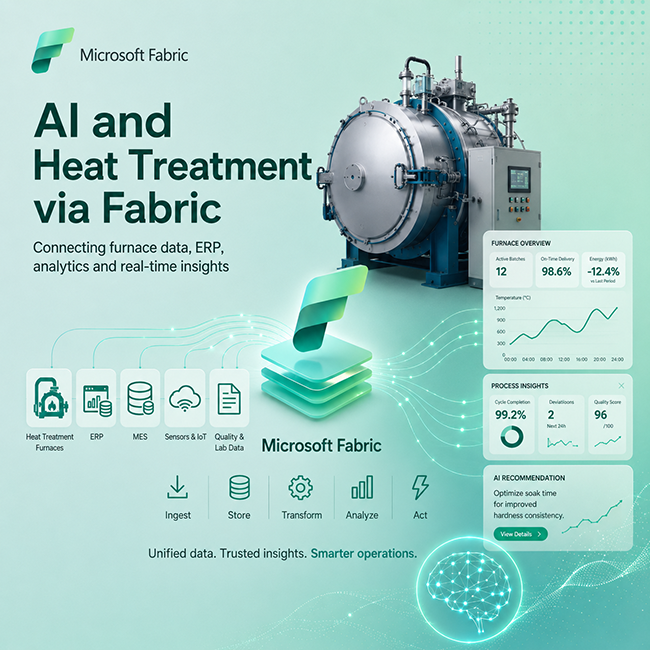
I personally see the heat treatment plant as a complete ecosystem, orchestrated by ERP systems. All financial, commercial, technical and technological data are concentrated there, and it is possible to see all the problems and links in the heat treatment operation with complete accuracy. Those who imagine ERP as accounting are mistaken. A properly designed ERP system also includes the entire production, technology, planning. And no AI can interfere with this ecosystem due to data consistency.
The same is true on the other hand. No AI can enter either SCADA or PLC. All commands, recipes, logical links contained in them are inviolable and are clearly subject to change management with confirmation by an authorized person.
I tried to indicate my opinion in the posts on my website, which are listed below. My model is based on the fact that ERP is something like the “central brain of humanity” in every heat treatment plant. It contains all the data, all the information from the “heat treatment” ecosystem.
But if that is the case, then it is also a great source of data for AI. ERP can add, subtract, multiply and divide, it can assign defined processes to other defined processes. What it cannot do, however, is have fantasy. All calculations must be accurate to the penny, otherwise accounting differences must be resolved.
And here there is a huge space for AI. It could significantly expand the capabilities of ERP with trends, forecasts, and finding deviations. AI has the capabilities to:
- a query engine (asks for data),
- an analytical engine (evaluates),
- a prediction engine (predicts),
- an advisory engine (recommends).
This is something that ERP cannot do. And here is the biggest space for using AI in the heat treatment shop. And if I realize that no SCADA or PLC can tell me anything about profitability, then I can start solving, for example, the RFQ process – Request For Quotation, i.e. the offer. This is exactly the area where AI can help me at the beginning with its analytical and predictive capabilities. And I don’t need anything for that, except data from the ERP system. What data? I describe this in posts I to VI “How to do AI in practice“. In this initial phase, I don’t even need to connect the furnaces and collect data, but provided that my ERP system includes Cycle Control.
And here I would like to express the idea of the incorrect addressing of the problem. In order for AI to really work in the heat treatment plant, I have to solve the entire heat treater ecosystem, and then gradually connect other entities to it. If I buy a new vacuum furnace with AI support, it is a step forward, but it will not affect my profitability or process economics much. Maybe just maintenance costs. The economy is created outside of SCADA and PLC, outside of IoT.
Therefore, development should be focused on ERP systems for heat treaters, with a superstructure in the form of AI for various models – predictive, analytical, evaluation. And here, unfortunately, furnace manufacturers, if they do not connect directly with ERP system developers, will not do much. All layers must communicate with each other, but the layer that is responsible for the performance of the thermal process, i.e. the furnace, is the last in line.
Does this seem too revolutionary to you? Maybe so, but take it as just my opinion.
If you want to see individual posts, click on the image







=======================================================================================================
Are you solving a similar problem? I will help you with the analysis…
 40+ years of experience in the field
30+ years of experience… HT-PROGRES, Bodycote, Galvamet
cooperation… VŠB, Czechimplant, ECM Technologies, TAV Vacuum Furnaces, GHC Invest
12+ years of expert activity
Want to ask for a solution or want a non-binding consultation? Click on this link, I will usually respond within 24 hours. Contact email
========================================================================================================
Jiří Stanislav, Ing. CSc.
Consultant and forensic expert
========================================================================================================
2/8/2026