How to do AI in practice, part IV – Data Flow
So how about the RFQ process, the commercial offer? It’s a few steps that a salesperson, a receptionist or a technologist or metallurgist, the quality department, do for us for now.
AI a RFQ (Request for Quotation)
- AI – Basic data validation process (Customer, Product, Routing, Control plan exists?)
- AI – supported Geometry Risk Screening
- AI – supported Heat Treatment Risk Screening
- AI – supported Load and Fixturing Design
- AI – supported Costing Model (Offer Costing)
- AI – supported Quotation Data Management and Traceability (Quotation storage)
Document AI helps us by retrieving all the data from the request, drawing, CAD model, checking and proposing a solution. It takes into account that the RFQ can be received in various forms, for example as an email, PDF, paper document, spreadsheet, XML or EDI message. The integration layer first identifies the document type. For structured formats, it performs mapping and rule validation, while for unstructured documents, it uses OCR and Document AI to extract technical and business data.
The result is a single RFQ data object, independent of the original format. Each extracted data is associated with a source, a level of certainty and an audit trail. The ERP then creates an official offer record and starts a Contract Review. Unclear, conflicting or low-trust data must be confirmed by an authorized person before further processing. The Contract Review can take on the statuses – Feasible, Feasible with Conditions, Trial Required, Process Development Required, Not Feasible.
So, if we have the assignment, a unified data object for the RFQ, we can start validating the data.
The validation system via API verifies:
- customer exists,
- product exists,
- material is clearly defined,
- production process exists,
- control process exists,
- qualifying production resources exist,
- valid specifications are available,
- customer and OEM requirements are known,
- there are no conflicts between requirements.
AI simultaneously creates a list of missing information, for example:
- The initial material state is not specified.
- It is not clear whether the effective or total layer depth is required.
- There is no consistency between the layer properties and the proposed measurement method
- A revision of the customer specification is missing.
- A matching product or process was not found
During validation, the Product/Process Classification is also determined: Existing Product, New Product, Existing Process, Process Adaptation Required or New Process Development Required. This is not an RFQ status, but a case classification for subsequent workflow.
RFQ Intake Status
Once the data is loaded and validated, the offer will receive a Data Completeness Status:
- Data Complete
- Data Incomplete
- Conflict Detected
- Customer Clarification Required
- Manual Data Review Required
What needs to be explained must be explained and only then can we move on.
AI-supported Geometry Risk Assessment
In the next step, AI can help us with risk assessment. From a photograph, drawing, or CAD file, an orientation screening of critical areas can be performed. Accurate assessment of dimensions, radii, thicknesses, and spatial geometry requires a calibrated image, technical drawing, or CAD model. In addition to AI, a specialized geometry engine is used to analyze CAD data. However, we can get information about:
- sharp cross-section transitions,
- notches and local stress concentrators,
- missing or too small radii,
- blind holes and deep pockets,
- thin walls,
- significant thickness differences,
- holes near the edge,
- part asymmetry,
- areas prone to uneven heating or cooling,
- potentially problematic orientation during preparation,
- risk of oil retention or restricted quenching gas flow.
But since the demand only includes simple data such as the weight of the piece and the number, AI can also calculate the areas we need for the correct management of a process dependent on the surface area, such as LPC, nitriding, coating.
The person who prepares the offer must respond to the risks identified by AI. Alone or in cooperation with a metallurgist, technologist, or quality department.
AI-supported Heat Treatment Risk Assessment
AI will also prepare an analysis of the risks arising from heat treatment
- Risk of cracks arising from geometry
- Risk of deformation
- Risk of uneven carburization or nitriding
- Risk during gas quenching
- Risk during oil quenching
- Risk of poor-quality washing
The impact is the same, the risks must be assessed by the responsible person. However, the advantage of any internal or external negotiation is that we still have full traceability.
AI-supported Load and Fixturing Design
Based on a photo, drawing or CAD model and a database of ovens and fixtures, AI can also determine a fixturing plan, select suitable grates, and even calculate the required quantity per batch. This, of course, requires a database of fixtures and their marking.

- proposes product orientation,
- selects available fixture,
- suggests part layout,
- calculates theoretical number of pieces,
- takes into account weight, thermal and hardening limits,
- determines recommended number of pieces in batch,
- estimates fixture time,
- calculates furnace utilization,
- transfers data to cost model.
The output is approved by the technologist or other authorized person, especially for:
- new product,
- new fixture,
- new orientation method,
- critical hardening,
- parts with a high risk of deformation.
For existing products, the system can gradually use the actual results of previous batches and refine the recommended number of pieces, optimize processes or propose changes to the procedure, resources.
Offer Costing and Pricing
Using AI to calculate the costs of the bidding process is also an interesting task for AI. Usually, a rate matrix is used for this purpose according to Machine ID, or Machine Group ID, and Labour grade. This cost matrix also includes all overhead costs. Every company has it differently, but the model of calculating overhead costs for workers (Labour), overhead costs for equipment (Assets) and overhead costs for the production area (Floor) has proven to be successful. It is then easier to distinguish between the costs of operations with a higher consumption of personnel costs, costs for equipment with a higher acquisition value, or covering a larger area.
The cost model distinguishes between direct costs (energy, gases, fixtures, consumable) and indirect costs in the form of overheads. For this cost calculation, all that is needed is to know the cycle time, the JobFillRate for batch utilization in %, the need for personnel costs for production and quality. It will therefore be good to have access to history, and AI has that.
The pricing model then determines:
- recommended price,
- minimum price,
- target margin,
- expected profit,
- calculation confidence interval.
AI estimates uncertain costing inputs. The deterministic costing engine in the ERP then uses valid cost rates and calculates bid costs, based on AI estimated times and the production process it suggests. The resulting price, including margin, is set by the sales person or pricing model and approved by an authorized person according to the approval matrix.
Quotation Storage and Traceability
Finally, the ERP creates and stores the offer under a unique ID, including content, status and approval. The DMS (Document Management System) then archives the RFQ, drawings, specifications, GTC and attachments. In the audit repository, AI inputs and outputs, model versions, approvals, and finally in the data warehouse, analytical data for reporting and models
Here our basic effort ends. The offer is almost ready and gets a status according to the subsequent activity:
- Draft – Under review – Approved – Sent – Accepted – Rejected – Expired
Once the quote is in the Approved status, it can be sent to the customer. The advantage of the ERP/AI combination is that even if we do not have qualified personnel, AI will largely help us deal with this handicap without reducing the quality of the quote process.
Data from newly created quotes can be used for controlled retraining and validation of the next version of the AI model after quality control. However, the production model must not be automatically changed without approval and an audit trail. However, this means that we must have an AI model administrator who administers the content of the AI layer and brings new versions to life.
This block, related to the bidding process, is, after the above modifications, a very good first independent use case for implementing AI. Direct control or data capture from the furnace is not needed here at all. The implementation risk is relatively small and the economic benefit is obvious. Risk reduction, reduced requirements for personnel qualifications, determination of the optimal selling price, optimal use of furnaces. But AI will also help us with strategy, because from the supply of bids we can better plan resources, investments, we can interpolate trends, etc.
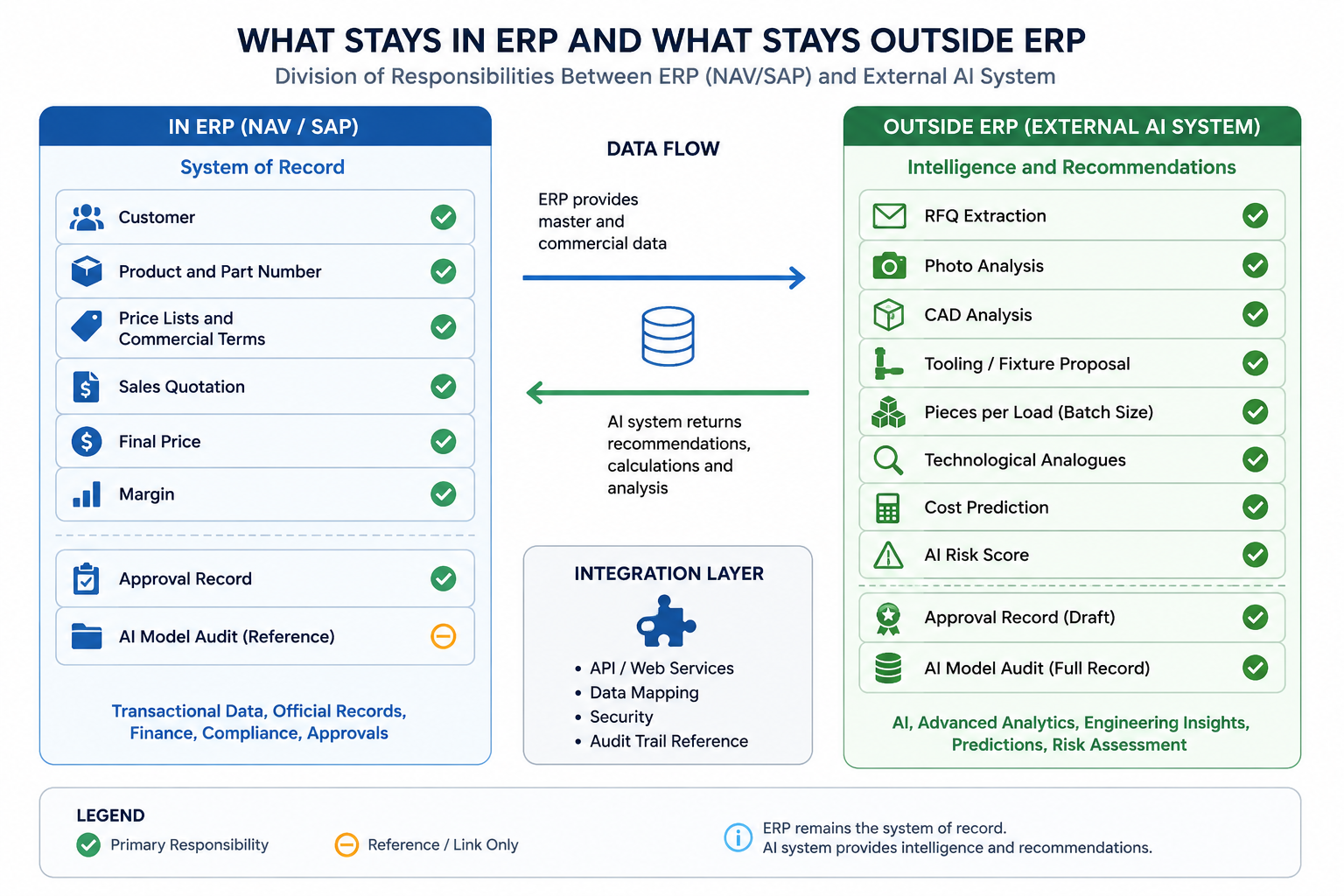
The next infographic provides an overview of what the ERP system must continue to do and what falls to AI.
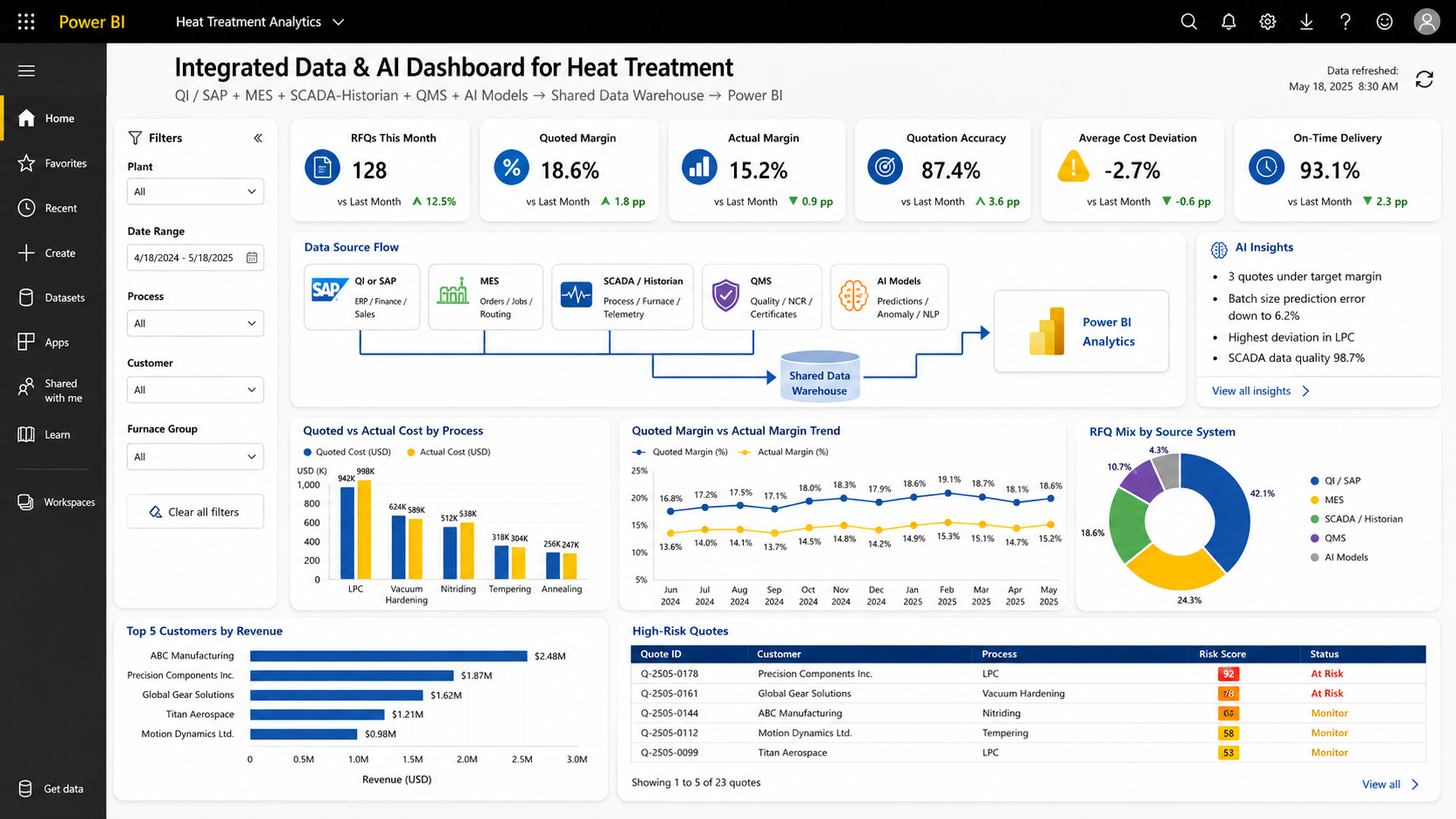
An interesting option is offered by using Power BI, which is an analytical and visualization layer. It is not a proprietary technological AI model, costing engine or quote creation system.
If the data from the ERP can be securely accessed via API, database views, data warehouse, BI model or other supported connector, it can also be connected to Power BI.
The entire architecture would look like this:
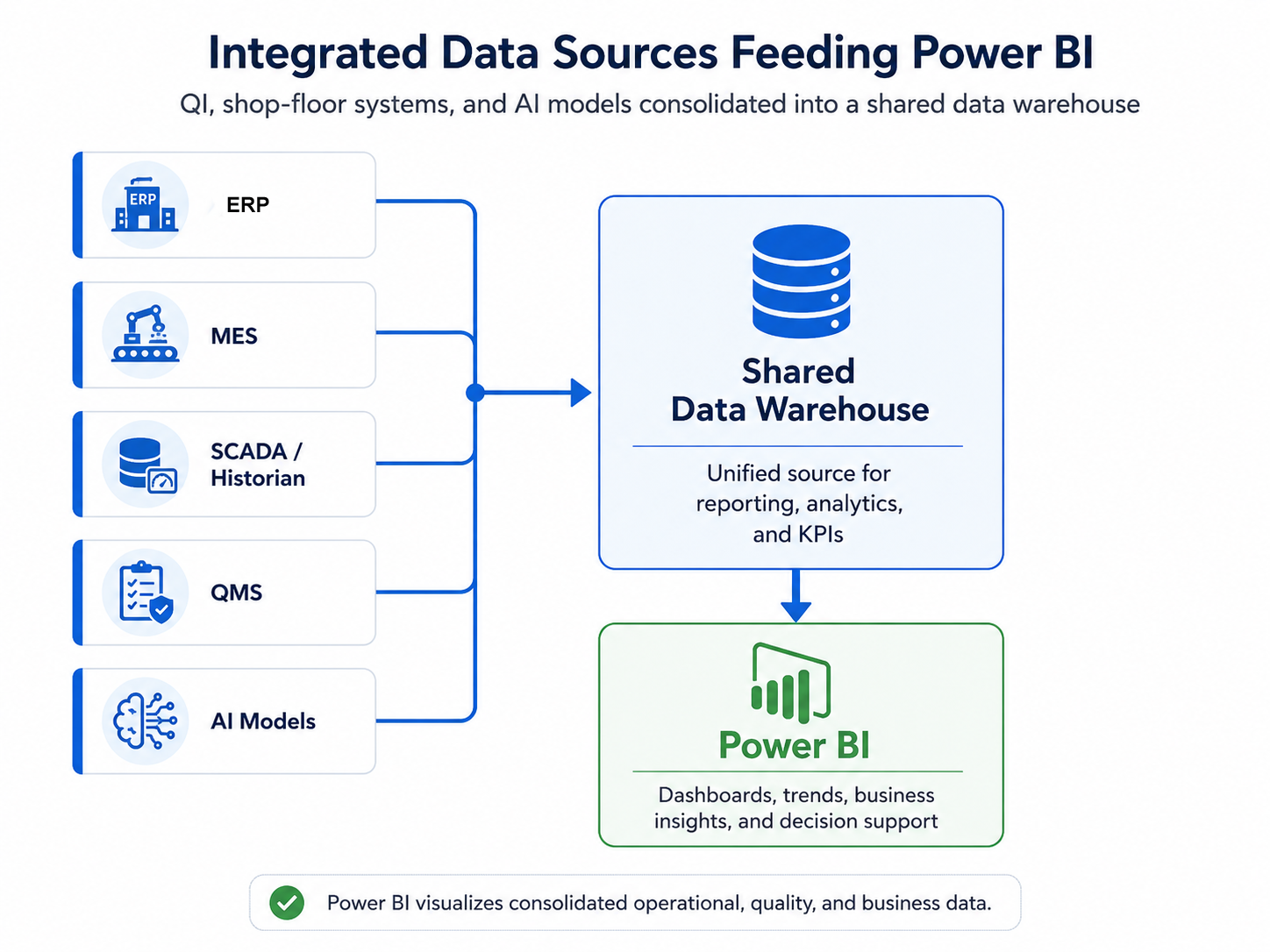
A common data warehouse would thus connect
- business data from ERP, technological data, furnace process data, quality, actual consumption, maintenance, AI outputs.
From the ERP system, it is possible to obtain
- customers, products, quotes, quote items, production orders, planned costs, actual costs, invoiced prices.
And then create Power BI dashboards, e.g.
- Quoted Cost vs. Planned Cost vs. Actual Cost
- Quoted Margin vs. Actual Margin
- Profitability by Customer
- Profitability by Product
- Profitability by Process
- Profitability by Furnace
- Quotation Lead Time
- Reasons for Cost Deviation
=======================================================================================================
Abbreviations used::
AI: Artificial Intelligence
API: Application Programming Interface: definované rozhraní a soubor pravidel, podle kterých si dva systémy předávají data a příkazy. Webové API může být dostupné prostřednictvím jedné nebo více URL adres, označovaných jako endpoints.
JSON: JavaScript Object Notation: textový formát pro strukturovaný přenos dat. Vznikl v prostředí JavaScriptu, ale dnes je nezávislý na programovacím jazyce.
Middleware: integrační vrstva, která propojuje systémy, transformuje data, řídí komunikaci, zabezpečení a auditní záznamy.
AI model: matematický nebo statistický model, který provádí klasifikaci, predikci, detekci odchylek nebo doporučení.
OPC UA: Open Platform Communications nebo OPC Unified Architecture
AI vrstva: řešení sestavené ze standardních platforem, konektorů, pravidel a individuálně nakonfigurovaných nebo vyvinutých modelů.
Document AI: Technologie využívaná k extrakci využívá k extrakci informací z tištěných i digitálních dokumentů, jako jsou obrázky, texty, znaky
DMS: Document Management System
FQ: Request For Quotation
APQP: Advanced Product Quality Planning
PPAP: Production Part Approval Process
ERP: Enterprise Resource Planning
=======================================================================================================
Are you solving a similar problem? I will help you with the analysis…
 40+ years of experience in the field
30+ years of experience… HT-PROGRES, Bodycote, Galvamet
cooperation… VŠB, Czechimplant, ECM Technologies, TAV Vacuum Furnaces, GHC Invest
12+ years of expert activity
Want to ask for a solution or want a non-binding consultation? Click on this link, I will usually respond within 24 hours. Contact email
========================================================================================================
Jiří Stanislav, Ing. CSc.
Consultant and forensic expert
========================================================================================================
31/7/2026