AI and ESG reporting in Heat Treatment plant
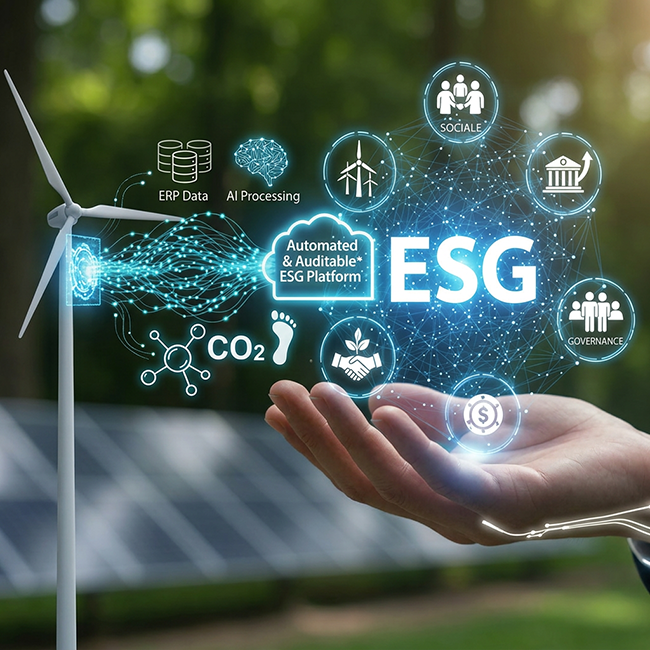
The use of AI in heat treatment operations can fundamentally change the way we look at our industry. I have already outlined a model that allows us to calculate the quoted, planned and actual costs of a production order. Can the same principle be applied to emissions and ESG reporting? The cost model is in this infographic.
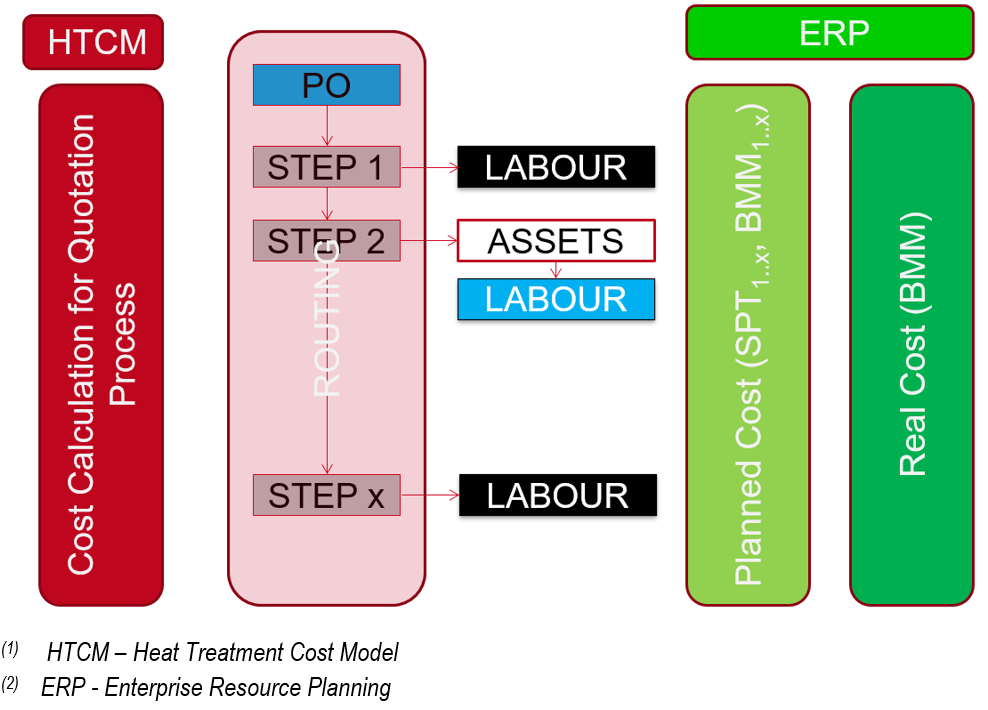
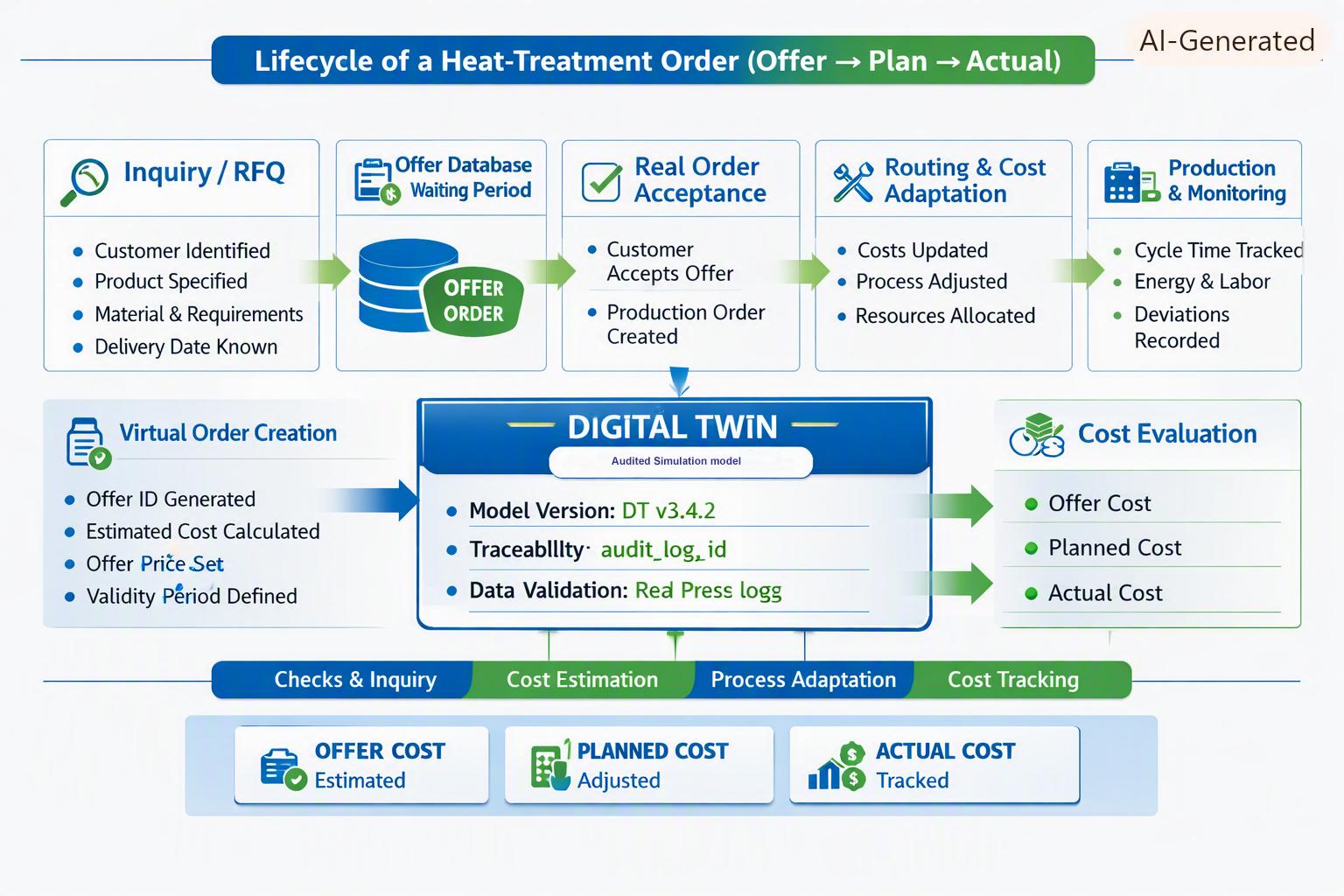
The basis of proper costing is the ERP system and its settings. I won’t go into details here, maybe we’ll get to that in the future, but the key is that I have to value the costs of each operation. Direct and overhead. Direct costs are tied to the cycle/operation time, while indirect costs are then categorized into labor, assets, and floor, using the same named correction factors.
The system should be able to calculate costs 3 times, as quotation costs, as planned costs at the time of accepting the job from quotation, and as actual costs resulting from production. And that it can’t be done? The opposite is true, it can be done, and quite elegantly. What support do I have for this statement? For the last 5 years at Bodycote, I have been the BCM system administrator for Eastern Europe. The abbreviation BCM stands for Bodycote Costing Model. This model was developed by the IT group in Edinburgh and completely changed my view of the world of ERP systems and accounting in the heat treatment plant. The idea that the moment I close a production order I will know how much profit I will make from it is realistic.
Why am I mentioning this? Based on the same principle, I can also have ESG reporting. That is, information on how many kgCO2 I have produced by processing the order. As a result, I will have information on bid emissions, planned and actual emissions.
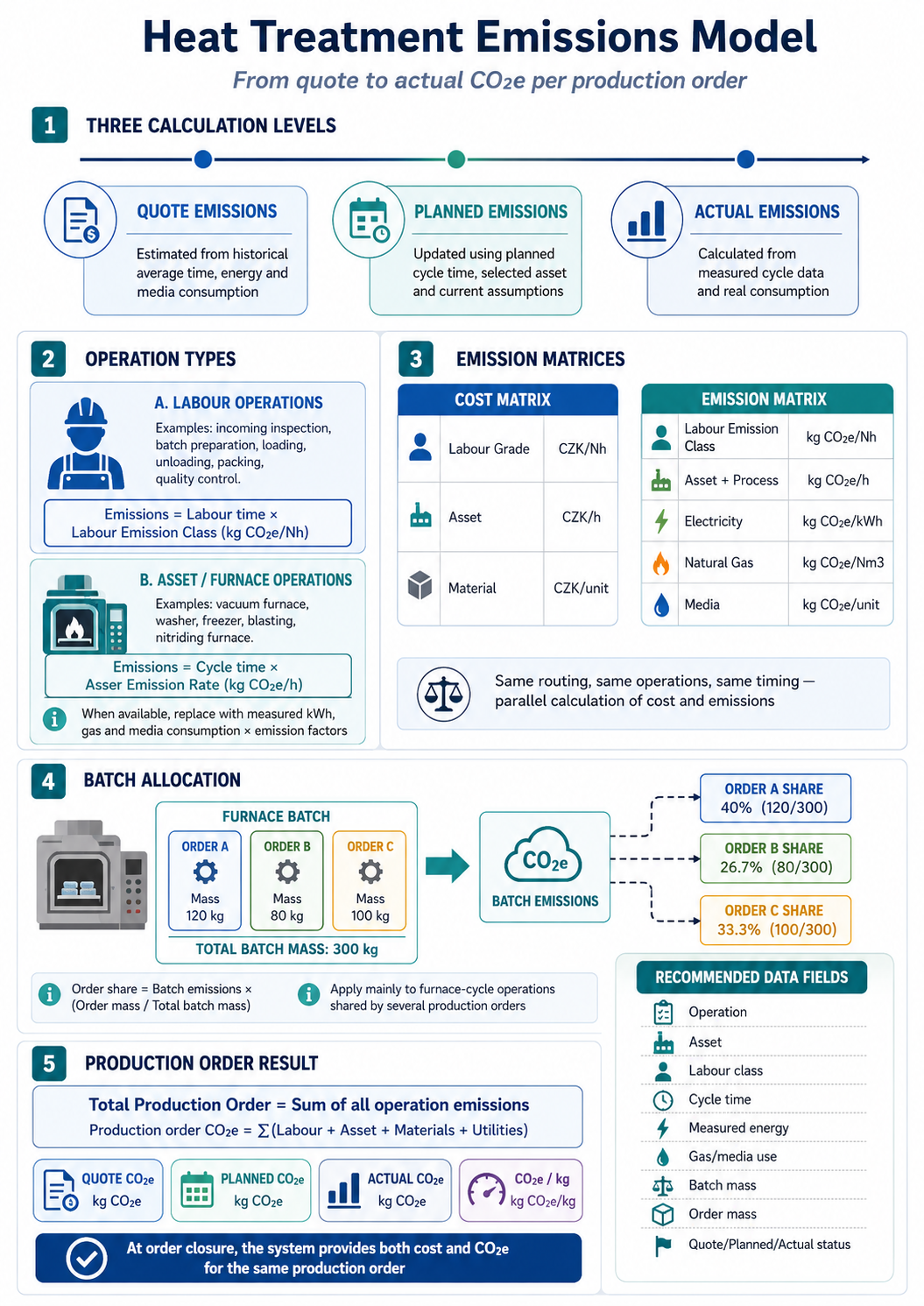
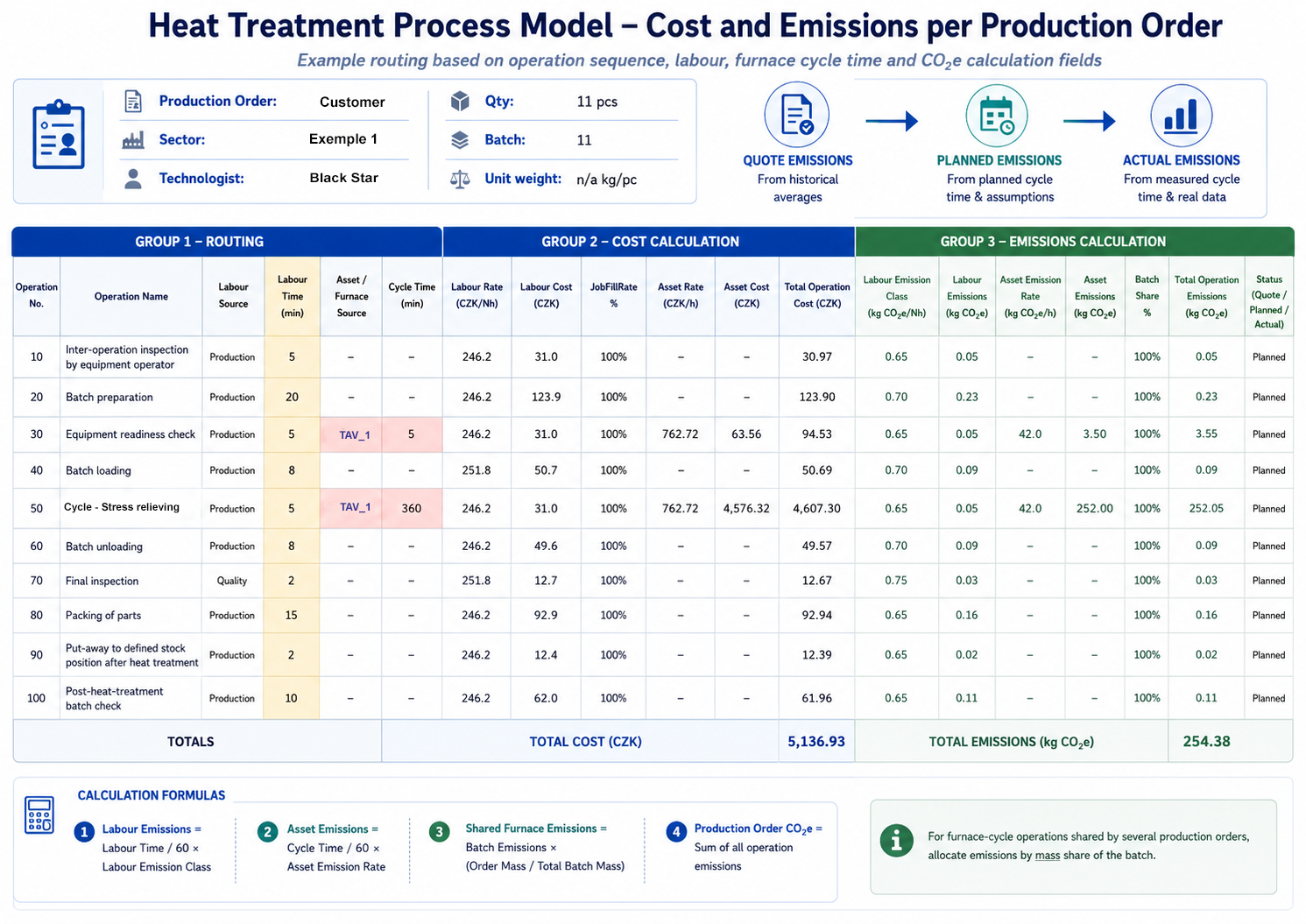
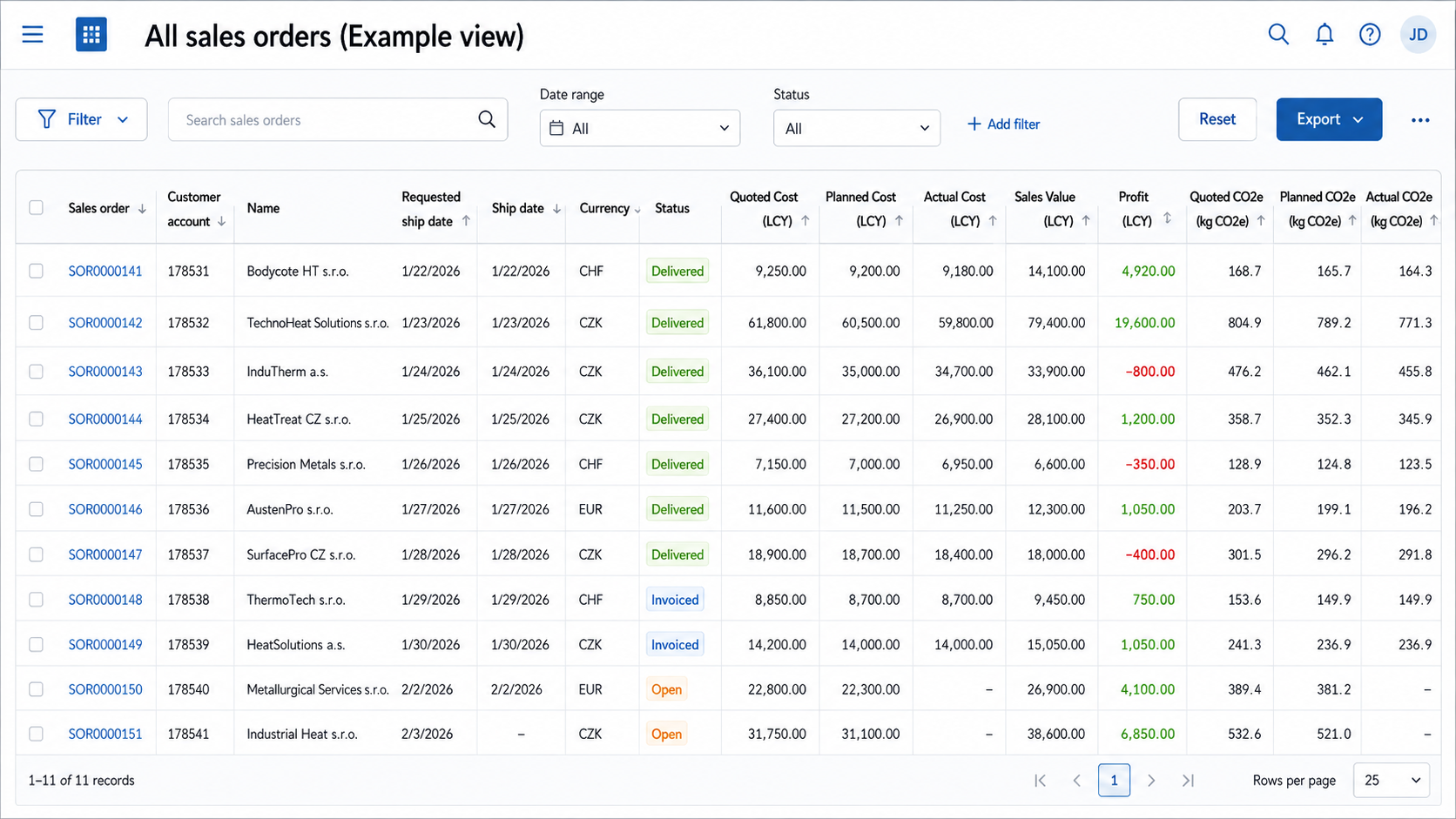
When I close a production order, usually by printing a delivery note, I have precise information about both costs and emissions. An illustrative example of the valuation of costs and emissions according to individual operations of the process is in this infographic. The result can then be displayed on the management dashboard of the status of production orders.
And how can AI help me with this? This assistance can be seen at several levels, however, the calculation itself will be completely deterministic, and will be performed by ERP.
1. AI in quotation calculation
At the time of the offer, we usually know:
- the customer and the part,
- the material,
- the weight,
- the required process,
- the required properties,
- the expected equipment,
- any similar previous orders.
But we don’t know exactly:
- the actual furnace,
- the actual batch composition,
- the actual cycle time,
- the actual energy and media consumption.
Here, AI can search for, for example, ten to twenty most similar historical orders and suggest from them:
- expected cycle time,
- expected electricity or gas consumption,
- nitrogen, argon, ammonia or acetylene consumption,
- standard working times of individual operations,
- likely LoadFillRate,
- expected kg CO₂e per cycle and kilogram of parts.
The output could look like this, for example:
- Four similar processes were found for the order on the TAV_1 furnace.
- The estimated cycle time is 355–375 minutes.
- The expected consumption is 1,180–1,280 kWh.
- The bid emission value is 245 kg CO₂e per day
- Estimate reliability: 87%.
So AI would not create a number arbitrarily, but would explain what orders and parameters the estimate is based on.
2. AI in job planning
After accepting the order, you already know the more specific conditions:
- the selected furnace,
- the current recipe,
- the planned batch,
- the number of production orders in the batch,
- their weights,
- the actual planned start,
- the furnace status, if applicable.
AI can refine the original quote calculation.
For example, it can recognize that:
- the planned furnace has higher consumption than the furnace used in the quote,
- the batch will only be 60% full,
- the specific geometry of the parts will extend the heating,
- the long holding time will increase consumption more than the weight itself,
- the current composition of the batch is not energy-optimal.
The planning model can then suggest: Moving the order from furnace A to furnace B can reduce expected emissions by 12%, but the cycle will be 35 minutes longer.
Or: Adding another order to the same batch will only increase cycle emissions by 4%, but emissions per kilogram of parts will decrease by 21%.
This is very valuable because AI can optimize simultaneously:
- time,
- cost,
- capacity utilization,
- emissions,
- risk of non-compliance with the technological process.
3.AI in cycle time estimation
Cycle time is a key piece of information for the calculation. At the same time, historical data shows relatively wide differences between minimum, average and maximum cycle times. AI can estimate cycle time based on a combination of:
- material,
- initial and target temperatures,
- charge weight,
- part weight,
- part geometry,
- furnace type,
- required atmosphere,
- quenching gas pressure,
- number of holds,
- required heating and cooling rates,
- historical behavior of a particular furnace.
The model then does not have to work with just one average, but for example:

AI can also indicate an interval:

This is significantly safer for the bid than a single fixed value.
4. AI in energy consumption estimation
Cycle time alone may not accurately capture consumption. Two six-hour cycles may have different consumption depending on:
- target temperature,
- initial furnace temperature,
- charge weight,
- product weight,
- number of heating stages,
- vacuum or atmosphere,
- cooling mode,
- insulation condition,
- age of heating elements.
AI can create a separate prediction model:

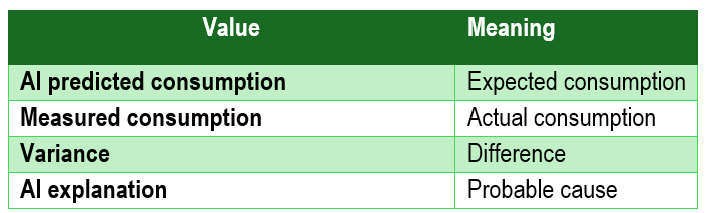
For the bid calculation, it would predict the consumption. For the planned calculation, it would update it according to the specific batch. For the actual, the forecast would be replaced by the measured values. It would be appropriate to store both values:
5. AI in work operations
For Labor-type operations, AI can analyze real historical times:
- batch preparation,
- preparation,
- set-up,
- unloading,
- inspection,
- packaging,
- internal logistics.
It can take into account:
- number of pieces,
- weight,
- complexity of preparation,
- number of layers in the batch,
- need for masking,
- required inspections,
- type of packaging,
- operational experience with similar parts.
The output can be a recommended operation time:

AI can also detect that a particular operation is systematically under- or over-estimated.
For example: The quoted batch preparation time is 20 minutes, but the average of the last 18 similar orders is 31 minutes.
This will improve both the cost and emission models, since both calculations use the same amount of work.
6.AI in evaluating the actual cycle
After the cycle is completed, the AI will have access to:
- real time,
- temperature history,
- real kWh,
- gas and media consumption,
- pressure,
- data from the vacuum system,
- alarms,
- actual batch weight,
- quality control results.
AI can perform three tasks here.
Data accuracy check
- For example:
- missing meter reading,
- unreasonably low consumption,
- duplicate cycle,
- time mismatch between ERP and SCADA,
- zero gas consumption for a gas furnace,
- incorrect emission factor.
Anomaly detection
For example: The consumption of this cycle was 18% higher than for comparable batches.
Root cause support
AI can compare the progress with history and suggest probable causes:
- low furnace fill,
- longer temperature ramp-up,
- repeated vacuuming,
- leakage,
- deteriorated insulation condition,
- longer gas quenching,
- extended holding time,
- measurement error.
It is important to use the wording probable cause, not to automatically declare that the cause has been confirmed.
7. AI in the distribution of batch emissions
The basic division should remain mathematically fixed:

But AI can help decide whether weight is really the best allocation key for a given process. For example, it can find out that for a certain group of parts, the following is better:
- weight,
- volume occupied,
- grid area,
- number of pieces,
- heat capacity,
- combination of weight and volume.
However, the basic methodology would not change automatically. AI would only warn: For this type of part, pure weight allocation may underestimate its share, because the parts occupy 65% of the useful space of the furnace, but only 30% of the batch weight.
A change in the allocation method must be approved by the responsible employee.
8. AI in ESG reporting
AI can automatically prepare:
- sum of emissions by operation,
- Scope 1, Scope 2 and Scope 3 breakdown,
- emissions by equipment,
- emissions by customer,
- emissions by process,
- emissions per kilogram,
- emissions per production order,
- comparison of quote, plan and actual,
- monthly and annual trends,
- comment on significant changes.
For example: Total emissions by operation increased by 7.2% in July. The main reason was the higher number of gas cycles and a decrease in the average LoadFillRate from 74% to 63%. On the other hand, the emission intensity of electric vacuum furnaces decreased by 4.5%.
AI can also automatically generate the text part of the report, but it must take the numbers from a controlled source.
9. Automatic consistency check of ESG data
The AI can perform a control balance before the month closes:

For example, it may indicate:
- 8% of electricity was not assigned to any equipment,
- two furnaces do not have an updated emission factor,
- actual gas consumption is 12% higher than the sum of the cycles,
- 34 orders are missing batch weights,
- some cycles are reported as both planned and actual,
- market-based and location-based values have been swapped.
This control function may be more important for the audit than the prediction itself.
10. What AI shouldn’t do
AI should not, without control,:
- change emission factors,
- change Scope 1, 2 or 3 classification,
- replace measured consumption with an estimate,
- decide on the official allocation methodology,
- overwrite data from ERP, MES or SCADA,
- automatically validate ESG reports,
- cover up missing data with calculated values.
- It must always be clearly marked:
Value Type
- Measured
- Calculated from fixed formula
- Estimated AI
- Manually Adjusted
=======================================================================================================
Are you solving a similar problem? I will help you with the analysis…
 40+ years of experience in the field
30+ years of experience… HT-PROGRES, Bodycote, Galvamet
cooperation… VŠB, Czechimplant, ECM Technologies, TAV Vacuum Furnaces, GHC Invest
12+ years of expert activity
Want to ask for a solution or want a non-binding consultation? Click on this link, I will usually respond within 24 hours. Contact email
========================================================================================================
Jiří Stanislav, Ing. CSc.
Consultant and forensic expert
========================================================================================================
5/8/2026