How to do AI in practice, part VII, Vacuum plant

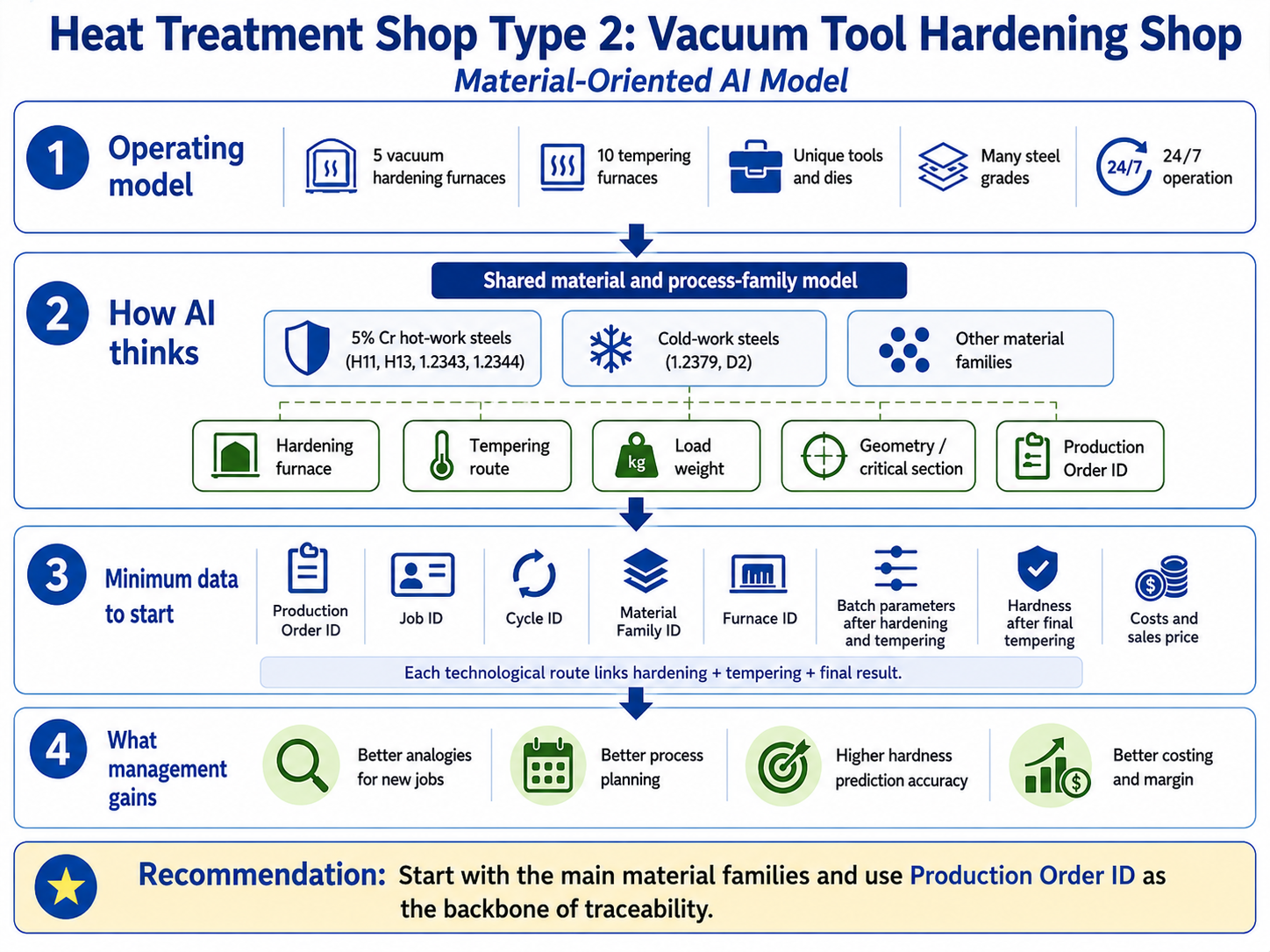
The second model of the quenching room is a vacuum heat treatment plant used for hardening tools. The type of product is indefinable, it is always a unique item, a part of a tool, a indivudal insert, a mold. It is similar with materials, the list is usually very long, however, the groups of steels for hot work H11, H13, or for cold work 1.2379, K110, HSS high-speed steels prevail.
The heat treatment plant usually has more quenching furnaces with nitrogen overpressure, in our model we will consider 5 furnaces, and twice the number of tempering furnaces, preferably vacuum again. The average charge is 250 kg, the average weight of one part is up to 30 kg, the cycle time for quenching is around 8 hours, as well as the time for the tempering cycle. The quenching room again operates in 24/7 mode, only with winter and summer shutdowns.
For some processes, the cycle time can be defined from closing the gate to opening it, but cycles with two or three tempering temperatures are also possible, without opening the gate, only between two tempering temperatures we have to cool the parts to 50 C. In this sector, we usually work with thermocouples Ts and Tc for hardening, and with Tc for tempering.
Since each hardening furnace can perform up to 3 hardening cycles per day, 5 furnaces can perform more than 5,000 hardenings per year, with a weight of over 1,200 tons of material. For tempering, we have 10 tempering furnaces at our disposal and they will perform 10,000 tempering cycles per year in the H+2T mode.
If the 5,000 annual cycles were evenly distributed among 100 materials, only 50 hardening cycles per year would be allocated to one steel grade. But that is not the case. The predominant steel groups are hot work steels (50%), cold work steels (25%), and the rest (25%).
If we were to request data for all combinations:
- material × product × furnace × fixture × quenching pressure × tempering mode
there would never be enough data. Therefore, a hierarchical structure is again recommended.
A common vacuum quenching model will use all quality records and learn general influences. Unlike a product model, this type of quenching will work with a material model. It is not realistic to create a separate AI model for each product or each steel grade. The data must be grouped according to metallurgical and process families.
For each Product ID, a route should be recorded:
Product ID
→ RFQ
→ Quotation Header ID
→ Quotation Line ID
→ Quotation Routing ID
→ Quotation Quality Order ID
—————————-
→ Sales Order Header ID
→ Sales Order Line ID
→ Routing ID
→ Quality Order ID
—————————-
→ Production order ID
→ Hardening Cycle ID
→ Hardening Process Parameters
→ Hardening Furnace ID
→ Tempering 1 Cycle ID
→ Tempering 1 Process Parameters
→ Tempering 1 Furnace ID
→ Tempering 2 Cycle ID
→ Tempering 2 Process Parameters
→ Tempering 2 Furnace ID
——————————
→ Quality Order ID – Hardness
→ Quality Release
→ Packing slip
→ Invoice
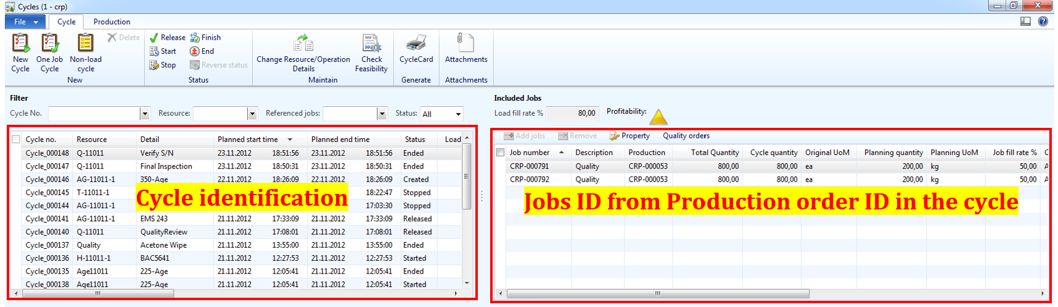
Each item of this route has its own data fields. If we have them, it will be an advantage, if we don’t, we need to consider what the AI layer will bring us. The most important are the data related to the Production Order ID, and the traceability of the Production Order ID according to the kiln cycle via the Job ID. The JOB ID is the identification of the operation from the workflow to the Production Order ID. The image below shows the cycle planning table from AX2012. On the left is a series of cycles defined as Cycle ID, on the right are the parts inserted into the cycle, with the JOB ID.
Therefore, 5,000 hardening cycles and 10,000 tempering cycles do not represent 15,000 independent references, but represent a maximum of 5,000 complete technological routes per year in the form of e.g. H+2T.
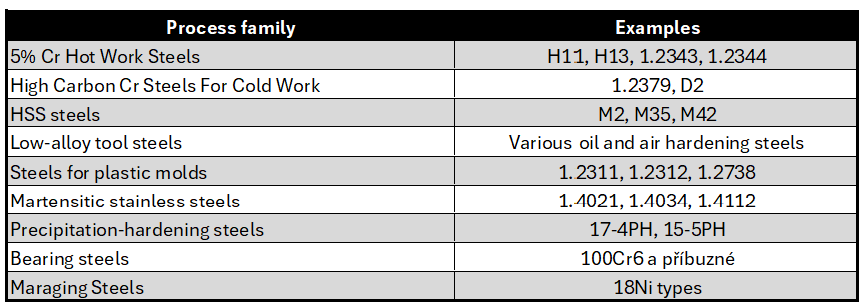
Each route must be linked by one Product ID, multiple Cycle IDs, according to the Material Family ID. Each group of materials will form a process family, e.g.
Recommended number of routes for one process family:
- 100–150 routes – first orientation model,
- 200–500 routes – usable pilot,
- 500–1,000 routes – good production model.
A pilot model built in this way can help us not only in the RFQ process, but especially in assessing the economy, efficiency, reliability and predictability of our production.
What to say in conclusion. From what I have said, it is clear that the transition to AI in the control of the quenching plant is an interesting task. However, in order to have enough correct data for the AI layer, we must have a quality ERP system, and above all, cycle control. This is not only for the RFQ process, but mainly for the future. Only the Cycle is a representative part of our activity, showing how efficient and profitable we really are. Only the profitability of individual sub-furnaces gives us the profitability of the heat treatment plant. Everything else, including the conversion to Product ID, kg, pcs, number of orders, is just a breakdown of how effectively we used the cycles.
Only when we deal with cycle management can we start thinking about AI. Janusz Kowalewski wrote:
“AI should not be seen as a general technological initiative, but as a targeted operational tool that translates existing data from vacuum furnaces and quality into actionable decisions.”
This is only his technical view. Yes, the furnace, even a vacuum one, is an important subject in the AI vision, but it is only a part of the whole that we need to see. If we buy expensive energy, technical gases, we will have unhealthy high wages, even the best behavior and control of the furnace will not ensure the viability of our quenching plant. And we will not find this data in SCADA. I would rephrase it to:
“AI should not be seen as a general technological initiative, but as a targeted operational tool that connects business, technological, quality, capacity and economic data of the heat treatment operation and translates them into specific predictions, recommendations and actionable decisions.”
How to translate it? From the ERP we have perfect data, verified by accounting, about what happened.
But AI will tell us what will happen!!!
And so it is up to us whether we leave the prediction of the behavior of the heat treatment plant to us, who are fallible, to our experience and knowledge, or we hand it over to AI.
Once in the past, I participated in a complaint about our quenching, it was a die-casting die. The customer’s technologist absolutely convincingly argued how the melt flows in the mold, and where the critical points are. With the addition that he has been doing it for 20 years, so he simply must know. So we put the entire model into PROCAST and simulated the casting process. Everything was completely different. What does this mean? Even a 100-fold repeated experience may not be true if we do not have the right information.
So for me, yes, AI is a good tool, but for it to work well, we cannot focus only on the furnace, but must address the entire system.
=======================================================================================================
Abbreviations used:
AI: Artificial Intelligence
API: Application Programming Interface: definované rozhraní a soubor pravidel, podle kterých si dva systémy předávají data a příkazy. Webové API může být dostupné prostřednictvím jedné nebo více URL adres, označovaných jako endpoints.
JSON: JavaScript Object Notation: textový formát pro strukturovaný přenos dat. Vznikl v prostředí JavaScriptu, ale dnes je nezávislý na programovacím jazyce.
Middleware: integrační vrstva, která propojuje systémy, transformuje data, řídí komunikaci, zabezpečení a auditní záznamy.
AI model: matematický nebo statistický model, který provádí klasifikaci, predikci, detekci odchylek nebo doporučení.
OPC UA: Open Platform Communications nebo OPC Unified Architecture
AI vrstva: řešení sestavené ze standardních platforem, konektorů, pravidel a individuálně nakonfigurovaných nebo vyvinutých modelů.
Document AI: Technologie využívaná k extrakci využívá k extrakci informací z tištěných i digitálních dokumentů, jako jsou obrázky, texty, znaky
DMS: Document Management System
FQ: Request For Quotation
APQP: Advanced Product Quality Planning
PPAP: Production Part Approval Process
ERP: Enterprise Resource Planning
OTIF: On Time In Full (%) – percentage of orders delivered within the required deadline
TAT: Turn Around Time (hrs) – the time between order recording and packing slip printing
=======================================================================================================
Are you solving a similar problem? I will help you with the analysis…
 40+ years of experience in the field
30+ years of experience… HT-PROGRES, Bodycote, Galvamet
cooperation… VŠB, Czechimplant, ECM Technologies, TAV Vacuum Furnaces, GHC Invest
12+ years of expert activity
Want to ask for a solution or want a non-binding consultation? Click on this link, I will usually respond within 24 hours. Contact email
========================================================================================================
Jiří Stanislav, Ing. CSc.
Consultant and forensic expert
========================================================================================================
1/8/2026