How to do AI in practice, part III – AI Support
To tell the truth, it is no longer easy for our generation to understand this. So an example is needed. Start with something simple and then develop it. But the idea is that I have to have all the data packages at once, including the data from the furnaces.
The opposite is true. I don’t have to. I can start completely without it.
Usually, the entire process of registering an order in the ERP system begins with an RFQ, with a request for quotation. In practice, this means that we have to create a product offer in the ERP, with a production process offer, validate it through a feasibility check, assign costs to it and propose a margin, i.e. the total selling price. Finally, we have to approve this offer in a demonstrable way and send it to the customer, including the GTC.
What do I need for this?
✔ ERP
✔ API (JSON request/response)
✔ Data layer: document or file storage, SQL database/data warehouse, and possibly data lake or lakehouse.
In this configuration, there is no connection of furnaces, but AI can still do: technological feasibility, furnace selection, process or production procedure selection, CHD prediction, hardness prediction, PPAP, deformation prediction, cost calculation, deadline calculation, audit log, automatic quote creation, automatic connection of GTC.
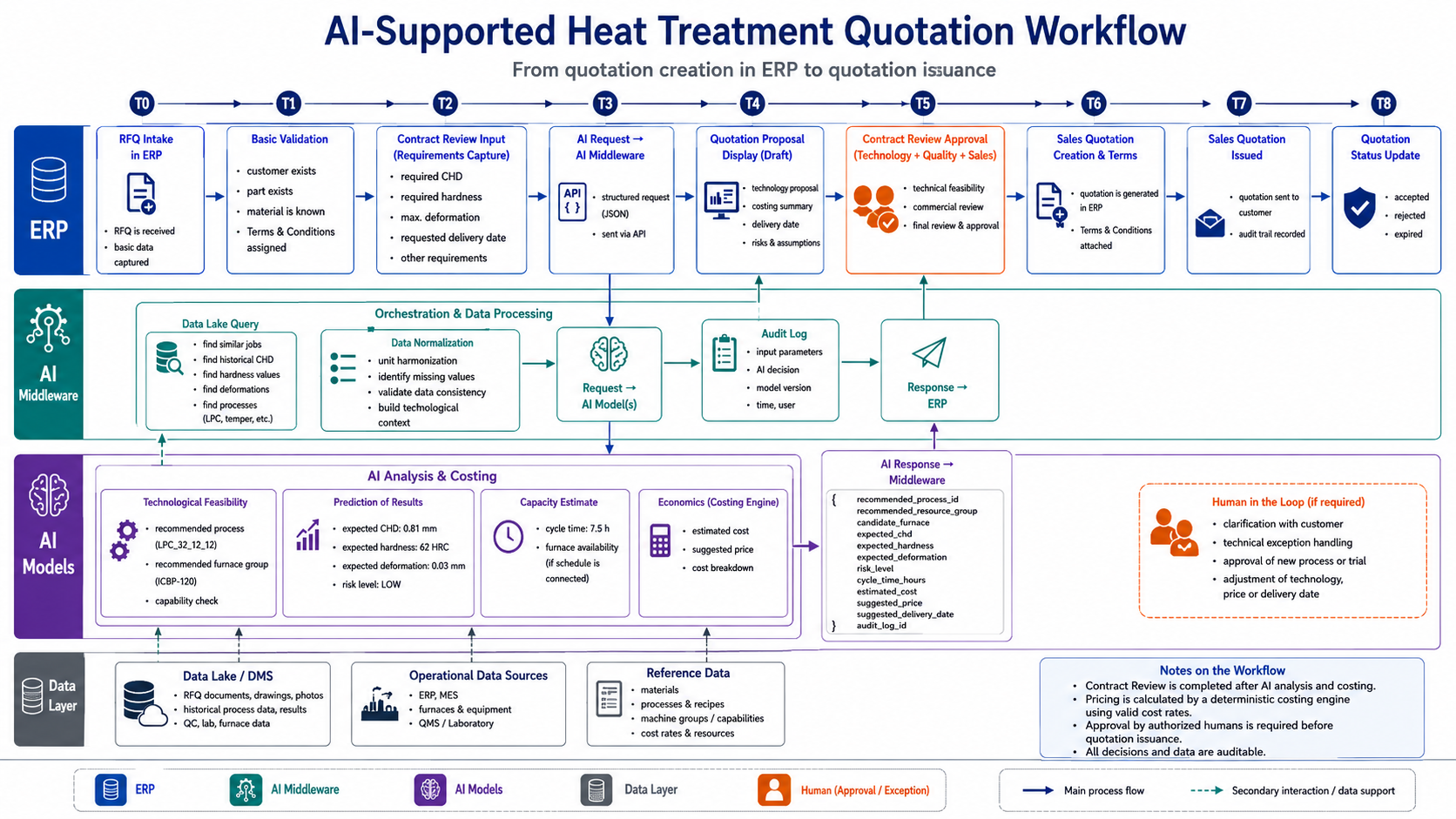
Since there is no need to communicate with the furnaces at this stage of implementation, I do not need OPC UA yet. This will only happen at a later stage, when I will have my first practical experience with AI and its use. However, there must already be sufficient quality historical data on processes and their results in the ERP.
Since I have to define the data structure and individual fields right from the start, I can then transfer a number of records from the ERP from existing, implemented processes to the data warehouse, including the relevant identification data for temperatures, pressures, and flows, if they are set in the production procedures, as a requirement for the setup of the furnace control systems.
The heat treater must archive process records of cycles for a period specified by customer, regulatory, contractual, and legal requirements; often many years. However, these records usually lie outside the ERP and are not digitally linked in any way.
Many quenching plants already have process data capture. However, their identification per cycle is missing. They are captured and archived as an endless record. Therefore, finding a specific record from a cycle means identifying Cycle START and Cycle END in the ERP system, and then filtering out a specific section of data in the endless record. In order to improve our future position, if we solve this problem today, it will be very, very useful to us tomorrow.
Since most of the tasks that AI will perform in the future will be related to the batch and the cycle, it is necessary to deal with this. Again, this is tied to the historical approach of heat treatment plant management to this area. There are heat treaters where this is already a given, but there are plants that are still resisting. But those will have an even worse future.
When I put it into practice, the basis of everything is cycle management in ERP. If I apply it, I know when the cycle started and ended, I have its Cycle ID, I know what products were processed in the cycle, what their IDs were, what the JOB ID was, under what conditions the process was carried out (temperatures, pressures, flows, failures), and with what result. If I also have a record of data from the furnace, energy consumption, gases and other direct materials, I have everything I need and I am able to feed the AI with a sufficient amount of real information. However, I do not need the data from the furnaces in this initial phase.
But here’s the problem. A classic commercial ERP product can’t do this. Neither SAP, nor Navision, nor Microsoft Dynamic AX 2012, nor QI. It simply has to be programmed first. The problem is not in the missing function, but the basic problem is that the classic cycle in ERP systems is built, for example, for machine tools, where the link is 1:1, one product, one machine. In heat treatment, however, there is a cycle with a 1:X link, so in one cycle there will be more sales orders, more production orders, more products.
A compromise is, for example, the TTC-Informatik GmbH solution, where all the functions needed for heat treatment exist, but it is a production module, outside of ERP. So to make it work, I have to create a bridge between ERP and TTC. Maybe it’s easier for programmers, but from the company’s point of view, it’s better to have only one system. Maintaining the connection will be difficult, because a change in one system will necessarily generate a change in the connecting bridge, sometimes in the other system.
However, it also follows that the ERP system is an indispensable basis for any future AI. Customers, products, processes, production orders, cycles, quality data, delivery notes, invoices, but also complaints and their costs are stored here.
And so the basic question arises. Can AI help us with this? I think only partially. In analysis, prediction, statistics, design. But it will not help us with classic production, which is strictly anchored in customer agreements, production instructions, in quality requirements, where we are usually not authorized to change anything without the customer’s consent.
If we have a recurring product, then everything is strictly defined in the ERP system, and receiving an order is a common routine. But AI will help us check the reliability of results, trends, dependencies, it can suggest changes to preparation, batch optimization, it can perform planning for us very well, but it is not authorized to make any direct intervention in ERP settings. Likewise, AI is not allowed into SCADA or PLC!!
First of all, it can help us design new production. That is, participate in the RFQ process. AI will select or compile the optimal procedure for the offered product, select the furnaces, help us optimize the charges and thus define the offer price. This area is very broad and it is possible, or rather necessary, to start here. This is where its positive properties will be demonstrated, in design, in prediction, in analysis.
So the question is whether this investment is even worth it. If I buy a furnace with AI metrics, great. I buy a finished product, I don’t have to worry about anything, this metric will protect me from critical furnace conditions, suggest preventive maintenance steps or limit some functions so that the furnace is not damaged.
But if I throw myself into development, just preparing the ERP system for AI will cost a lot of money. And at the beginning I have to ask myself: do I know how to do it?
Only after I go through this stage can I start AI.
=======================================================================================================
Abbreviations used::
AI: Artificial Intelligence
API: Application Programming Interface: definované rozhraní a soubor pravidel, podle kterých si dva systémy předávají data a příkazy. Webové API může být dostupné prostřednictvím jedné nebo více URL adres, označovaných jako endpoints.
JSON: JavaScript Object Notation: textový formát pro strukturovaný přenos dat. Vznikl v prostředí JavaScriptu, ale dnes je nezávislý na programovacím jazyce.
Middleware: integrační vrstva, která propojuje systémy, transformuje data, řídí komunikaci, zabezpečení a auditní záznamy.
AI model: matematický nebo statistický model, který provádí klasifikaci, predikci, detekci odchylek nebo doporučení.
OPC UA: Open Platform Communications nebo OPC Unified Architecture
AI vrstva: řešení sestavené ze standardních platforem, konektorů, pravidel a individuálně nakonfigurovaných nebo vyvinutých modelů.
Document AI: Technologie využívaná k extrakci využívá k extrakci informací z tištěných i digitálních dokumentů, jako jsou obrázky, texty, znaky
DMS: Document Management System
FQ: Request For Quotation
APQP: Advanced Product Quality Planning
PPAP: Production Part Approval Process
ERP: Enterprise Resource Planning
=======================================================================================================
Are you solving a similar problem? I will help you with the analysis…
 40+ years of experience in the field
30+ years of experience… HT-PROGRES, Bodycote, Galvamet
cooperation… VŠB, Czechimplant, ECM Technologies, TAV Vacuum Furnaces, GHC Invest
12+ years of expert activity
Want to ask for a solution or want a non-binding consultation? Click on this link, I will usually respond within 24 hours. Contact email
========================================================================================================
Jiří Stanislav, Ing. CSc.
Consultant and forensic expert
========================================================================================================
31/7/2026