How to do AI in practice, part VI, SQ plant

Another question is how much data do I need to give the AI room for its activities. I tried to work with ChatGPT with two types of quenching plants.
The first is a classic quenching plant with 3 multipurpose furnaces, with 100 to 200 repeat products, with SQ furnaces for 750 Kg, with a 24/7 operating mode and two annual shutdowns, each lasting 14 days (Summer, Winter). As a model, I designed the quenching of C45 steel, batches of 500 kg, cycle time 4 hours.
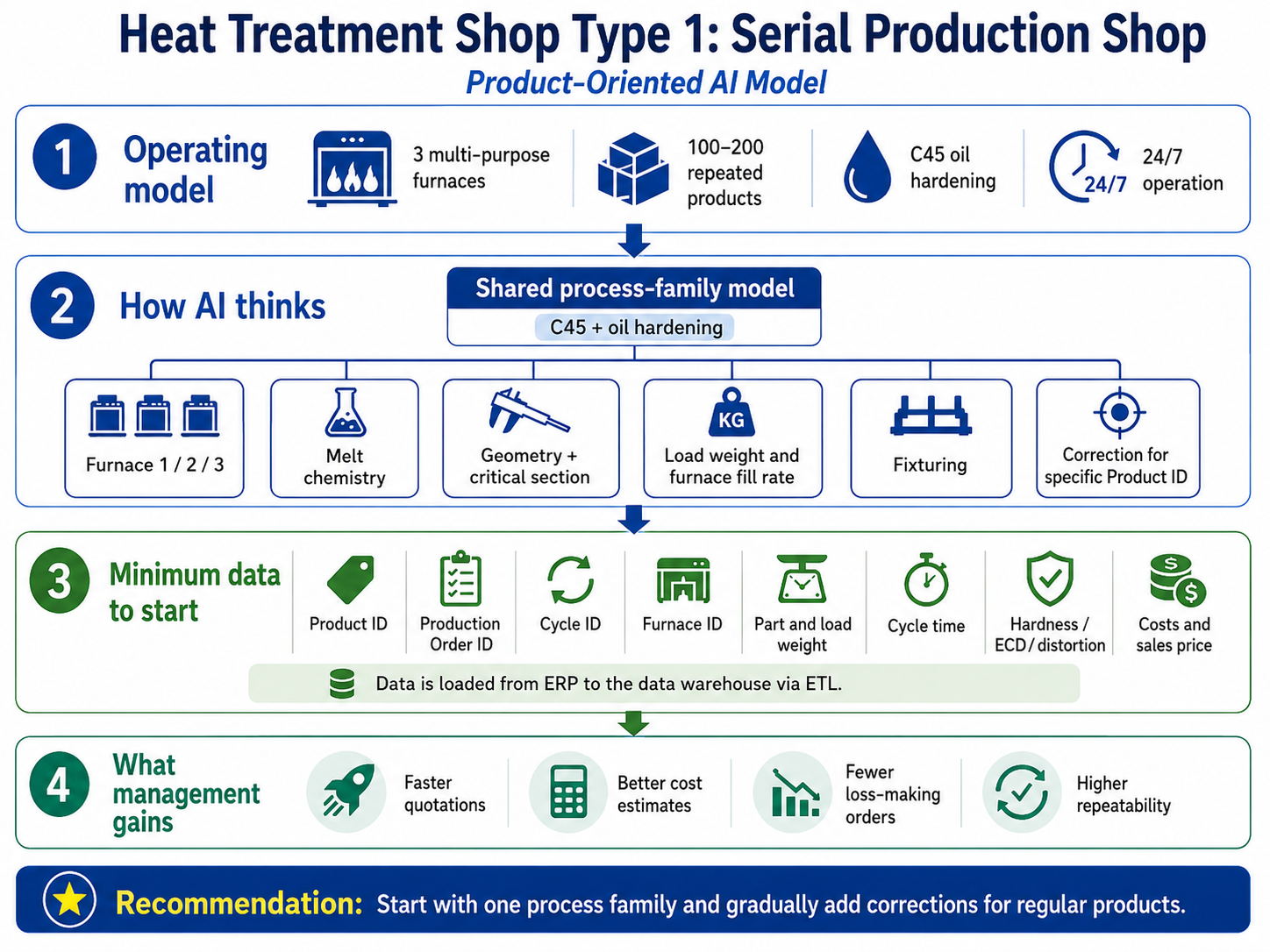
The question is how much and what data do I need to prepare for the data warehouse so that the AI can start working? In this mode, the furnaces will perform 6,066 cycles and process 3,033 tons of parts per year.
The decisive factor is not the total number of records, but mainly:
- whether the records are complete and correctly labeled,
- whether they represent truly independent batches or cycles,
- whether they cover the necessary materials, geometries, furnaces and process variants,
- how many input parameters should the model use,
- whether you are predicting a continuous value, such as CHD, or a rare event, such as a crack.
The number of records in the table below refers to individual completed and identified batches or cycles, not individual second-by-second temperature records.
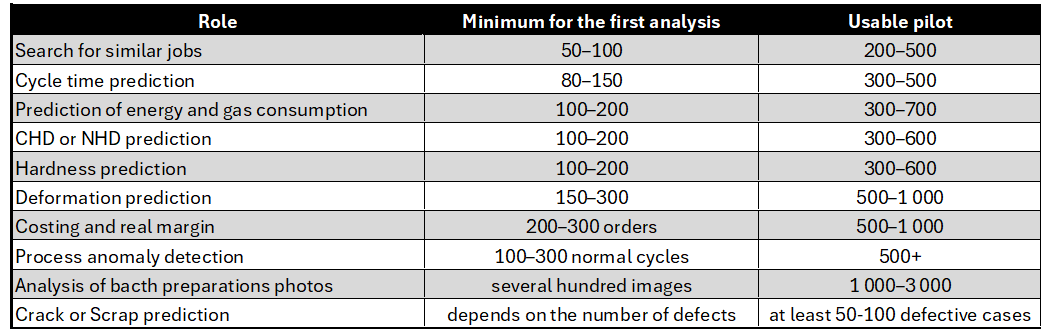
The best approach is to create a model on the initial set and then observe the learning curve: the accuracy of the model is evaluated at 50, 100, 200, 400 and other records. The curve will show whether additional data still improves the result, or saturation is already occurring.
The model that will be used for such a quenching plant will be a product model. We will therefore collect data related to the product, containing everything related to the material and cycle, quality data. It will be good if we create a process family, where we will also associate similar processes and materials, and then later include similar materials and similar products in this family.
There must be a clear link from the data set: RFQ and quotation, material and material condition, basic geometry and weights, number of pieces and proposed number of pieces in the batch, fixture and layout of parts on the fixture, recipe, required cycle parameters (temperature, pressure, gas type), AI proposed SPT (Standard Process Time) cycle time, AI calculated consumption per cycle, prediction of CHD, NHD, hardness and deformation results, quotation costs, risks of deviations and rework.
With 300-500 quality cases, you can usually:
- search for historical analogs,
- estimate the number of batches,
- create a first time and cost model,
- compare the offer with reality,
- create a learning curve and determine the real need for more data.
For a broader production model covering more technologies, I would aim for at least: 1,000–3,000 full cycles, divided by process families.
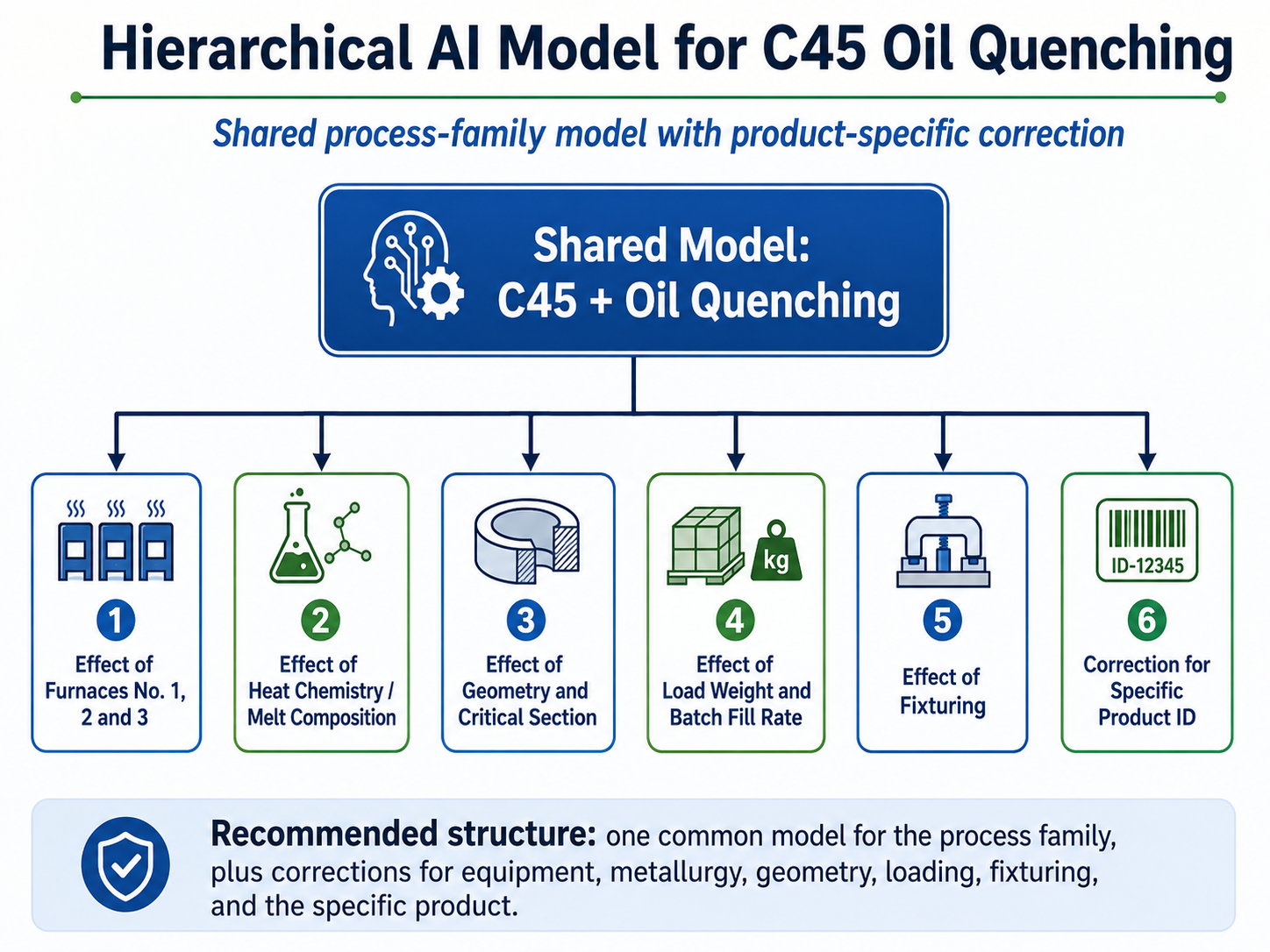
The selected model should first be limited to, for example:
- Process family: SQ Oil hardening
- Material family: Carbon steel C45, C60
- Furnace group: SQ TQ10
- Quench medium: Oil Durixol W72
- Result as quench: Hardness
- Result as temper: Hardness
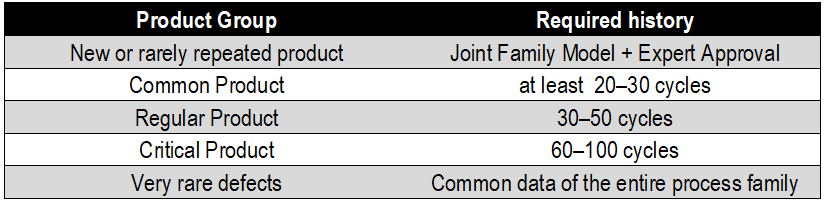
So the practical goal is not to obtain hundreds of records for each product. A reasonable goal is to create a common model from a few thousand C45 cycles and obtain approximately 30–50 well-described reference cycles for each regular product.
If the process is stable and known:
After one year, the data warehouse could contain, for example: 3,000–5,000 usable C45 cycles, data from all three furnaces, different dimensions, different preparations, different casts, different oil conditions, resulting hardnesses and deformations, costs.
The model does not relearn the entire process. It only finds out, for example: This product has an average hardness of 1.5 HRC lower than the general C45 model under the same conditions. Or: When filled above 85%, the deformation of this product increases by 0.04 mm.
Of course, in the first case I also have to store hardness measurements in the data warehouse, in the second case deformation measurements.
However, at the beginning we said that such a hardening plant has 100 to 200 products. For such a heat treatment plant, this means from 200*30 to 200*100 cycles, or data tied to a quenching cycle, i.e. from 6,000 to 20,000 structured data records. This is a huge amount of data and the AI layer administrator alone is not enough. It has to be handled differently. Since all ERP systems are based on relational tables, the above data should not be a problem to prepare if the ERP system knows it. But we are back to ERP quality.
To get started, we need to make sure that the ERP system gives us the basic data structure for export to the AI layer. However, this historical backfill must contain the data that we actually need to obtain from the ERP – see infographic. The abbreviation ETL stands for Extract-Transform-Load. After processing the data in the middleware, the data is moved to the data warehouse.
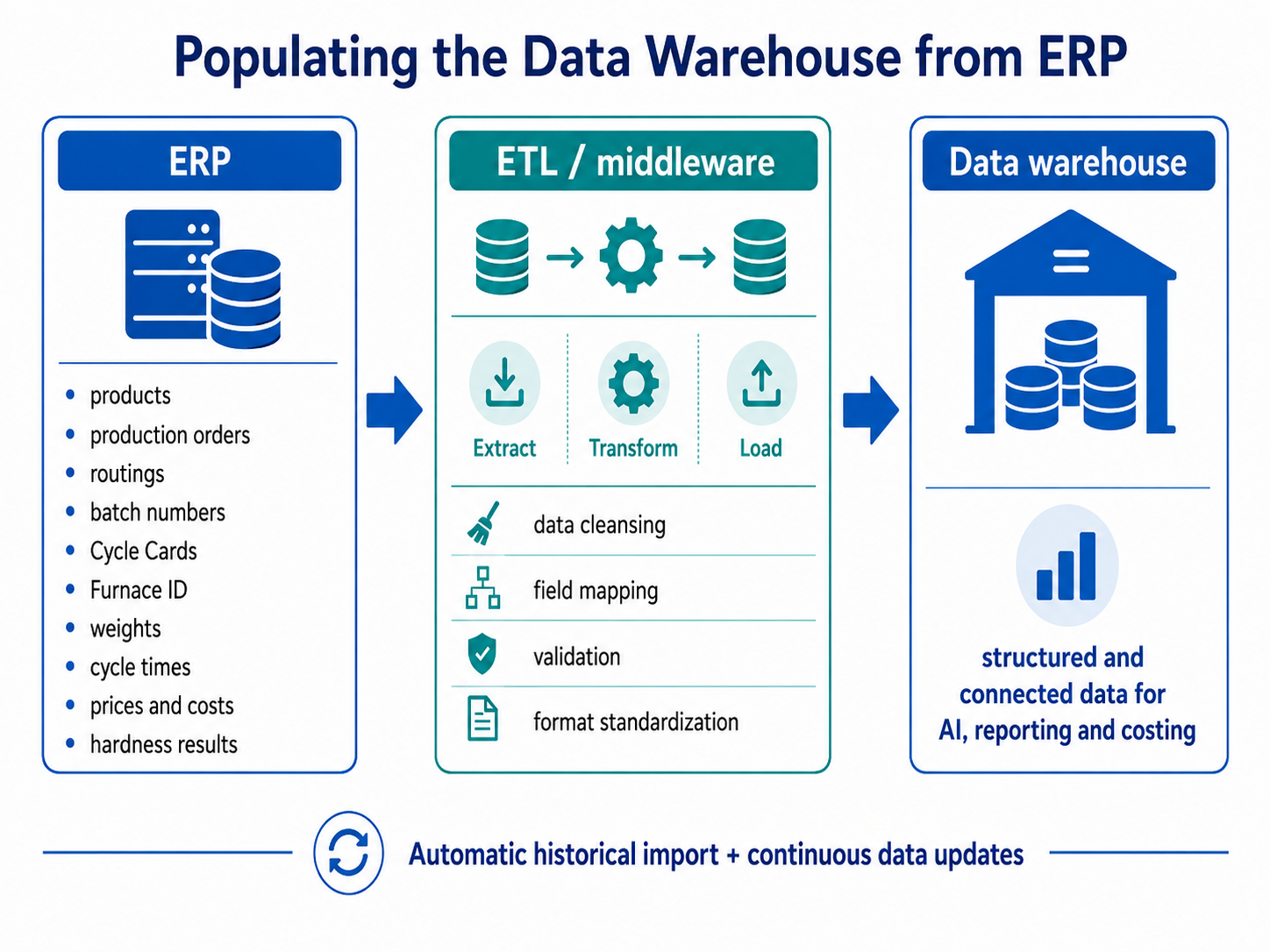
Once the system is launched, new records are automatically added. So if we import 2 years for this heat treatment plant model, we have 12,000 cycle records. The initial data is prepared by an ERP consultant, data engineer, integrator and technologist who will explain the meaning of the fields. The fact that we do not have process data for cycles at this point – temperature, pressure, flow rates, dew point, Cp, is not crucial. The crucial thing is that the rest is there. And here we are back to Cycles. If we do not have cycle management in ERP, if we do not have a deterministic cost calculation model in ERP, we do not have data for AI either. In this case, I assume that it is simply not worth it at all. Even AI will not solve the missing data for us. Even if ?
=======================================================================================================
Použité zkratky:
AI: Artificial Intelligence
API: Application Programming Interface: definované rozhraní a soubor pravidel, podle kterých si dva systémy předávají data a příkazy. Webové API může být dostupné prostřednictvím jedné nebo více URL adres, označovaných jako endpoints.
JSON: JavaScript Object Notation: textový formát pro strukturovaný přenos dat. Vznikl v prostředí JavaScriptu, ale dnes je nezávislý na programovacím jazyce.
Middleware: integrační vrstva, která propojuje systémy, transformuje data, řídí komunikaci, zabezpečení a auditní záznamy.
AI model: matematický nebo statistický model, který provádí klasifikaci, predikci, detekci odchylek nebo doporučení.
OPC UA: Open Platform Communications nebo OPC Unified Architecture
AI vrstva: řešení sestavené ze standardních platforem, konektorů, pravidel a individuálně nakonfigurovaných nebo vyvinutých modelů.
Document AI: Technologie využívaná k extrakci využívá k extrakci informací z tištěných i digitálních dokumentů, jako jsou obrázky, texty, znaky
DMS: Document Management System
FQ: Request For Quotation
APQP: Advanced Product Quality Planning
PPAP: Production Part Approval Process
ERP: Enterprise Resource Planning
=======================================================================================================
Are you solving a similar problem? I will help you with the analysis…
 40+ years of experience in the field
30+ years of experience… HT-PROGRES, Bodycote, Galvamet
cooperation… VŠB, Czechimplant, ECM Technologies, TAV Vacuum Furnaces, GHC Invest
12+ years of expert activity
Want to ask for a solution or want a non-binding consultation? Click on this link, I will usually respond within 24 hours. Contact email
========================================================================================================
Jiří Stanislav, Ing. CSc.
Consultant and forensic expert
========================================================================================================
01/8/2026