Jevons Paradox

The International Monetary Fund released a report that surprised me. It’s long, 65 pages long, and it basically says that:
Global energy and materials are essential to the functioning of the economy and have significant implications for macroeconomics and the environment. At the same time, the world is not on track to meet Paris Agreement goals. This paper documents two stylized facts that connect these observations. First, the world economy is characterized by large embedded emissions and materials: different energies and materials are deeply entwined and interdependent. This has historically led to additive – rather than substitution – dynamics in energy and materials on a global scale. Second, historically there has been a strong positive correlation between efficiency in resource use and total resource use at a global scale. We synthesize these observations by introducing the Generalized Jevons Paradox (GJP). We argue that the GJP reflects the direct and indirect energy/material demand effects of long-term energy and material interdependencies, themselves shaped by market and geoeconomic power, trade arrangements, and financial factors. While future scenarios may diverge from historical data, including because of different population and growth trends, the GJP calls for caution in projecting energy and material flows within the energy transition framework, as it suggests that a declining share of fossil fuels in primary energy consumption can coexist with rising total fossil consumption, and thus rising global emissions – as observed since 2012. The GJP highlights the importance of policies to better allocate energy and material flows across sectors and countries and reduce supply chain vulnerabilities, but raises difficult distributional and political economy questions. Based on the GJP, the paper identifies three areas for research: the detailed analysis of the role of materials in supply chain vulnerabilities; the political economy of material flows; and multidimensional welfare analysis in decarbonization scenarios.
So that’s a quote. The content is translated as: The more efficiently I use something, the cheaper it is to use it — and therefore I start using so much of it that the total consumption eventually increases.
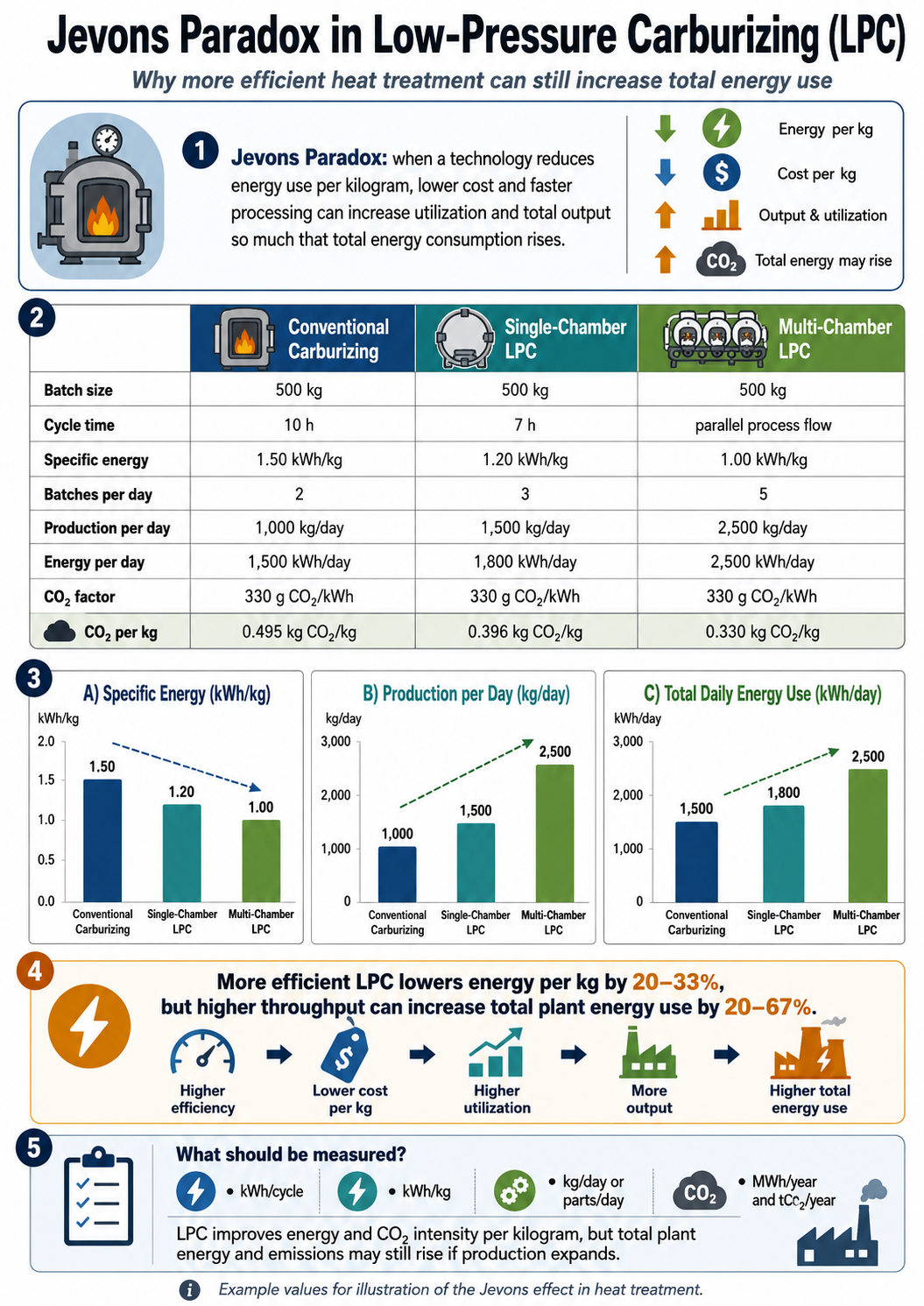
I will illustrate this with the example of replacing classical cementation with LPC. This is clear from the picture. The more I reduce the unit energy consumption, e.g. in kWh/kg, the higher the overall consumption I can generate.
And is it true? Already in 2008, President Havel declared: If we are still the same, why should everything keep growing? Havel’s later Imaginary Election Program is even more explicit. In it, he criticized political programs that, according to him, are guided by “the ideal of permanent growth of everything, without asking whether such growth has any meaning“. And he adds a very Havelian formulation that “work only has meaning if it has any meaning”.
The Jevons paradox can then result in a situation where a company announces in its ESG report: −25% kWh/kg, −25% CO₂/kg, but +50% production and therefore +12.5% absolute energy and CO₂ consumption. So we probably need to think about what we actually want.
=======================================================================================================
Are you solving a similar problem? I will help you with the analysis…
 40+ years of experience in the field
30+ years of experience… HT-PROGRES, Bodycote, Galvamet
cooperation… VŠB, Czechimplant, ECM Technologies, TAV Vacuum Furnaces, GHC Invest
12+ years of expert activity
Want to ask for a solution or want a non-binding consultation? Click on this link, I will usually respond within 24 hours. Contact email
========================================================================================================
Jiří Stanislav, Ing. CSc.
Consultant and forensic expert
========================================================================================================
22/8/2026