Not LPC as LPC
OLYMPUS DIGITAL CAMERA
It is still claimed that, unlike classical carburizing, where we control the carbon potential Cp with an oxygen probe, or using a dew point or via a CO2 infrared analyzer, there is no way with LPC, and we have to make do with simulation programs that adjust the C2H2 flow rates at the inlet to the carburizing chamber.
This is not entirely true, we have two options today. A mass spectrometer or an OPTIX gauge from Gencoa. In both cases, however, these are relatively expensive devices. However, these devices will accurately measure the ion flows, convert them into an electrical quantity, and we can then use that to regulate the mass flow rate of the carbon partial pressure gas.
However, practice is different. Mass flow meters are used to control the supply of carburizing gas. However, some systems require the charge area for proper LPC control. This is a problem, because we usually do not know this quantity at the inlet to the quenching chamber. So how is it?
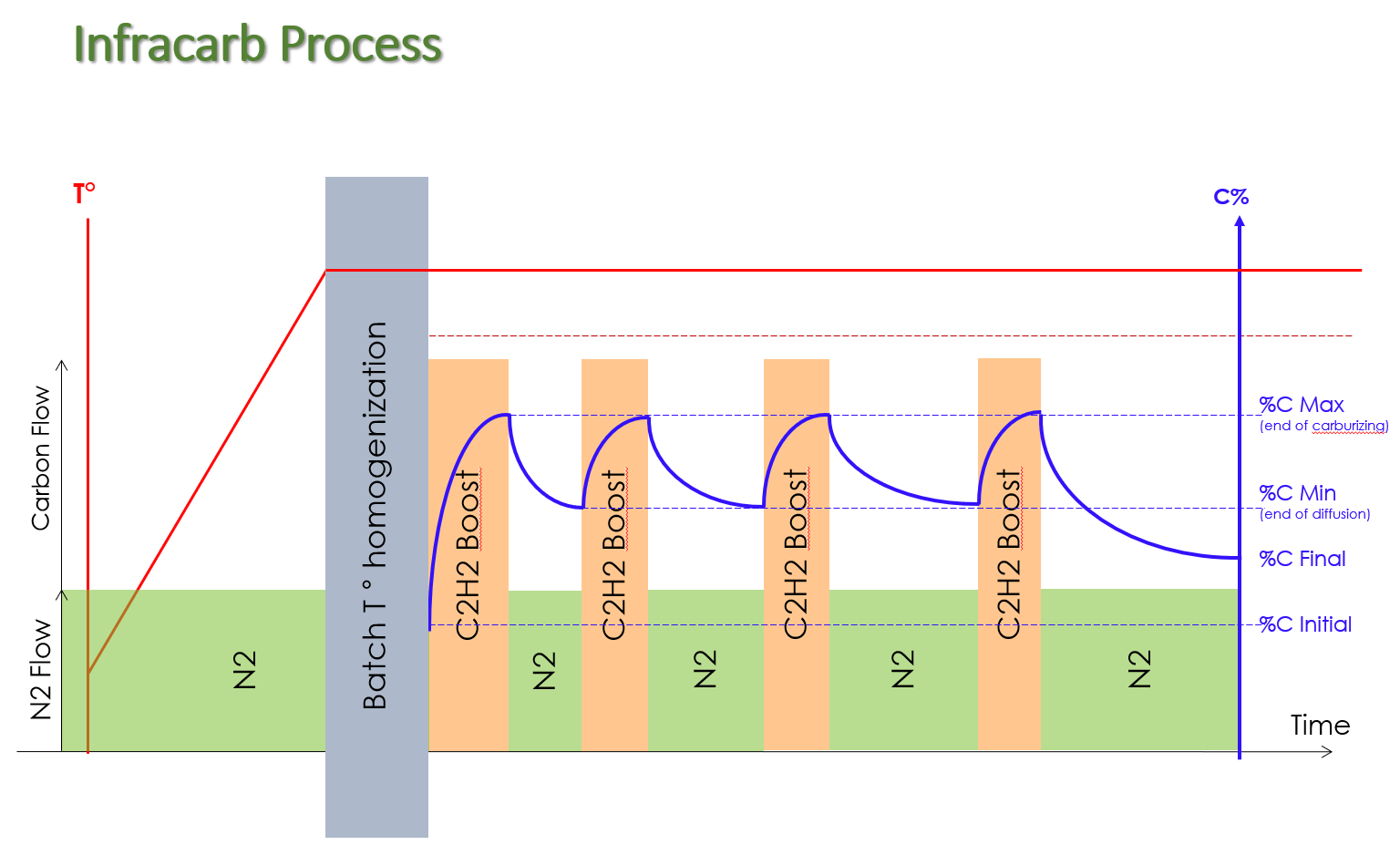
This image on the left shows a comparison of the ICBP InfraCarb® cementation process and the classic view of Cp control at LPC, and the image on the right shows the ICBP InfraCarb® model
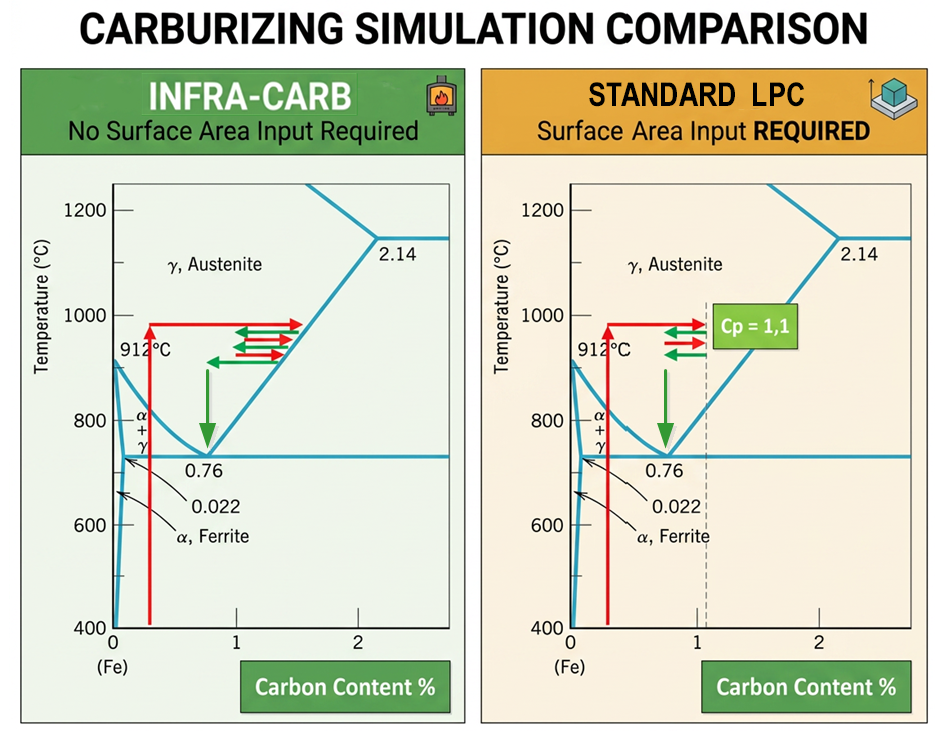
The difference is evident. Simulation programs try to create a similar situation in LPC as in classical cementation in ENDO gas. We choose a saturation potential, for example, Cp=1.1%, and then we model the saturation and diffusion periods so that we finally reach the eutectoid amount of carbon, approximately 0.8% C. However, in order to hit this point, we need to know the area of the charge. If we are not right, and the area of the charge is smaller than the area used for the calculation, then the layer will be oversaturated. Conversely, if the area of the charge is larger, then the layer will be undercarburized.
It is different with the InfraCarb® system. For a given furnace volume, a maximum area of the charge is defined, usually up to 25 m2. Surface carburization stops at the Acm line, at the point where the formation of Fe3C already begins. The position of this point depends on the temperature and will therefore depend on our choice of where we will move. Since in a very short time, within 120 s, an equilibrium state is reached between the saturation potential of the atmosphere and the amount of carbon on the surface, the diffusion flow stops due to the zero gradient.
Excess gas is pumped out of the system by vacuum pumps. The diffusion period then reduces the amount of carbon on the surface and restores the gradient, and therefore the carbon flow in the next saturation period. The final diffusion period will bring us to the carbon content at the eutectoid point. The huge advantage of this system is that we do not need to know the area of the charge.
Since I only know InfraCarb® and SimVac, I asked AI to find out how others do it. And especially to tell me if their systems depend on the area of the charge.
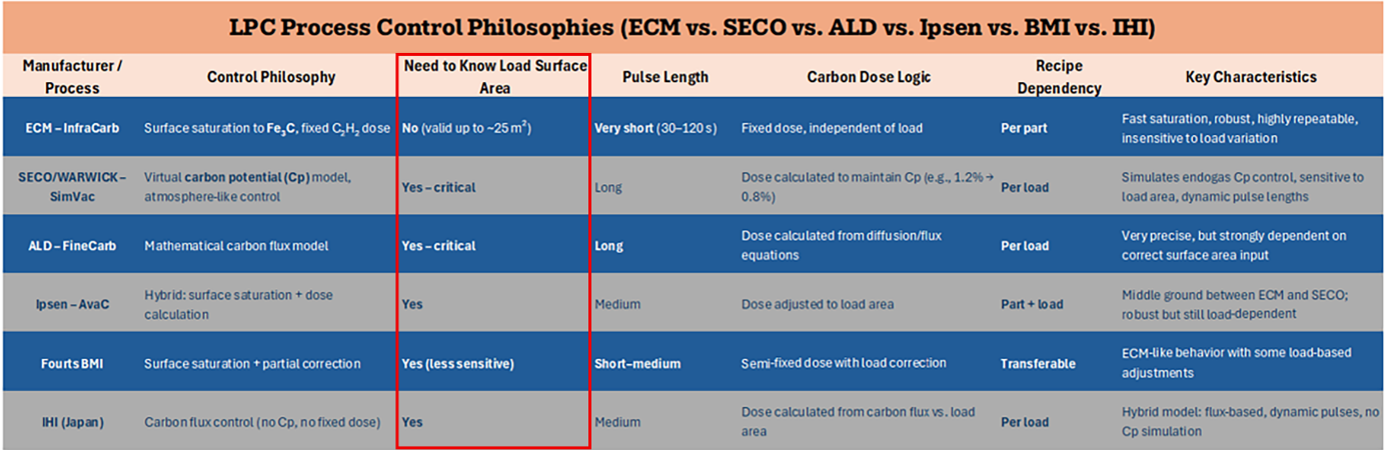
The result is in this table. I don’t know if it’s true, I can’t verify it. I only know from personal experience that InfraCarb® from ECM is independent of the surface area size, SimVac needs to know it. If the batches are stable, then it’s probably not a problem. But with variable batches of custom hardening plants, it’s a problem, the furnace programs have to adapt to it. The CHD/Temperature matrix becomes the more complex CHD/Temperature/Area problem. Unfortunately, even after a lot of effort, I couldn’t figure out with what precision it is necessary to work with this parameter. It doesn’t matter if I have programs for 1 m2, 0.5 m2 or 0.2 m2 for one CHD/Temperature combination.
So for me, it’s a clear choice. InfraCarb® not only ensures process stability, minimal risk of setting, precise carburization, but at the same time I don’t have to deal with the surface area of the part and fixtures in the ERP system when accepting an order.
=======================================================================================================
Are you solving a similar problem? I will help you with the analysis…
 40+ years of experience in the field
30+ years of experience… HT-PROGRES, Bodycote, Galvamet
cooperation… VŠB, Czechimplant, ECM Technologies, TAV Vacuum Furnaces, GHC Invest
12+ years of expert activity
Want to ask for a solution or want a non-binding consultation? Click on this link, I will usually respond within 24 hours. Contact email
========================================================================================================
Jiří Stanislav, Ing. CSc.
Consultant and forensic expert
========================================================================================================
22/6/2026