Energy savings in commercial heat treatment I
Let’s be honest. It’s too late to start now. But if we still have a chance of a year’s delay, because based on God’s inspiration we have fixed the prices of electricity or gas until the end of 2023, then there is still time to get started.
We need data both for the analysis of our own activity and for the contractual relationship with the energy supplier. For this you need:
- We must be able to measure consumption, not only at the input in heat treatment shop, but above all at each important individual appliance. These consumptions must be measured online in 24/7 mode. If we don’t have this input data, we can’t even calculate the savings
- We must be able to assign the actual consumption to the actual batch and evaluate it, for example, in CZK/kg, CZK/piece, CZK/hour, etc. Therefore, in addition to consumption, it is also necessary to measure the times of production operations so that it is possible to evaluate direct energy costs related only and exclusively for batch
- We must also be able to evaluate consumption for non-production times of equipment, the so-called idling energy. These will be allocated to overhead costs.
- In the case of electricity, we must be able to measure the ¼ hour maximum and regulate the heat treatment plant as a whole in order to reduce payments for this parameter. The price for the reserved power can be 10-20% of the total payment for electricity, but the penalty for exceeding the contracted power reserved goes to sky high amounts
- We must have correctly dimensioned power factor compensation for the entire plant or for individual appliances of an inductive nature so that we are not penalized for not complying with it in the range of 95-1.0.
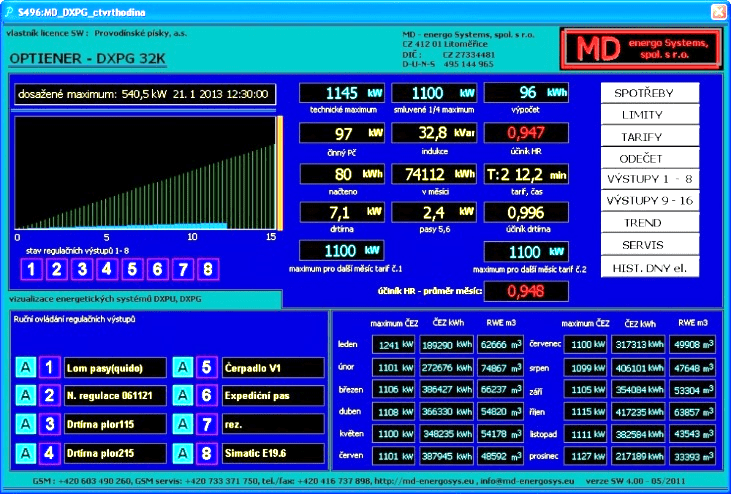
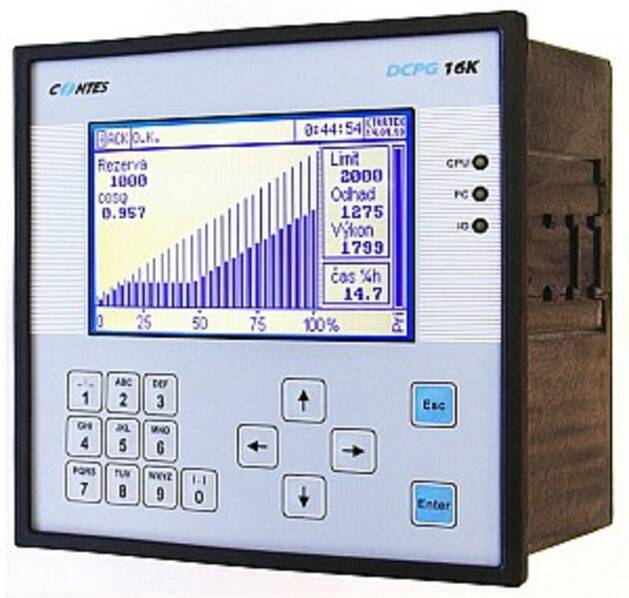
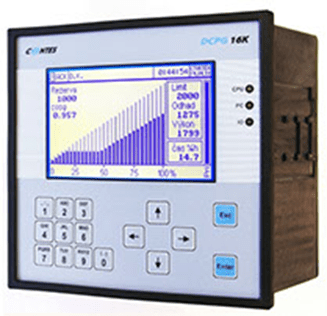
Fig. 1 and 2 – Examples of devices for measuring consumption and 1/4 hour maximum
Only if the above is fulfilled and we have input data, we will create a consumption matrix for the entire heat treatment shop for future consumption planning, and for actual consumption recording, according to what we have measured. The device matrix can be, for example, in the form below, it is only up to the evaluator’s invention.

From the table above, from the values for planning, we can plan the values for the demand diagram with the energy provider, and from the table of actual values, we can then perform other analyses needed to evaluate the energy consumption of our production or to evaluate the efficiency of individual appliances.
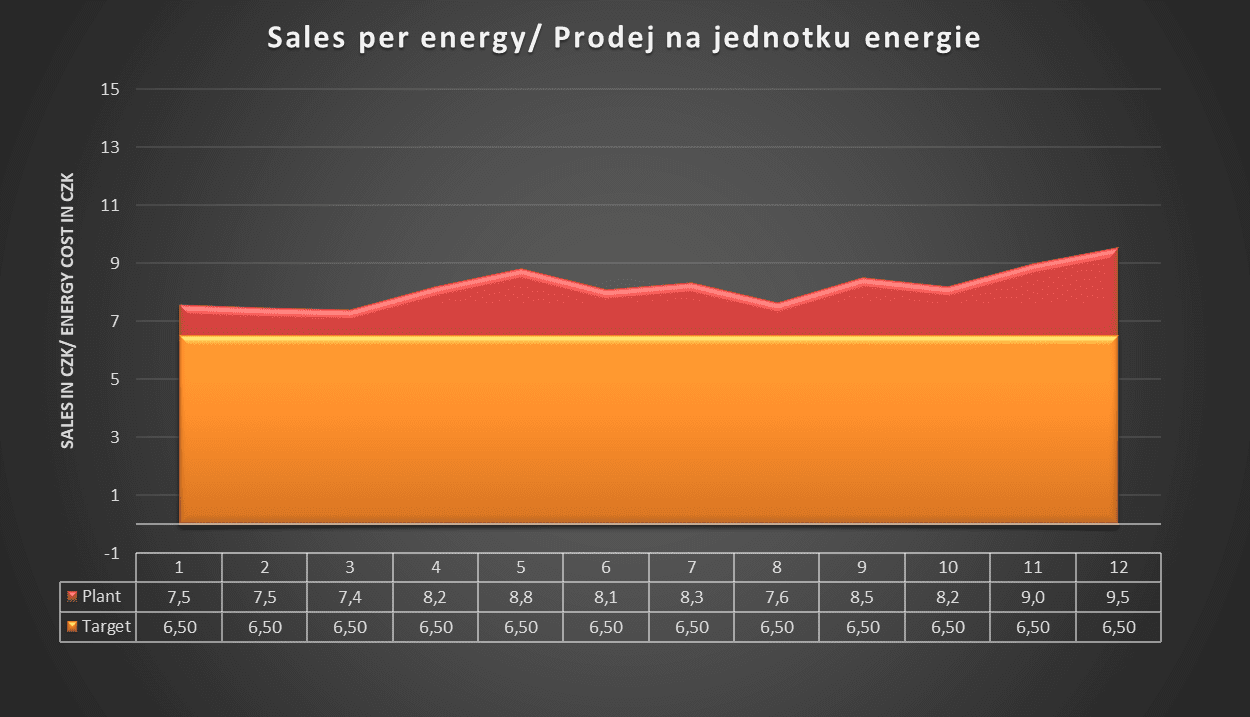
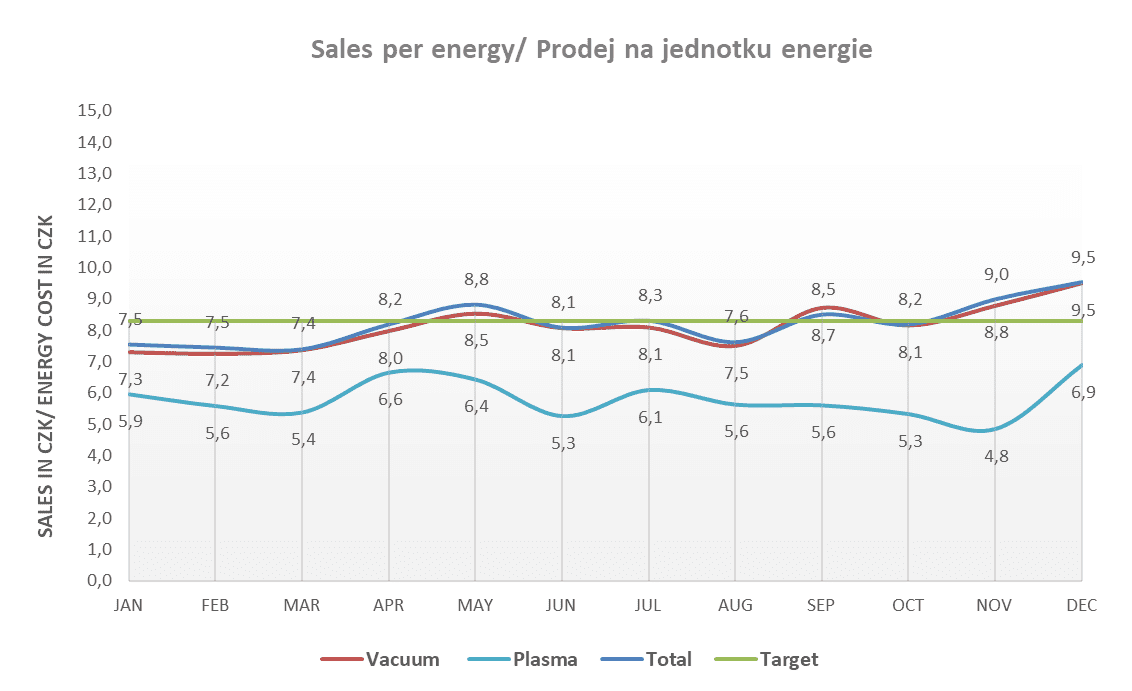
For example just evaluating how much production we make from 1 CZK spent on energy for our thermal processing can be a very simple but illustrative indicator of the success of the heat treatment plant. In our theoretical case, we set an annual goal of obtaining sales of CZK 6.50 from every CZK spent on energy. On the basis of our measures, we can then monitor how this affects the efficiency of the plant. If we measure and have a connection to the ERP system, we can create such a diagram for each furnace involved in the turnover.
The situation is different with reserved capacity. According to the definition, reserved capacity is the contractually agreed value of the maximum quarter-hourly electrical output in kW, which the customer may take from the distribution network at one point of consumption. In practice, this value corresponds to the simultaneous sampling of individual furnaces and appliances in the heat treatment plant, and is an important invoicing parameter. If we negotiated too high values, then we are paying for something we did not take. If we agreed on values that are too low, we risk being penalized for exceeding the agreed values.
We estimate the reserved capacity based on the past, from the supplier’s invoices, but if we want to reduce it in a targeted way, we have to measure it. There is no other option. In practice, this means that in the measurement system we will set our desired value to ¼ of the maximum, and we will put a large display with a copy of the screen and an audio signal in the hall of the heat treatment plant. If in the first minutes of the measured quarter of an hour we begin to approach the state where we would exceed the value, the system will alert us.
Interventions in the furnaces cannot be carried out automatically, no SW currently recognises whether we can intervene in the program of the furnace or not. We have to do this manually or the operators must go around the hall and, where the consumption can be reduced without impacting the resulting technology, they will reduce the start-up ramp in the program step or suspend the heating of the furnace by switching to an extraordinary hold. Central dispatching and control of furnaces from one place is an advantage.
An interesting article on this topic was published on Industrial Heating. Here, the authors dealt with the relationship between the total consumption of the furnace during the warm-up at different heating ramps, and the impact on the reserved capacity.
3 different temperature ramps were tested on a vacuum furnace with a charge of 1000 lb, approx. 500 kg. 10 F/min = 5,55 C/min, 15 F/min = 8,33 C/min a 20 F/min = 11,1 C/min
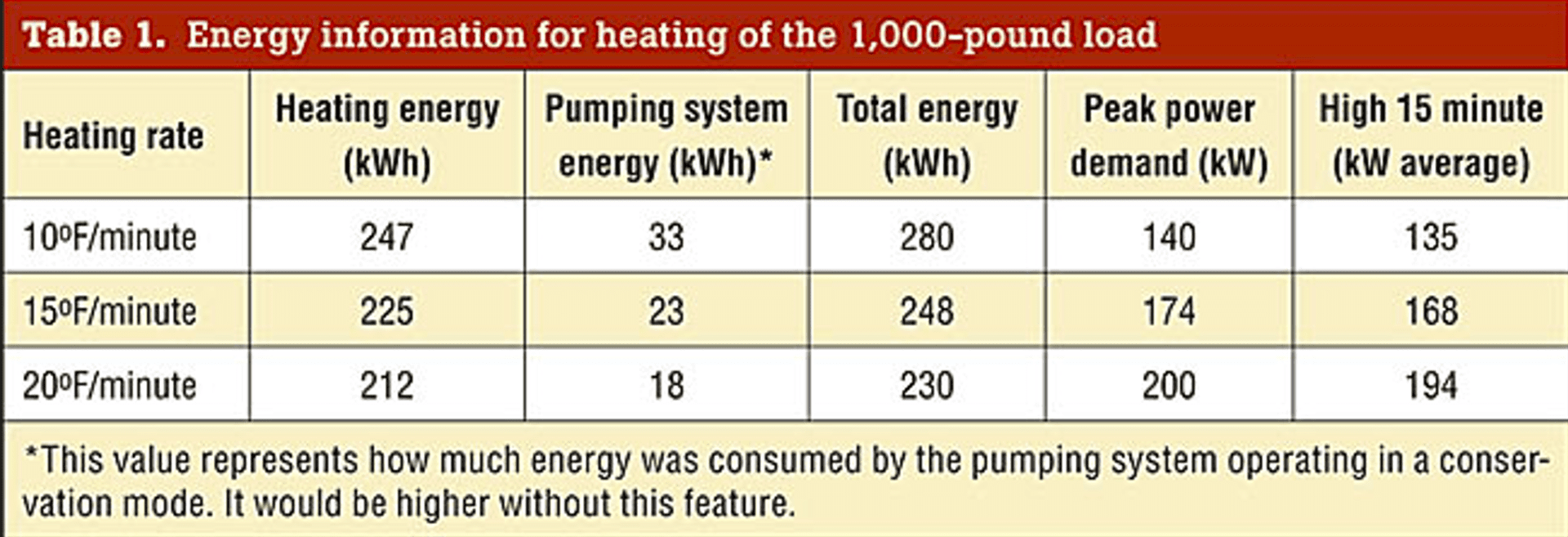
The interpretation of the result is that the highest heating speed of 20 F/min gives lower consumption, because the heating times are shorter, but the ¼ maximum will be up to 194 kW compared to the value of 135 kW at a speed of 10 F/min, i.e. 43.7% higher.
If we use CEZ rates for reserved capacity and an hourly consumption rate of CZK 5/kWh, we get the following values:
VVN – Very high tension, VN – High tension

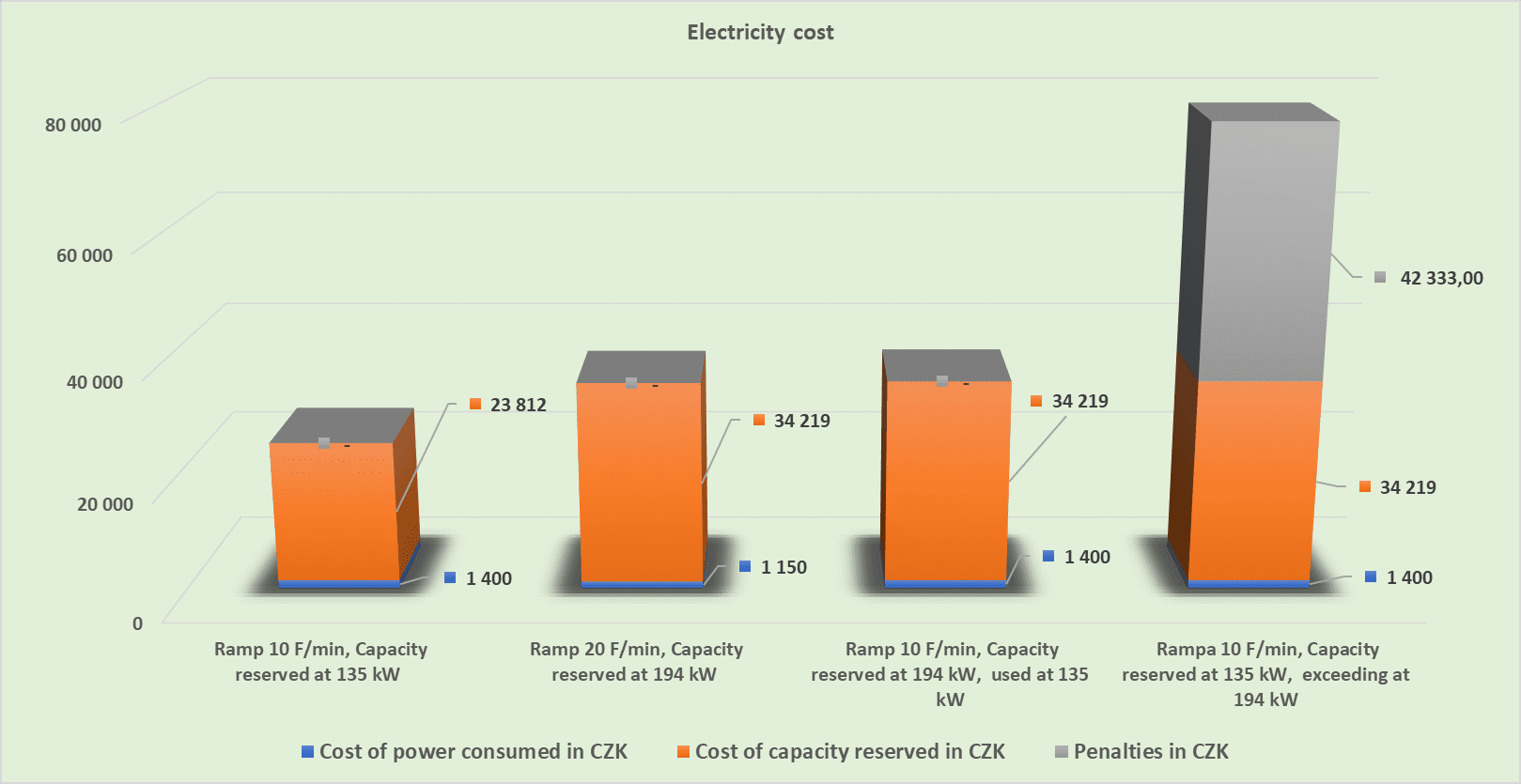
Ramp 10 F/min, reserved capacity at minimum level 135 kW
Consumption: 280 kWh * 5 = 1 400 Kč
Payment for the reserved capacity of 135 kW: 176 388 * 0,135 = 23 812 Kč
Total: 1 400 + 23 812 = 25 212 Kč
Ramp 20 F/min, reserved capacity at maximum level 194 kW
Consumption: 230 kWh * 5 = 1 150 Kč
Payment for the reserved capacity of 194 kW: 176 388 * 0,194 = 34 219 Kč
Total: 1 150 + 34 219 = 35 369 Kč
The result is that with fast heating we will pay (35,369 – 25,212) = CZK 10,127 more than with slow heating.
However, if we exceed the reserved capacity, then the penalty is four times the original value of the payment for the reserved capacity, i.e. not from CZK 176,388, but from CZK 705,552.
If we had a contracted maximum of 135 kW, and I exceed it at the stated 194 kW, then we will pay a penalty of 0.06 x CZK 705,552 = CZK 42,333 from the difference of 194-134 = 60 kW. Therefore, the reduced consumption mode with regard to the low ramp of 10 F/min would be very expensive for us.
However, if we have contracted reserved capacity for 194 kW, and we only use it for 135 kW at a ramp of 10 F/min, then our costs will be 34,219 + 1,400 = 35,619 CZK.
Ramp 10 F/min, with underutilization of the reserved capacity of 194 kW
Consumption: 280 kWh * 5 = 1 400 Kč
Payment for reserved capacity of 194 kW: 176 388 * 0,194 = 34 219 Kč
Total: 1 400 + 34 219 = 35 619 Kč
Ramp 10 F/min with exceeding reserved capacity 135 kW
Consumption: 280 kWh * 5 = 1 400 Kč
Payment for reserved capacity of 135 kW: 176 388 * 0,135 = 34 219 Kč
Penalty for reserved capacity exceeding by 60 kW 705 552 * 0,06 = 42 333 Kč
Total: 1 400 + 34 219 +42 433 = 78 052 Kč
The above calculation shows that for the same technological result we can pay from CZK 25,212 in the best variant to CZK 78,052 in the worst variant. So, it is almost 3 times more. But it can also be seen that in this extreme case with one furnace, the own power consumption contributes to the total cost of electrical energy only from 2 to 4%. The majority of costs are tied to payments for reserved capacity.
With the number of devices and with their consistency in consumption, this ratio improves, even so, ¼ maximum is a very sensitive parameter that we have to be very careful about.
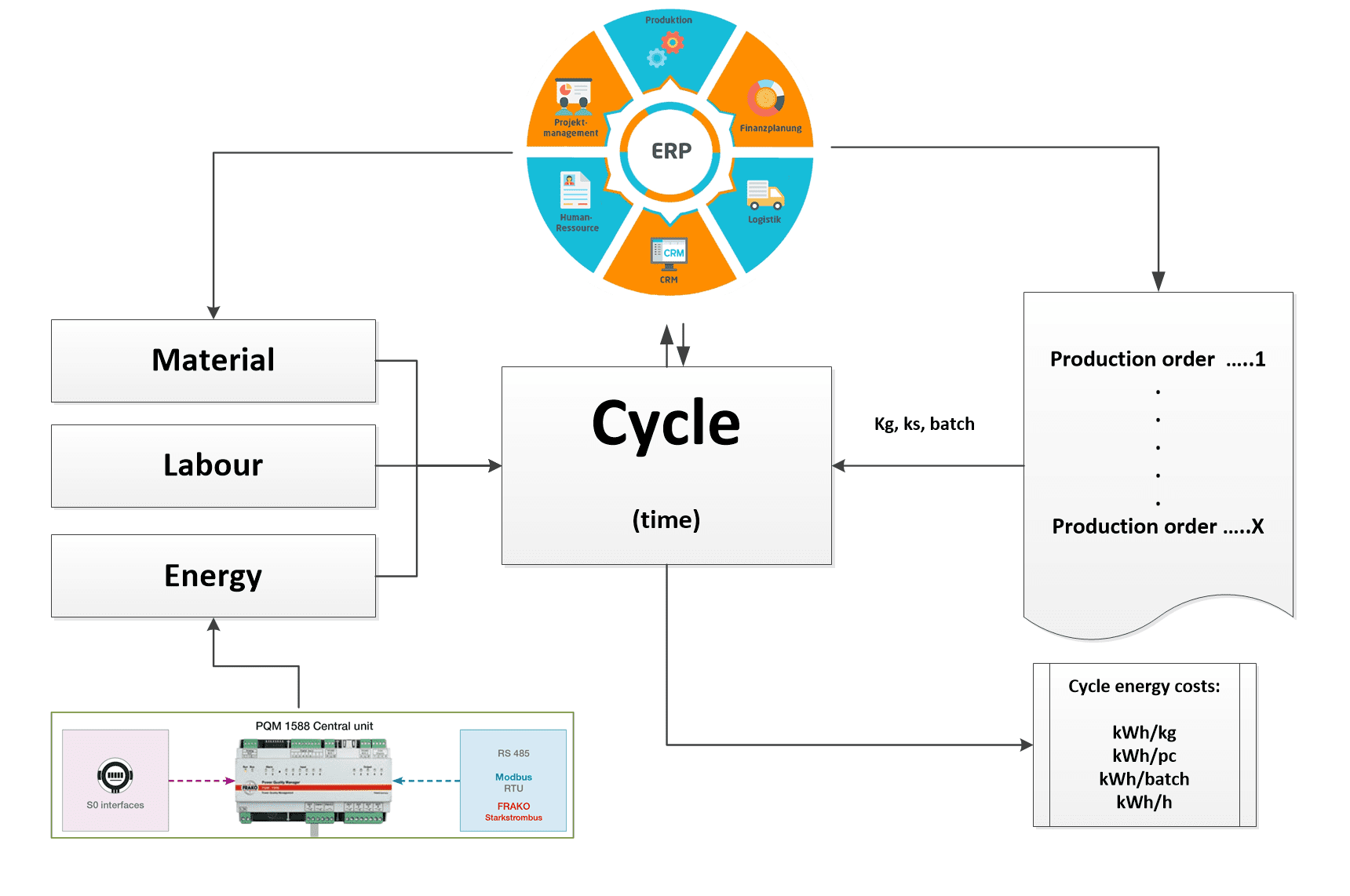
So much for the contractual relationship with the energy supplier. However, if we also want to analyse energy consumption and energy costs per unit of goods, we must have a connection with the ERP system. But the energy measurement itself gives us only one data for our task. The other data must result from the ERP system, where we have data on the batch, weight, and number of pieces.
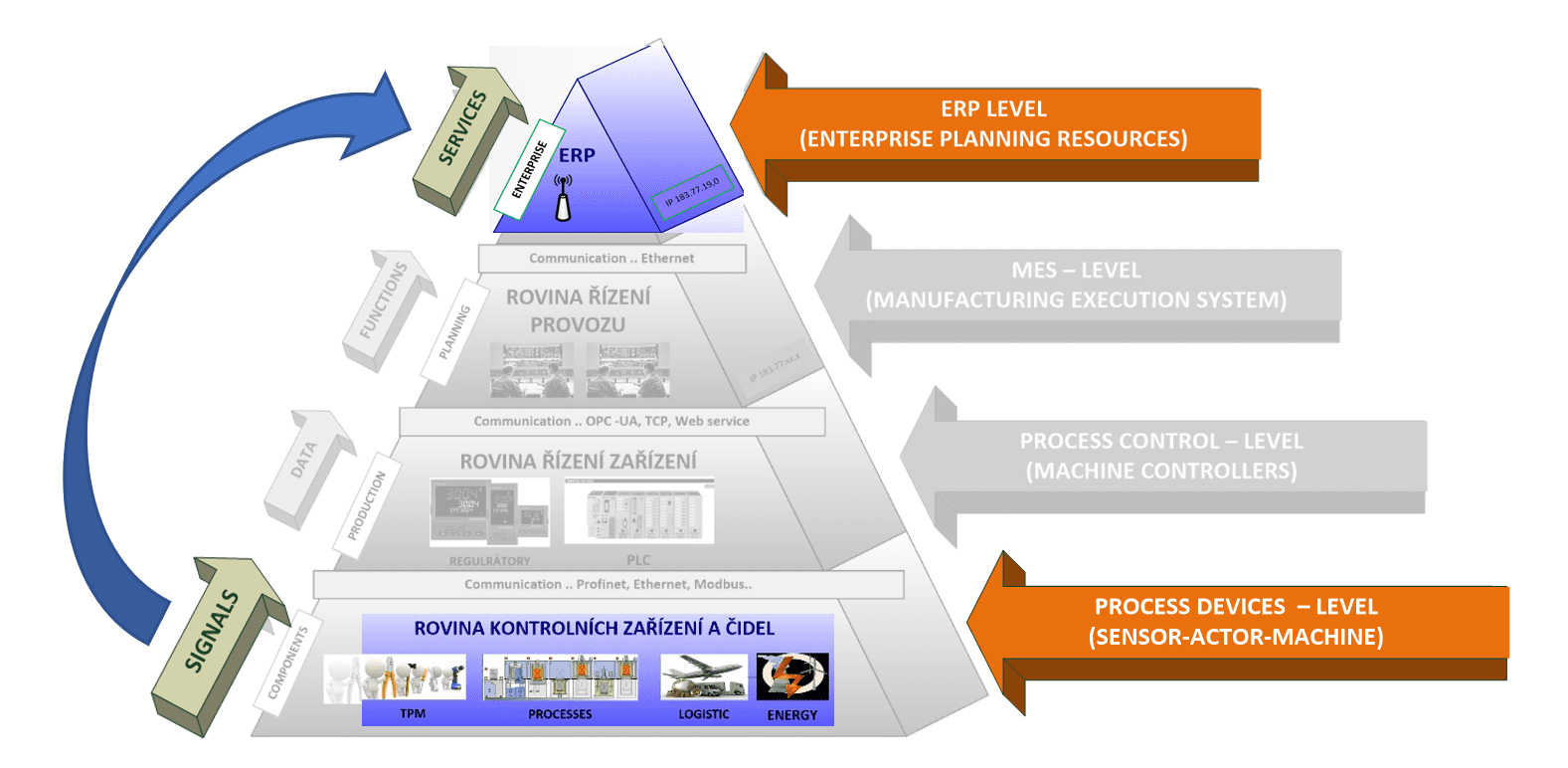
Only if we connect these two levels of data, we get direct access to our task, the calculation of the efficiency of heat treatment in terms of consumed energy in kWh/kg, in kWh/piece, in kWh/hour.
And what should those values be? According to what I blogged about LPC, we should get less than 1 kWh/kg with individual furnaces, optimally 0.5 kWh/kg. The total revenues of the heat treatment shop should be 8.3 times higher than energy costs, which corresponds to a 12% share of energy in revenues. Achievability of such results is shown in the following graph. The data are from 2012. However, since the prices for heat treatment are increasing in proportion to the energy prices, a similar ratio should apply today as well.
January 10, 2023
Jiří Stanislav