Nadca 207 and input material quality control
The vast majority of tool sources producing die-casting molds do not perform an initial material quality control according to Nadca 207. The question is why this is the case when at a foundry association conference, section 06 For die casting, it was stated several times by die casting foundries that the life of the molds is still a critical factor, unpredictable, and in many cases the mold disintegrates without reaching the required life. At the same time, there is an effort to permanently reduce the cost of casting, and as I understand it, savings in pennies are desirable.
The general impression is that this activity can be circumvented by inaction, and we can rely on the steel supplier to supply what is needed and correct without having to control it. But how does this happen in other fields, where the service life of parts has a critical effect on safety and reliability? I am thinking, for example, of cars or aircfrafts. For example, if the production of parts for the aerospace industry behaved in this way, most of us would not even get on that plane.
Few people know that there are a number of standards for the purchase and quality control of steel, and that what the Nadca 207 requires or suggests is not at all unusual. On the contrary. Compared to parts manufactured for the automotive or aerospace industries, the Nadca 207 directly reduces inspection activities to a minimum.
E.g. There is a comprehensive set of ISO standards for steel purchasing and quality control specifications for a variety of applications:
ISO 683-1:2016
Heat-treatable steels, alloy steels and free-cutting steels — Part 1: Non-alloy steels for quenching and tempering
ISO 683-2:2016
Heat-treatable steels, alloy steels and free-cutting steels — Part 2: Alloy steels for quenching and tempering
ISO 683-3:2014
Heat-treatable steels, alloy steels and free-cutting steels — Part 3: Case-hardening steels
ISO 683-4:2016
Heat-treatable steels, alloy steels and free-cutting steels — Part 4: Free-cutting steels
ISO 683-5:2017
Heat treatable steels, alloy steels and free-cutting steels — Part 5: Nitriding steels
ISO/R 683-6:1970
Heat-treated steels, alloy steels and free-cutting steels — Part 6: Wrought quenched and tempered steels with 3 % chromium and 0,5 % molybdenum
ISO/R 683-7:1970
Heat-treated steels, alloy steels and free-cutting steels — Part 7: Wrought quenched and tempered chromium steels
ISO/R 683-8:1970
Heat-treated steels, alloy steels and free-cutting steels — Part 8: Wrought quenched and tempered chromium-nickel-molybdenum steels
ISO 683-9:1988
Heat-treatable steels, alloy steels and free-cutting steels — Part 9: Wrought free-cutting steels
ISO 683-10:1987
Heat-treatable steels, alloy steels and free-cutting steels — Part 10: Wrought nitriding steels
ISO 683-11:2012
Heat-treatable steels, alloy steels and free-cutting steels — Part 11: Case-hardening steels
ISO 683-12:1972
Heat-treated steels, alloy steels and free-cutting steels — Part 12: Flame and induction hardening steels
ISO 683-13:1986
Heat-treatable steels, alloy steels and free-cutting steels — Part 13: Wrought stainless steels
ISO 683-14:1992
Heat-treatable steels, alloy steels and free-cutting steels — Part 14: Hot-rolled steels for quenched and tempered springs
ISO 683-15:1992
Heat-treatable steels, alloy steels and free-cutting steels — Part 15: Valve steels for internal combustion engines
ISO 683-16:1976
Heat-treated steels, alloy steels and free-cutting steels — Part 16: Precipitation hardening stainless steels
ISO 683-17:2014
Heat-treated steels, alloy steels and free-cutting steels — Part 17: Ball and roller bearing steels
ISO 683-18:2014
Heat-treatable steels, alloy steels and free-cutting steels — Part 18: Bright steel products
However, there are a number of standards for the shipbuilding industry, issued by DNV GL (Det Norske Vereitas), or ASTM eg A681-08, Standard Specification for Tool Steel Alloy, focused on the same issues, ie how to properly order material and how to check it before by starting production.
Tab. 1 – Comparison of selected standards
For comparison, we have made a table where I compare the individual control steps for the specifications of Nadca 207, version 2018, DC-9999-1, revision 18, AMTD DC2010, revision L, and DNV-GL standards. The result is in the attached document and can be summarized in the following table

Tab. 2 – Number of control steps according to the selected standard
The Nadca 207 therefore has the lowest number of checkpoints required to order both material and its input inspection, and therefore requires less care than, for example, a gearbox for a car transmission. In addition, Nadca 207, as the only standard, makes it possible to replace all inspection points with an impact test and thus significantly simplify steel quality control for users.
However, this approach also has a huge advantage for the tool manufacturer, because until the result of the impact test is known, the responsibility lies with the steel supplier or the heat treatment supplier, and only when both impact tests are OK does the responsibility pass back to the tool manufacturer.
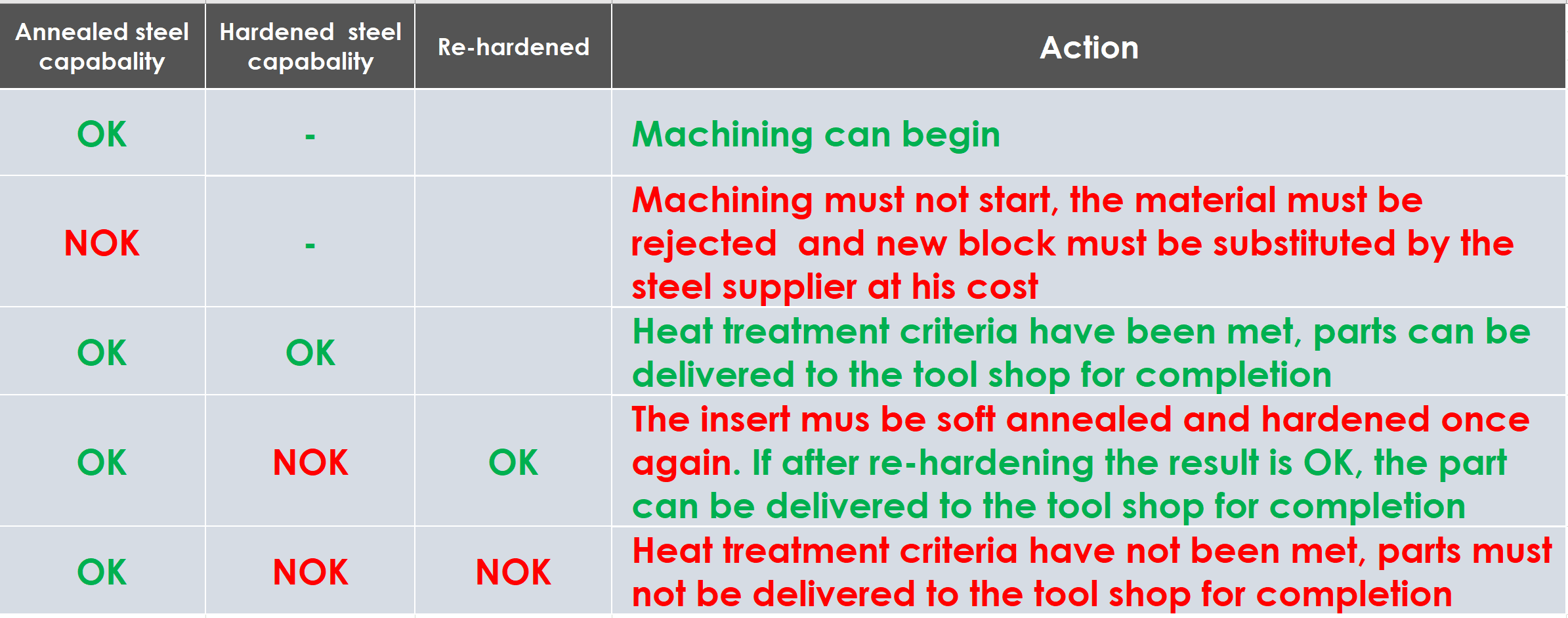
Tab. 3 – Control steps of die casting production processes
So what does this mean? It is therefore necessary to change the behavior of tool shops, or pressure foundries must make sufficient efforts to change the behavior of tool shops. This can be done easily. Correctly specify the purchase contract or work contract for the production of the tool, and insert into it the conditions that must be met by the tool manufacturer.
As can be seen, for example, from the US standard DC-9999-1 for GM, the contractual penalty for non-compliance or non-delivery of the required documentation for individual mold inserts is the delivery of a new, correctly documented insert and a $ 400 penalty for each incorrectly documented insert, deductible from total billing values. According to AMTD-DC2010 for FMC, it’s even $ 1,000.
I have also noticed that tool shops do not work with approved suppliers, even though they should according to ISO 9001. This is also a warning, because they are not able to perceive the need to audit suppliers at all.
Standards DC-9999-1 and AMTD DC2010 state that a temporary supplier is the supplier who passes the input test for material quality or heat treatment, but then a period of 30 to 40 months follows, when the supplier must prove success in material deliveries of more than 88 %, and in the case of heat treatment up to 95%. An approved supplier is then the one who successfully passes the entire test period and at the same time the result of the internal audit confirms that all required criteria are met.
So it’s not just that the steel or heat treatment supplier has to prove its ability to meet the conditions of Nadca 207 once, but it has to achieve it in the long run and the statistics demonstrably.
May 10, 2022
Jiří Stanislav