How do you handle the approval of a heat treatment supplier at GM Powertrain or Ford in the USA?
When I wrote in the last blog about the relationship between Nadca 207 and AMS 2750F, it occurred to me that our tool shops, which produce die casting dies, are not so interested. Their satisfaction is given by the price, deadlines, achieved hardness and the fact that the insert did not crack during hardening. During my entire career working in the field of heat treatment, I do not remember that any of the tool shops in CZ or SK intend to deal with this issue or a detailed audit of heat treatment plants.
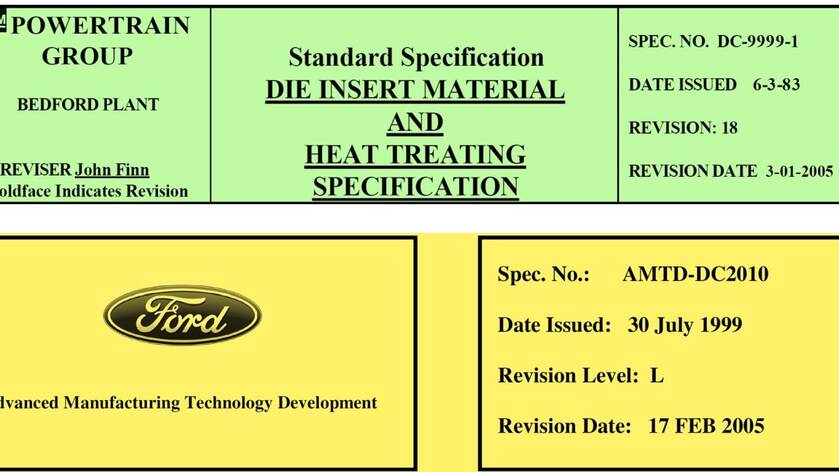
However, because there are above the Nadca 207 specification other in-house standards, like DC-9999-1, now revised 18 for GM Powetrain (GM) and AMTD-DC2010 for Ford Motor Company (FMC), today in revision L, it will probably be good to introduce them here.
Both standards have a lot in common, and when you read this, apart the description of the individual processes as in Nadca 207, these are basically general business conditions for suppliers of steel, tools, heat treatment and testing who want to supply dies for die casting plants GM or FMC.
But there is one fundamental difference between them. In the first case, I mean DC-9999-1 standard, the entire process is controlled by a GM die casting plant. In the second, following AMTD-DC2010 standard, by approved tool shop.
In both cases, terms are introduced – a provisional source and an approved source. The provisional source is not an approved source, it is only a source that demonstrates intention to meet the customer’s criteria, but does not yet have a sufficiently long history of statistically demonstrable results on die casting dies to confirm its capabilities.
An approved source is the source that obtains the “Approved Supplier” certificate after completing the test period.
In addition, for steel suppliers, they can only supply steels from the approved list of hot working steels, and at the same time they must be its producers. It is clearly prohibited for an approved or provisional steel supplier to supply steel outside the list of approved steels, as well as steel that has not been produced by them but has been purchased from another manufacturer and subsequently sold to GM or FMC. If an approved or provisional steel supplier wants to sell a new type of steel, he must first have it certified by GM or FMC.
A provisional or approved heat treatment supplier is a source that owns GM or FMC approved furnaces. In no case is it not allowed for the heat treatment to be carried out in another heat treatment plant, even within one company, or in furnaces which have not undergone the approval process
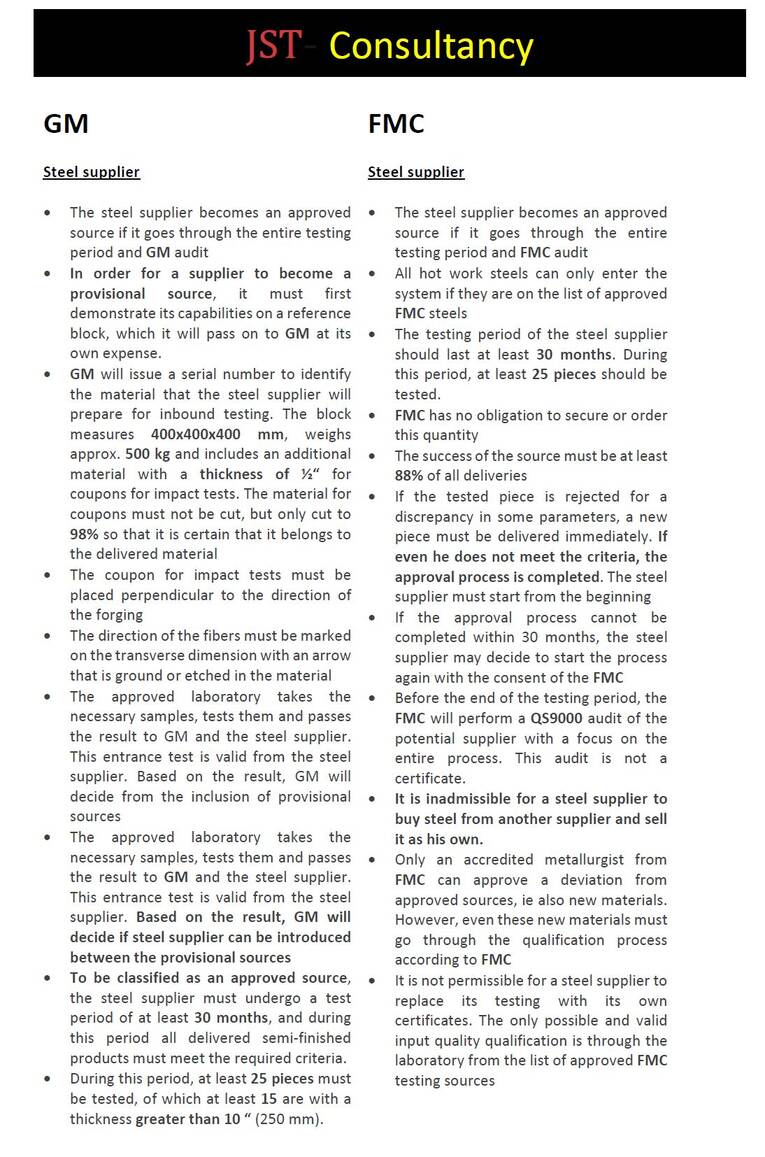
I tried to compare both specifications:
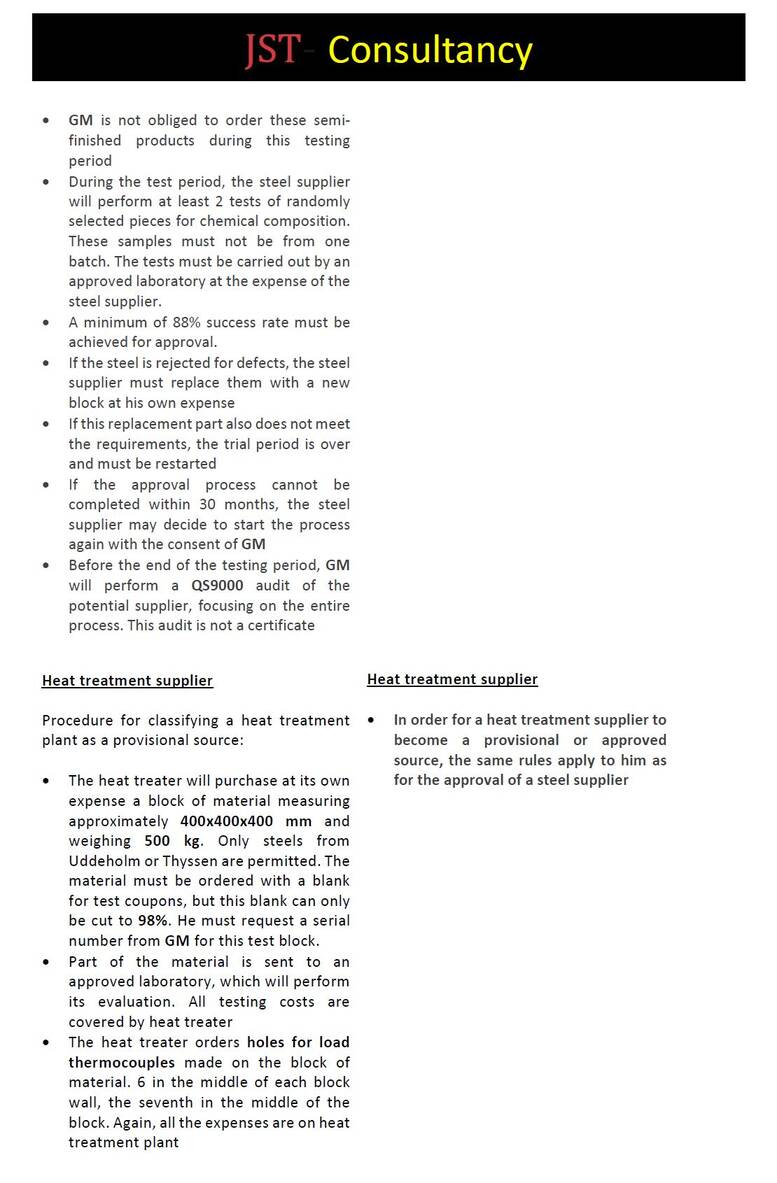
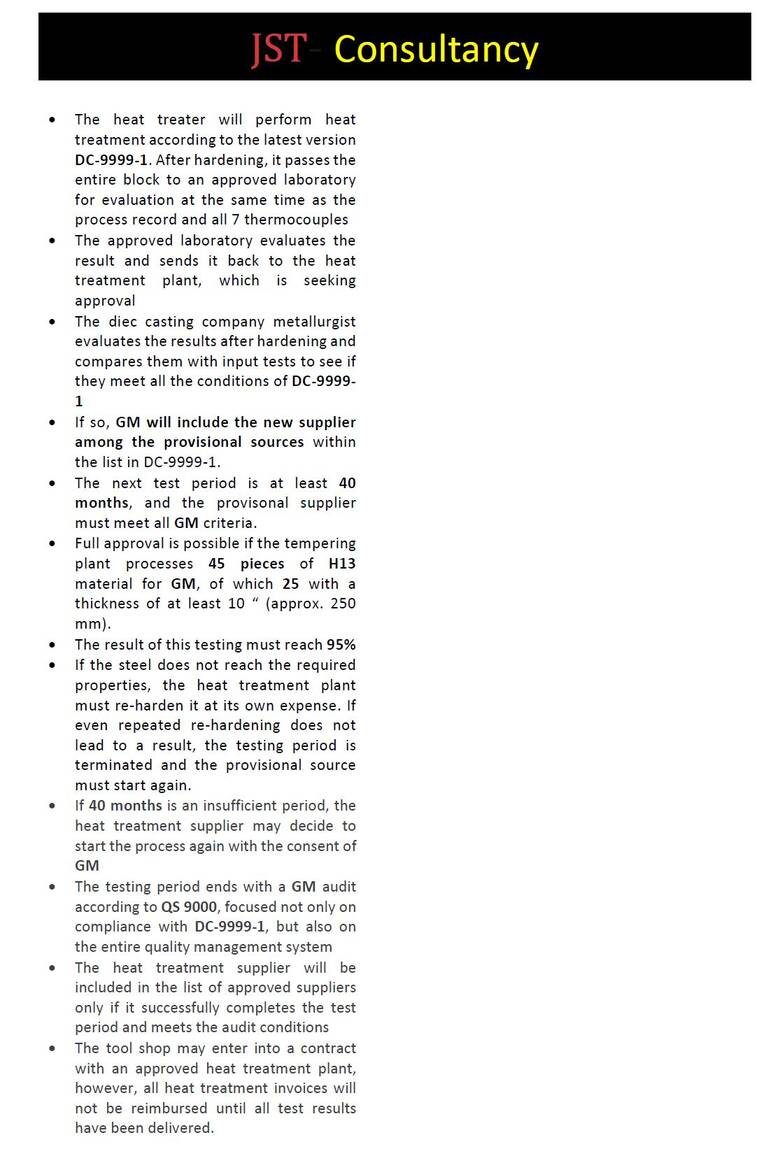
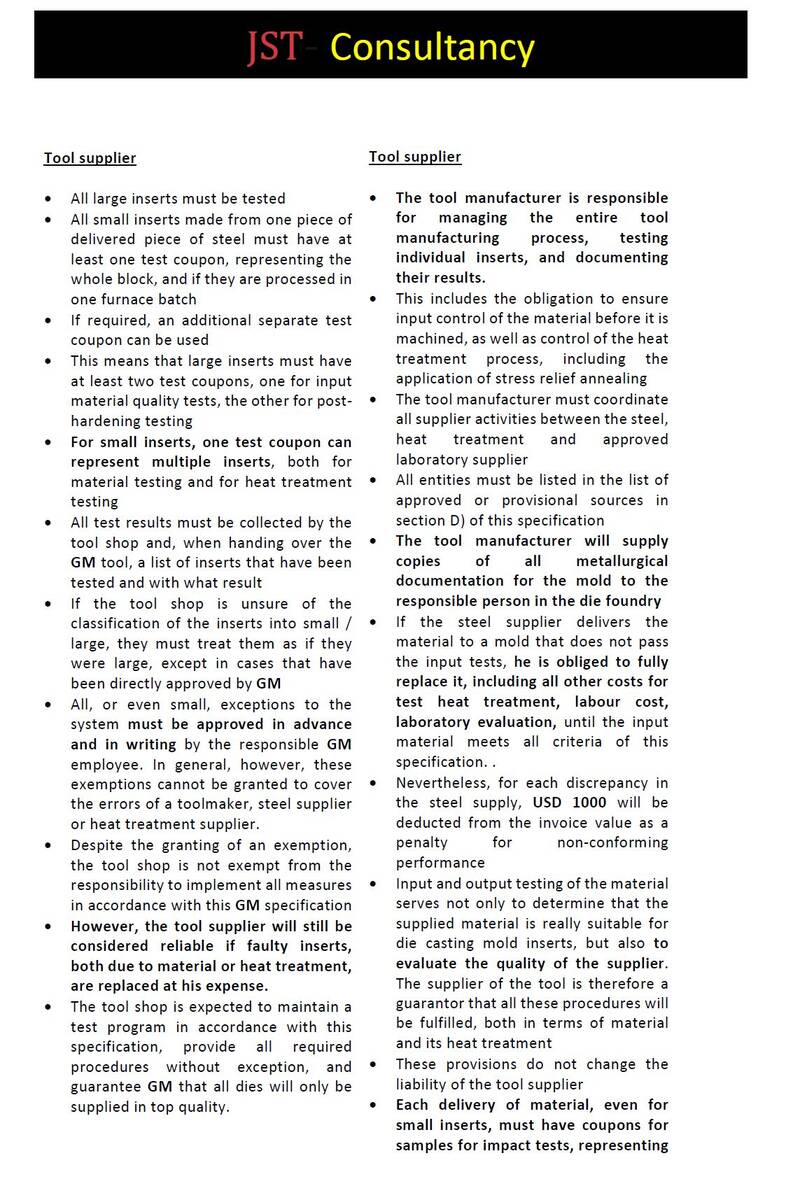
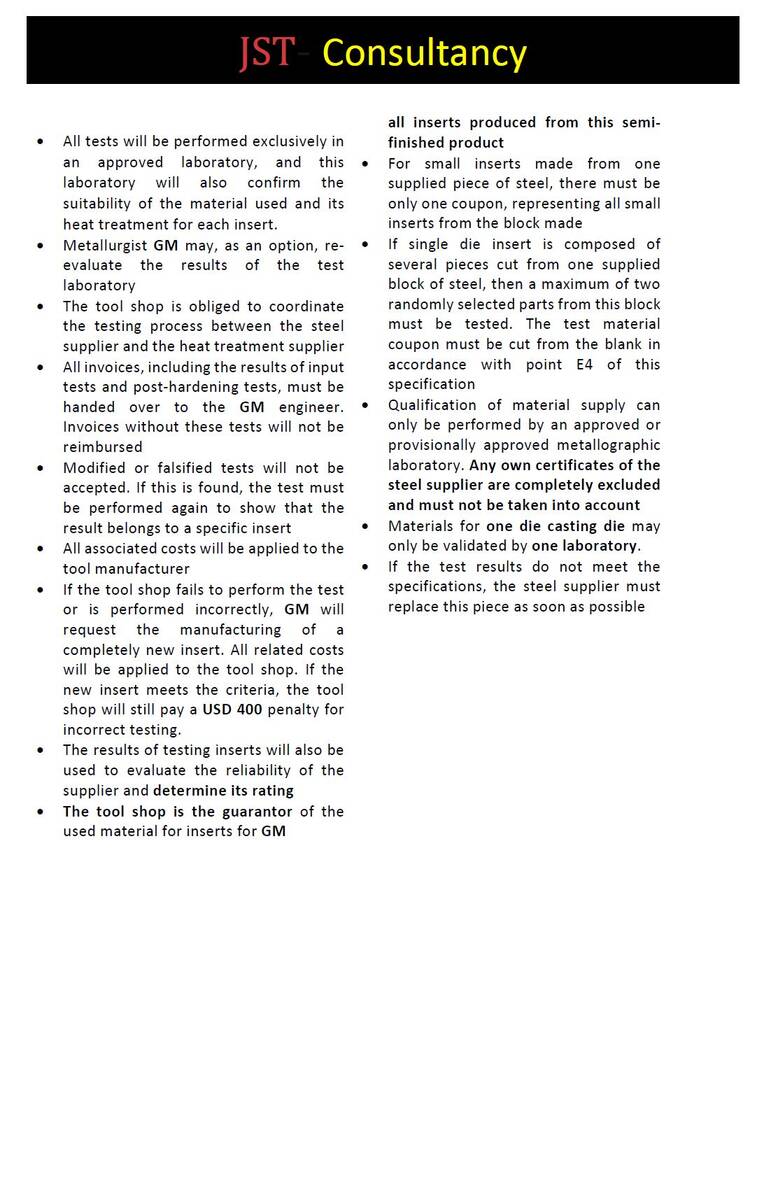
What to say in conclusion? From the citation of the above specifications Nadca 207, GM and FMC it can be seen that a great weight of responsibility for the quality of dies lies with the tool shop, respectively, it is precisely the tool shop that has significant powers in the process of manufacturing die casting molds, even towards the heat treater. .
Both specifications differ only in details and it is difficult to say which one is more significant. GM requires 9 bar overpressure and cooling rate of. 35 °C/min, but grain size 7, FMC then 28 °C/min but grain size 9. For GM, therefore, the choice of furnace for heat treatment will play a bigger role, for FMC then the choice of steel.
Although the significance of the furnace qualification according to AMS 2750F is not emphasized in these specifications, because the approval process is based on the compliance of impact strength before and after hardening with the values according to the specification, it is quite evident that these values will be very difficult to achieve on vacuum furnaces not validated in the conformity to AMS 2750F.
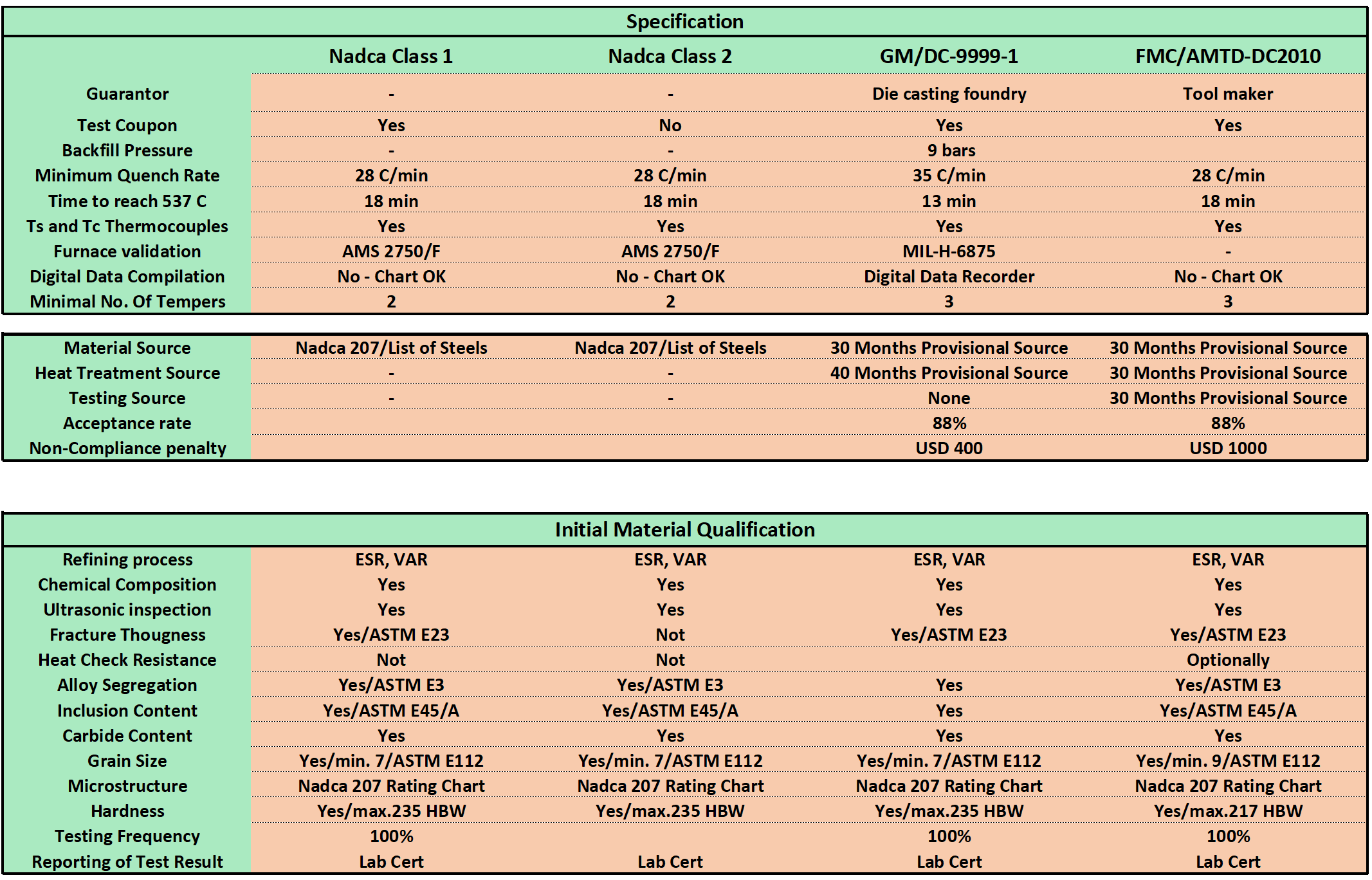
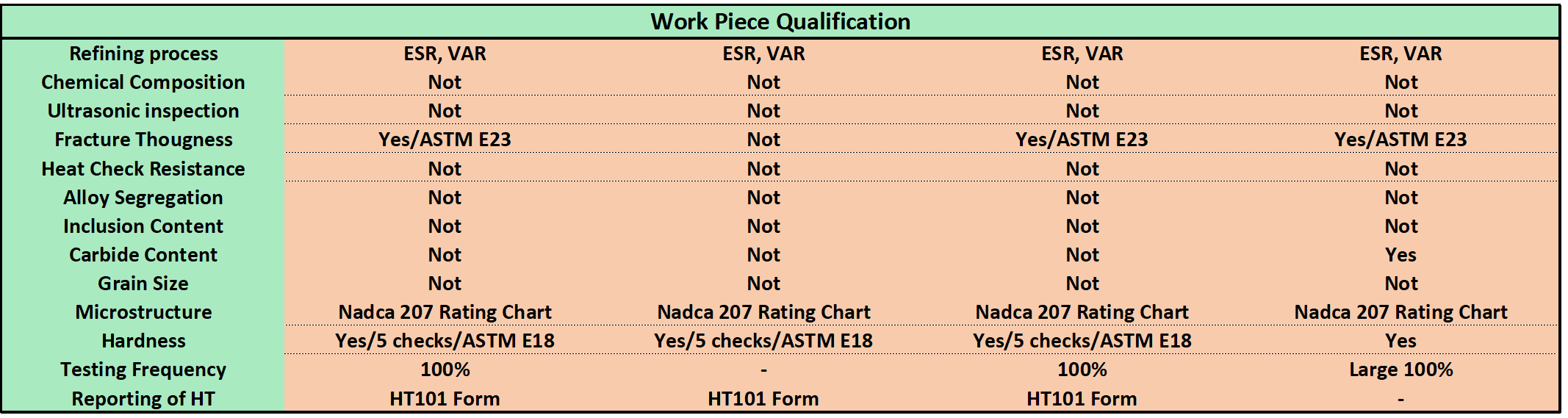
Tab. 1 – Comparison of requirements of individual specifications
6th of October, 2021
Jirka Stanislav