Furnaces for heat treatment of titanium alloys after 3D printing
Last week I attended a webinar on 3D printing for medical applications. Among other things, Mr. Dalibor Vojtěch from the Institute of VŠCHT in Prague gave a presentation on the topic “Influence of the furnace atmosphere on the processing of titanium alloys after 3D printing”. He used his publication as a source, which can be found here:
https://www.researchgate.net/publication/325122192_Thermal_Treatment_of_3D-printed_Titanium_Alloy
https://www.journalmt.com/pdfs/mft/2018/02/10.pdf
Although I only subsequently discovered that this was a publication dating back to 2018, I was very pleased with the result. What was it? Because titanium in the composition Grade 5, ie Ti6Al4V, is usually used for medical applications, after printing it is necessary to anneal the material to improve and homogenize its structural properties. It is mainly about eliminating internal stresses and improving the plasticity of the material
But what about the environment in which this thermal operation can be performed? Usually, those who print have simple chamber furnaces without a protective atmosphere. Another type of furnaces are muffle furnaces with the possibility of processing parts after 3D printing in a gas-tight box under a protective atmosphere of nitrogen or argon, and last but not least we can also consider furnaces with a gas-tight retort, when the retort can also be evacuated, with subsequent filling of 5.0 purity gases such as nitrogen or argon.
In the above work, all 3 options were compared. The annealing was performed in different types of furnaces
- without protective atmosphere in air (resistance muffle furnace Martínek MP05)
- with a flow of inert gas Ar 5.0, with samples inserted into a graphite box, subsequently covered with titanium chips to improve the purity of the atmosphere by means of the getter effect of titanium (muffle furnace Svoboda 018 ZP80)
- in high vacuum 1 * 10-5 mbar (vacuum furnace Xerion XRETORT)
The aim was, on the one hand, to find out under which conditions the surface does not oxidize and, on the other hand, how this layer of oxides affects the mechanical properties. And what was the result?
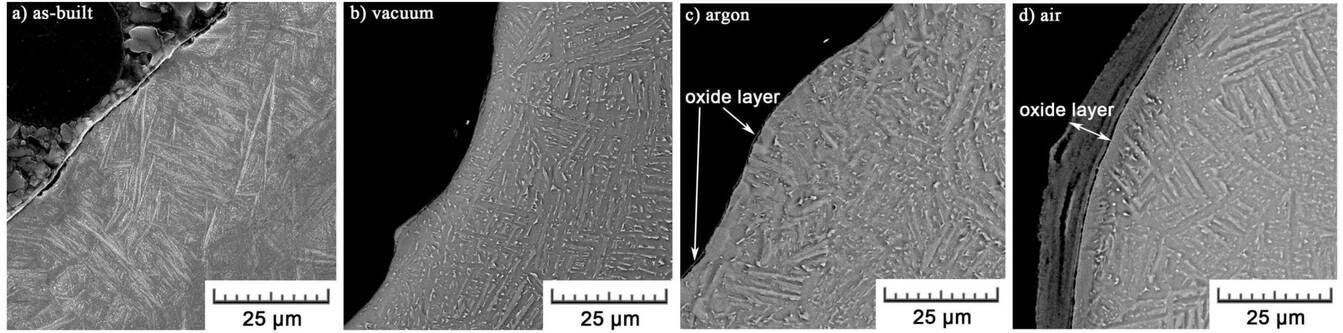
Fig. 1 – Surface layer metallography
a) as – built, b) heat treatment in vacuum 1*10-5 mbar – no oxide layer, c) heat treatment in muffle furnace with gas-tight box and with argon 99,999% – layer TiO2, Al2O3, V2O5 o tl. 0,3 +/- 0,1 µm, d) heat treatment in muffle furnace on air – layer TiO2, Al2O3, V2O5 o tl. 9,0 +/- 4,5 µm [1]
In addition to the result of oxidation being reflected in increased hardness, the oxide layer also affects other mechanical properties of the material. Although in all cases both the yield strength Rp and the yield strength Rm decrease, which is desirable, the oxide layer mainly affects the relative elongation A (%). Its presence means a reduction in the elasticity of the material by up to 50%. In the case of argon processing, the affected layer was 45 µm, in the case of air treatment then 60 µm.
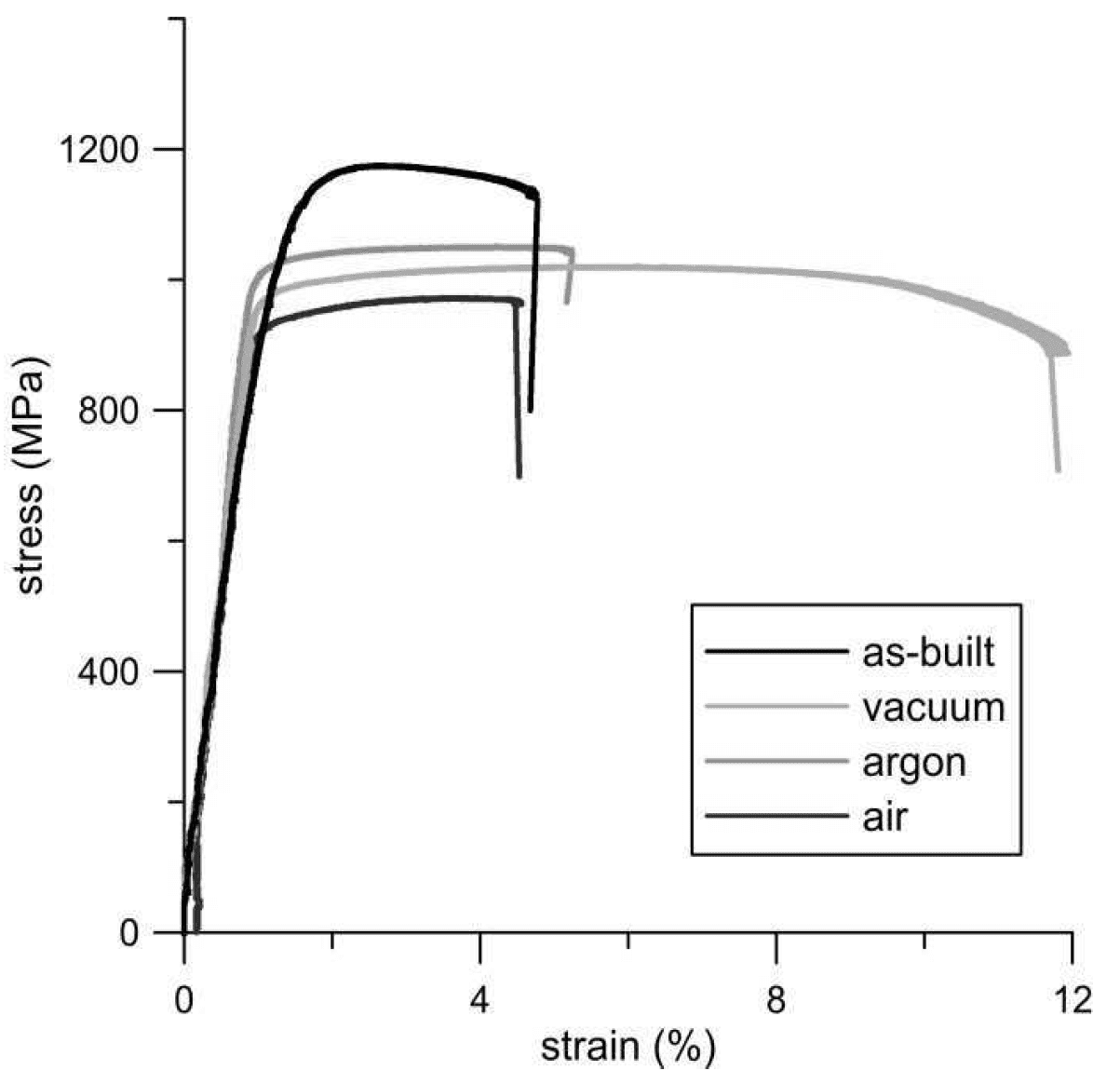
Fig. 2 – Dependence between stress and relative elongation
How do you explain that? In the case of a vacuum furnace, the residual atmosphere is 1 * 10-3 Pa. Because it is a residual air atmosphere, 78% is nitrogen, 21% oxygen and 1% residual gases. Another participant in the process will certainly be water vapor absorbed on the walls of the furnace, but we will not consider this yet. However, since we are in the order of 10-3 Pa, the individual gases will be present with a partial pressure of the order of lower, ie 10-9 Pa.
Because we work with a high vacuum, we must also consider the leaks of the working chamber. In this case, however, if we maintain a working pressure of 1 * 10-3 Pa throughout the process, the leakage will have no significant effect on the result, provided that the pumping speed of the system combined primary pump, Roots pump and diffusion or turbomolecular pump is greater than leaks flow rate.
If we have 1 ppm of oxygen in the atmosphere (1 / 1,000,000 = 10-6 bar), then it is approximately a partial pressure of 10-1 Pa, because 1 Pa = 1 * 10-5 bar. However, since due to working pressures (1 * 10-5 mbar = 1 * 10-3 Pa) we have oxygen in the order of 10-9 Pa, then this value will represent a value in the order of 10-8 ppm. So very small.
However, once we use a muffle or retort furnace with an argon flow, albeit with a purity of 99.999% (Ar 5.0), the situation is different. The sum of H2O, O2 and CO2, which will form oxides, is about 5.5 ppm in units of volume. With regard to the above, we will therefore permanently release into the retort about 5.5 * 10-1 Pa partial pressure of oxygen, water vapor and CO2, ie a value about 550 000 000 times higher than in the case of pure vacuum.
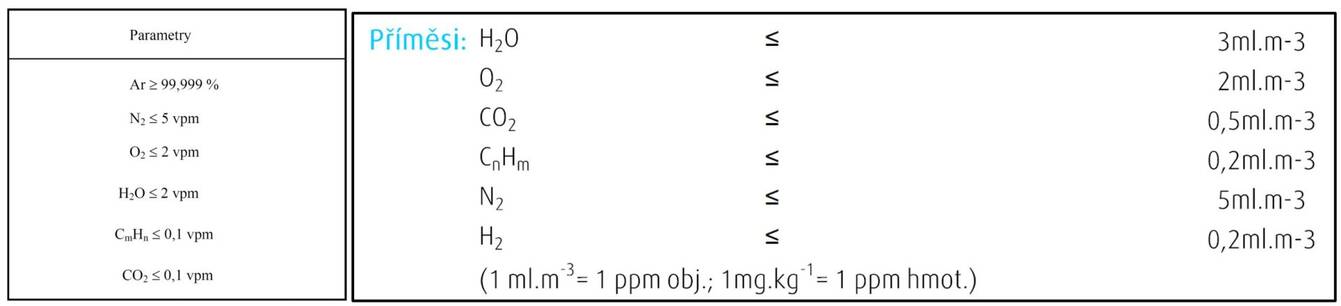
Tab. 1 – Argon 5.0 purity from Messer Technogas or Linde Linde in volume units ppm
We must also take into account that even if the retort or muffle is vacuumable, then desorption requires not only a high vacuum but also a high temperature above 1100 C. This is usually not possible and therefore the necessary purity of the residual atmosphere, necessary for the processing of titanium alloys without surface oxidation, precisely because desorption is not possible. Even in the case of using argon with a purity of 6.0, ie 99.9999%. Even this super pure argon contains about 1.1 ppm O2, H2O and CO2, and these are therefore 100 000 000 times higher values than in the case of high vacuum 1 * 10-3 Pa
Another obstacle is that with this type of device it will be very difficult to look for leaks, when it is possible to assume the formation of microcracks in the retort wall during long-term thermal loading.
What does this mean? If we really want to heat-treat titanium parts after 3D printing without oxidation, we have to go to the furnace, which has furnaces for the required temperature, in the range of 700-1000 °C, and at the same time has a diffusion pump to ensure a high vacuum. As can be seen from Figure 2, it is not just that the parts are colored by interfering colors of the TiO2 layer, but we mainly lose mechanical properties. Even the allowance of argon partial pressure, usually used to prevent evaporation of some elements in high vacuum, cannot be used, because even Argon 5.0 with a purity of about 5 ppm has enough oxygen and water vapor to oxidize the Ti6Al4V surface.
This can certainly be solved by fully machining the surface after heat treatment, but this is not always possible in all applications.
Another apparent possibility is the use of hydrogen as part of the process, and its high reactivity with oxygen and steam, as is used in EXO atmospheres. In that case, some gas would be charged into the gas-tight box or retort at the same time as argon. However, in addition to the need to ensure that such an atmosphere burns out at the furnace outlet, there is another problem. According to ASTM F2924-14, the maximum H2 content in Ti6Al4V is 0.015% by weight. At the recommended operating temperatures from 750 to 950 °C, hydrogen will diffuse into the material and the permitted value in surface wells will certainly be exceeded. The subsequent de-hydrogenetion process would be so time consuming that it is unnecessary to consider this option [3]. Similarly, all hydrocarbon-based atmospheres will be eliminated, and nitrogen will be eliminated as a protective gas, meaning nitriding of the surface of the parts.
So what should such a furnace for processing Ti6Al4V after 3D printing look like? In particular, it should meet the parameters of AMS 2801 [4]. The size of the working space will be determined by the size of the printing platform, eg 250 x 250 x 325 mm for EOS M290, diffusion pump is a must, molybdenum heating elements can be recommended, as well the inner walls of the heating chamber in molybdenum for better desorption of the furnace, and cooling argon overpressure up to 2 bar . To ensure the purity of the gases, the furnace must be equipped with on-line dew point measurement at the gas supply, automatic leak test, process control from batch thermocouples, etc. An example is shown in Figure 3:
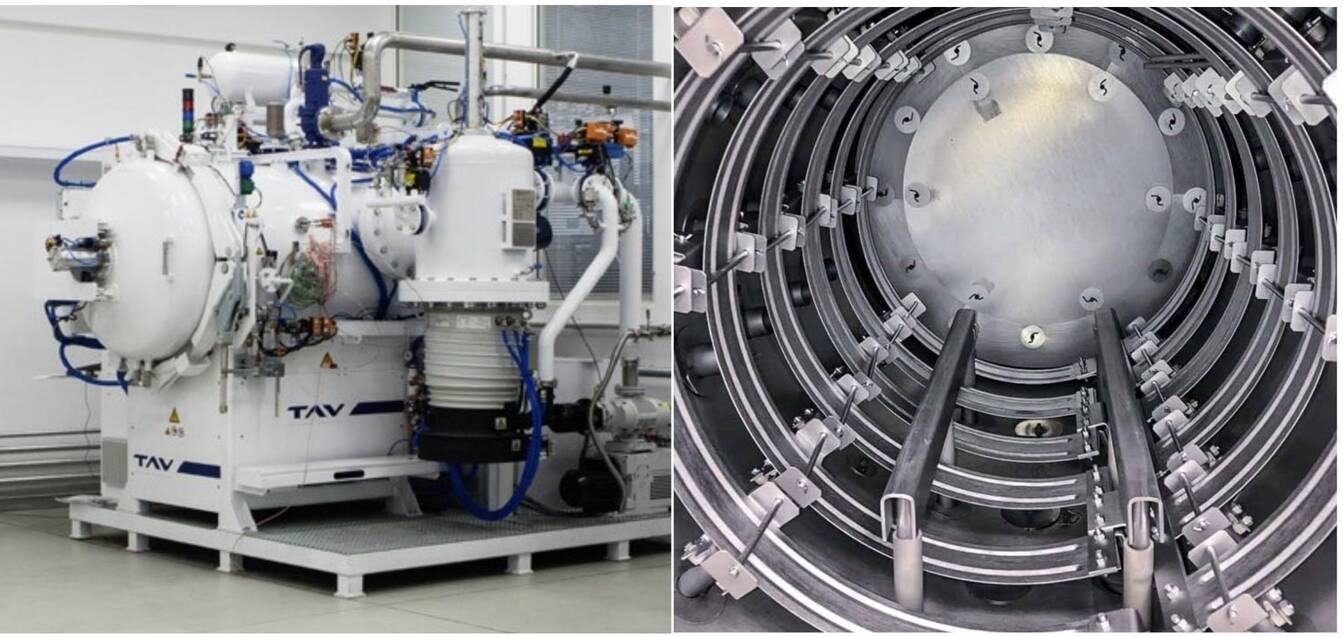
Fig. 3 – Example of the furnace for AM production
It is therefore a very sophisticated device, but ensuring perfect, reproducible heat treatment of AM production.
[1] Thermal Treatment of 3D printed Titanium Alloy, Manufacturing Technology, Michaela Fousová, Dalibor Vojtěch, April 2018, ISSN 1213-2489
[2] ASTM F2924-14 Additive Manufactured Ti 6Al 4V With Powder Bed Fusion
[3] Optimization of the Mechanical Properties of Ti6Al4V Alloy Produce by Three Dimensional Additive Manfacturing Using Thermomechanical Processes, Guney Bilgin, Middle East Technical University, Turkey, 2017
[4] AMS 2801 – Heat Treatment of Titanium Alloy parts, rev. B
February 27, 2022
Jiří Stanislav