AM Ecosystem for Defence, Aerospace and Medical
AM technologies have enormous development potential, but they come up against a supply chain where securing any part means logistical hell (AM → HIP → HT → machining → NDT → surface treatment). In this field, it is no longer possible to do business within the framework of individual technology, but a workplace must be created that provides a comprehensive solution, ensuring:
- guaranteed part properties
- reduced lead time
- one partner who guarantees the result
OEMs want one partner, and it doesn’t matter if it’s an aerospace or automotive OEM. Everyone is pushing for
- shortened supply chain
- reduced risk
- guaranteed part propertiesdigitalized traceability
A full service additive center should be able to:
- Design & topology optimization
- Material selection and simulation
- Printing (outsourcing or in-house)
- HIP
- Vacuum HT / LPC / FCN / HPGQ
- Brazing / surface treatment
- NDT (CT scanning, RT, UT)
- Certification and documentation
- Series production
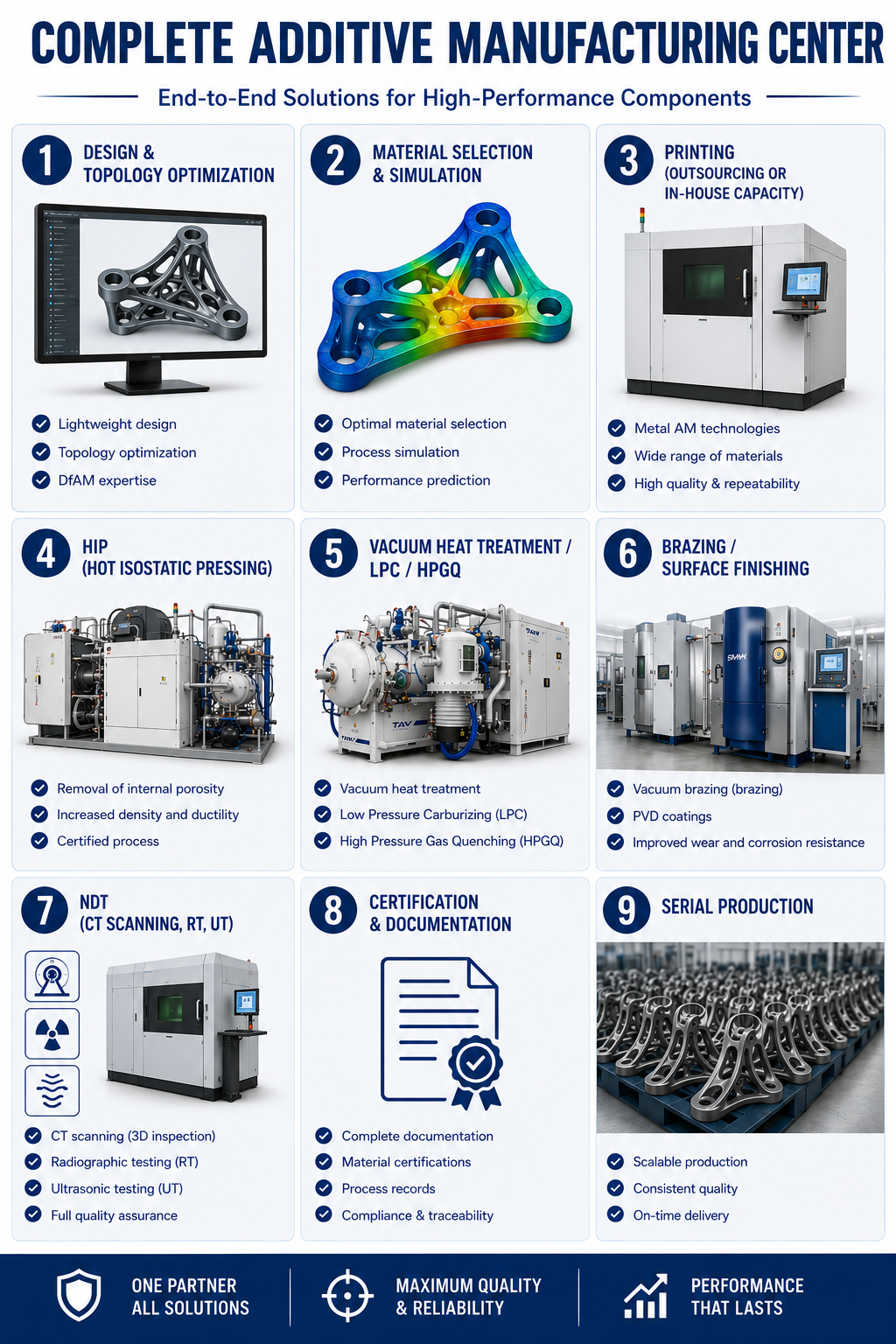
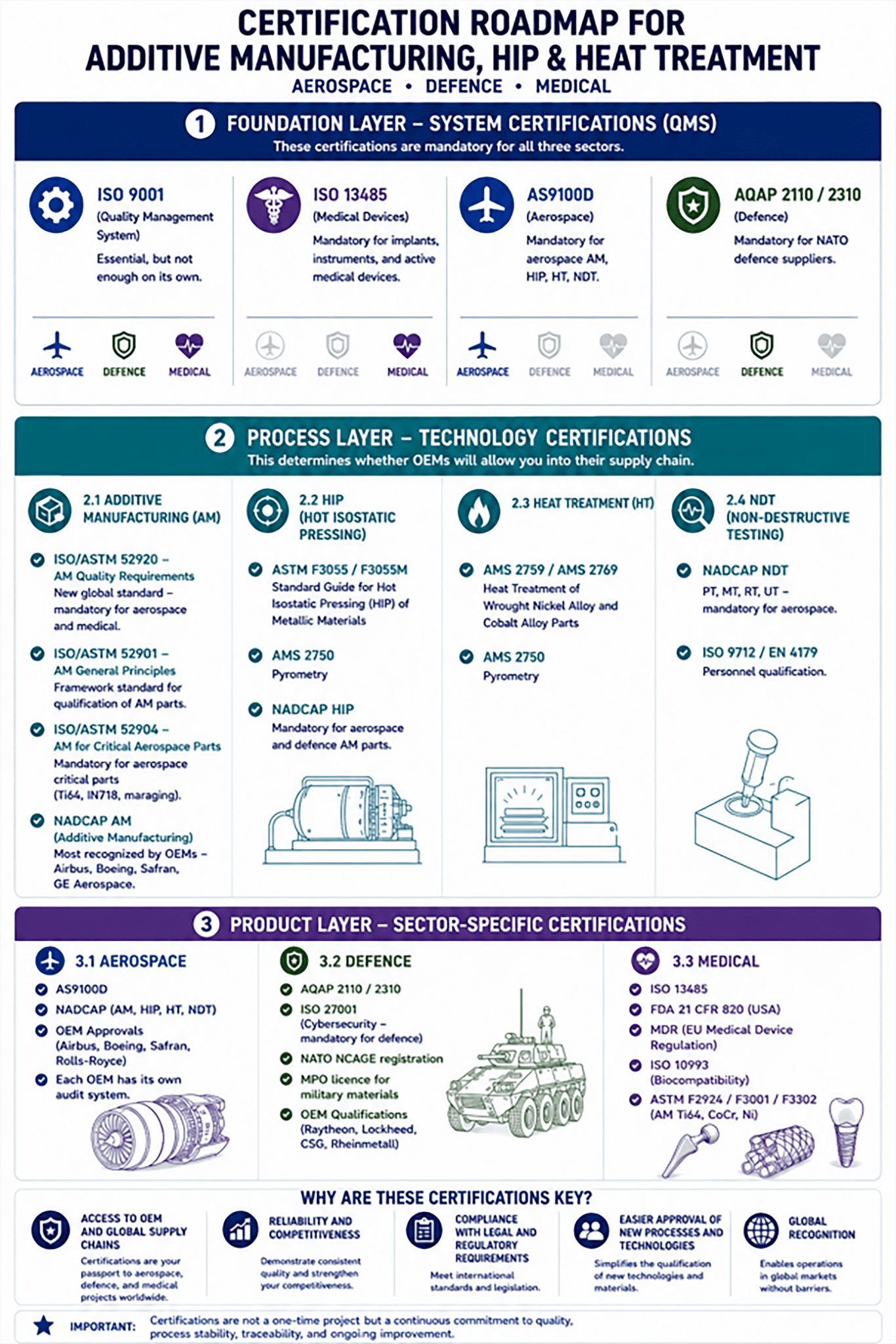
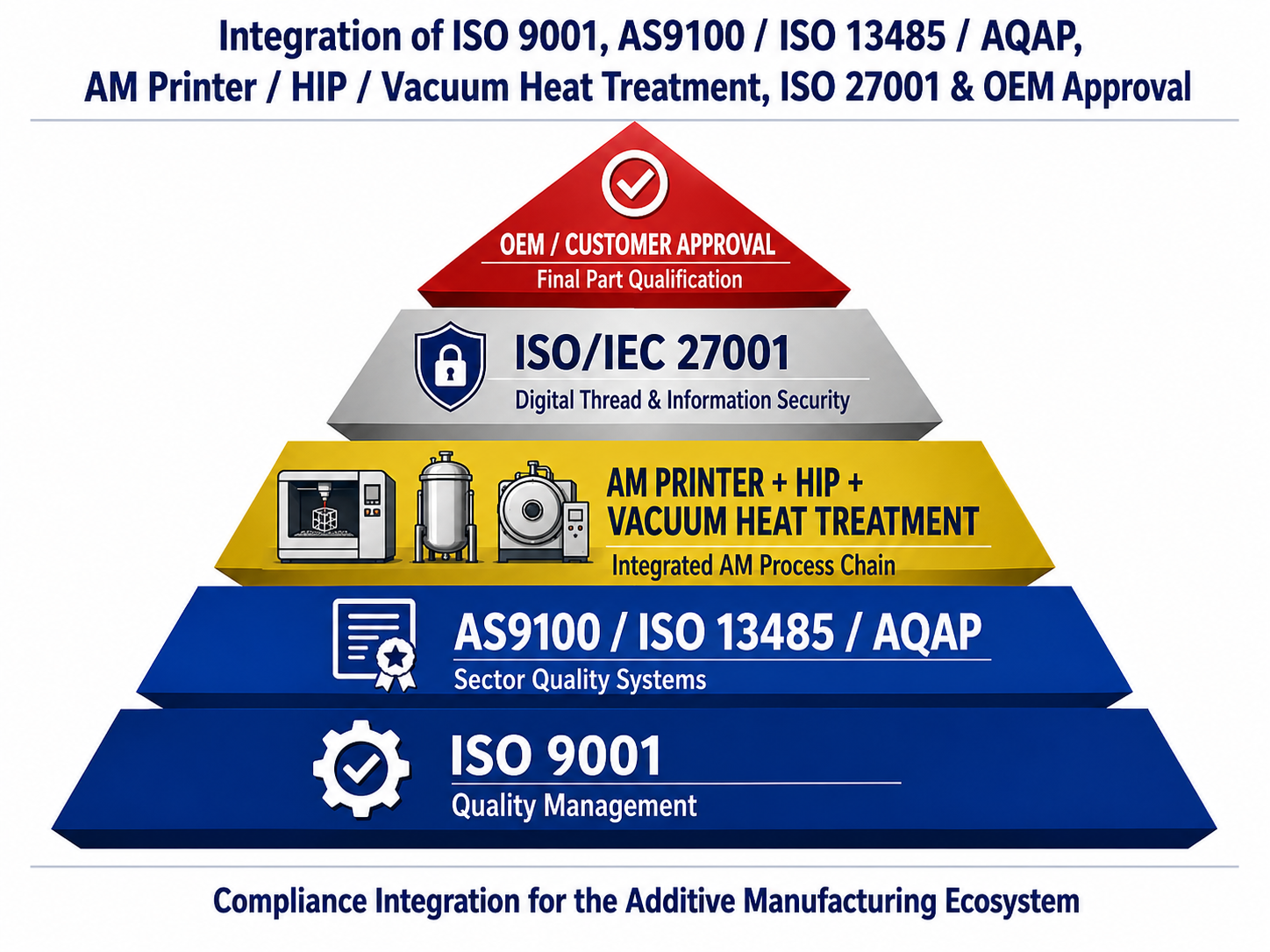
Fig. 1 – Additive ecosystem process chain
Fig. 2 – AM Center Road Map
Fig. 3 – Quality Pyramid for the AM Ecosystem
Although a custom heat treaters owns HT post-process equipment, it usually does not own a printer, HIP and NDT. I think that this non-systematic approach significantly reduces the reputation and benefits of AM technologies. At the very least, it will have a negative impact on the medical sector, where the availability of HIP and lead time is very important. The patient simply cannot wait. But other fields have the same problem. A well-known example is the business of cast turbine blades that are sent thousands of kilometers away to HIP in Bilbao or Sint-Niklaas in Belgium.
I see huge future potential for this, and I’m curious to see which commercial heat treater will take it on. And if it will not be anyone with the existing TOP 10 list, then those who print must do it. There is probably no other way in this field. If powder technologies are to make sense in the future, then only as a comprehensive service of manufacturing AM parts for aerospace, energy, medical.
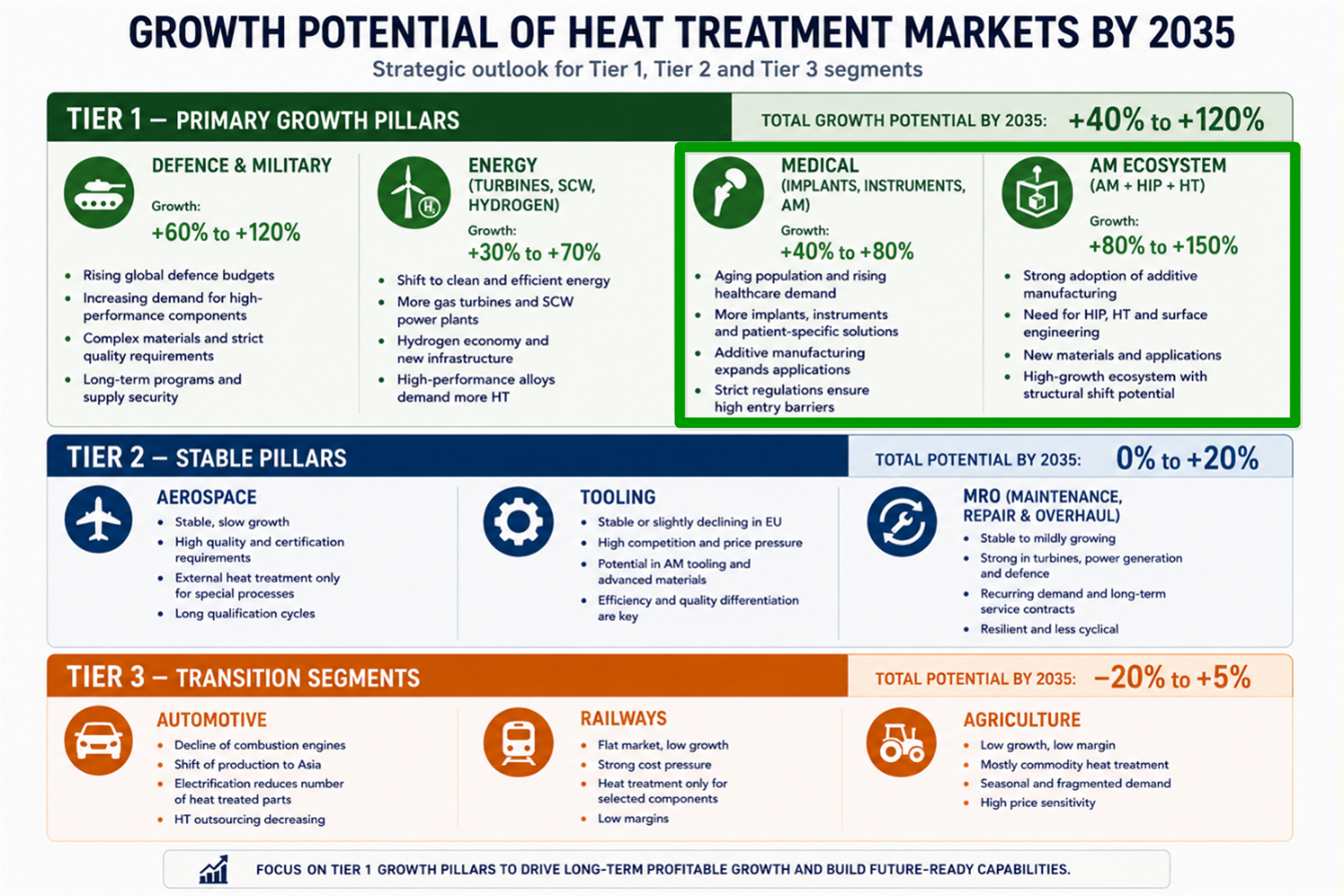
The purpose of the commercial heat treatment plant must therefore change. From a role of “provider of heat treatment operations” to a role of “provider of complete material & manufacturing solutions”.
What do I think will be the biggest change by 2035? Historically, heat treatment was sold as:
“We have a furnace. Bring the parts.” The future will be: “We have complete materials engineering for critical components.”
The greatest value will not be created by the furnaces themselves, but by the knowledge:
- process simulation,
- digital twins,
- property prediction,
- product property management
- AM + HIP + TZ as one integrated chain,
- certification for aerospace, defense and medical
The AM Ecosystem, like the previous segments, must be subject to very strict certification requirements.
Level 1
- ISO 9001, Basic QMS – Necessary, but not enough on its own.
- ISO 13485 (1) (Medical), Mandatory for implants, medical instruments, AM Ti6Al4V for medicine.
- AS9100D (2) (Aerospace), Manadatory for aerospace AM, HIP, HT, NDT.
- AQAP 2110 / 2310 (3,4) (Defence), Mandatory for NATO defence suppliers
Level 2
Additive Manufacturing (AM)
- AMS 7003 – Laser Powder Bed Fusion Process
- AMS 7007 – Electron Beam Powder Bed Fusion Process
- AMS 7031 – Batch Processing Requirements for the Reuse of Used Powder in Additive Manufacturing of Aerospace Parts
- AMS 7032 – Machine Qualification for Fusion-Based Metal Additive Manufacturing
- ASTM 52900 – Standard Terminology for Additive Manufacturing
- ASTM 52920 – AM Quality Requirements, New global standard – will be mandatory for both aerospace and medical.
- ASTM 52901 – AM — General principles — Requirements for purchased AM parts
- ASTM 52904 – Process characteristics and performance — Metal powder bed fusion process to meet critical applications (Ti64, IN718, maraging)
- ASTM 52920 – AM Quality Requirements
- ASTM 52941 – Additive manufacturing – System performance and reliability — Acceptance tests for laser metal powder-bed fusion machines for metallic materials for aerospace applications
- ASTM 52942 – Additive manufacturing – Qualification principles – Qualifying machine operators of laser metal powder bed fusion machines and equipment used in aerospace applications
- ASTM 52926-1 – Additive manufacturing of metals — Qualification principles, Part 1: General qualification of operators
- ASTM 52926-2 – Additive manufacturing of metals — Qualification principles, Part 2: Qualification of operators for PBF-LB
- ASTM 52926-3 – Additive manufacturing of metals — Qualification principles, Part 3: Qualification of operators for PBF-EB
- NADCAP AM (Additive Manufacturing), The highest level – created with the support of Airbus, Boeing, Lockheed Martin, Raytheon, Rolls-Royce, GE Aviation, Pratt & Whitney, Honeywell Aerospace, Collins Aerospace, Parker Hannifin, Textron, NASA a Liebherr Aerospace
- AC7131/1: The current governing audit criteria for Laser and Electron Beam Metallic Powder Bed processes.
- AC7131/2: Criteria for Directed Energy Deposition (DED) processes, including laser wire, electron beam wire, and plasma wire.
- AC7131/3: Emerging criteria for Laser Powder Bed Fusion of non-metallic materials (such as Selective Laser Sintering)
HIP
- AS7102/6 – NADCAP HIP, HIP audit criteria, Mandatory for aerospace a defence AM parts
- ASTM A1058 (5), Specifications for HIP processes.
Heat Treatment
- AS7102 – NADCAP Heat Treating, Heat treatment audit criteria, Mandatory for aerospace.
- AMS 2750 – Pyrometry
- AMS 2759/3 – Heat Treatment, Precip-Hardening Corrosion-Resist. and Maraging Steel Parts
- AMS 2774, Heat Treatment, Nickel Alloy and Cobalt Alloy Parts
- AMS 2801 – Heat Treatment of Titanium Alloy Parts
- NADCA-207 – Die Casting Die Specification
NDT
- AS7114 – NADCAP NDT, metody PT, MT, RT, UT – NDT audit criteria, mandatory for aerospace.
- ISO 9712 (6)/ EN 4179 (7), Personals qualification
Level 3 – PRODUCT LAYER – CERTIFICATION FOR SPECIFIC SECTORS
Aerospace
- AS9100D
- NADCAP (AM, HIP, HT, NDT)
- OEM kvalifikace (Airbus, Boeing, Safran, Rolls‑Royce)
- Each OEM has its own audit system.
Defence
- ISO 9001 – Basic QMS
- AS9100 – Basic for Defence-Aerospace
- AQAP 2110 / 2310
- ISO 27001 (cybersecurity – mandatory for defence)
- NATO NCAGE registration
- MPO license for military manufacturing and services
- OEM qualification (Raytheon, Lockheed, CSG, Rheinmetall)
Medical
- ISO 13485 (8)
- FDA 21 CFR 820 (USA) (9)
- MDR (EU Medical Device Regulation)
- ISO 10993-1 (biocompatibility) (10)
- ASTM F2924(11) / F3001(12) / F3302 (13) (AM Ti64, CoCr, Ni)
I think we will still call it the golden days when we carburized and hardened tractor parts.
Abbreviations used
(1) EN ISO 13485 – Medical devices – Quality management systems – Requirements for regulatory purposes
(2) AS9100 – Quality system Aerospace
(3) AQAP 2110 – Allied Quality Assurance Publication
(4) AQAP 2310 – Nato Quality Assurance Requirements For Aviation, Space and Defence Suppliers
(5) ASTM A1080 – Standard Practice for Hot Isostatic Pressing of Steel, Stainless Steel, and Related Alloy Castings
(6) ISO 9712 – Non-destructive testing — Qualification and certification of NDT personnel
(7) EN 4179 – Qualification and approval of personnel for nondestructive testing
(8) ISO 13485 – Medical devices — Quality management systems — Requirements for regulatory purposes
(9) FDA 21 CFR 820 (USA) – Regulation outlining the current Good Manufacturing Practice (CGMP) requirements for the Quality Management Systems (QMS) of medical device manufacturers
(10) ISO 10993-1 – Biological evaluation of medical devices
(11) ASTM F2924 – Standard Specification for Additive Manufacturing Titanium-6 Aluminum-4 Vanadium with Powder Bed Fusion
(12) ASTM F3001 – Standard Specification for Additive Manufacturing Titanium-6 Aluminum-4 Vanadium ELI (Extra Low Interstitial) with Powder Bed Fusion
(13) ASTM F3302 – Standard for Additive Manufacturing – Finished Part Properties – Standard Specification for Titanium Alloys via Powder Bed Fusion
=======================================================================================================
Are you solving a similar problem? I will help you with the analysis…
 40+ years of experience in the field
30+ years of experience… HT-PROGRES, Bodycote, Galvamet
cooperation… VŠB, Czechimplant, ECM Technologies, TAV Vacuum Furnaces, GHC Invest
12+ years of expert activity
Want to ask for a solution or want a non-binding consultation? Click on this link, I will usually respond within 24 hours. Contact email
========================================================================================================
Jiří Stanislav, Ing. CSc.
Consultant and forensic expert
========================================================================================================
29/6/2026