How to perform annealing for die casting dies
An integral part of die casting dies manufacturing process is annealing. Its purpose is to relax stresses, caused both by different types of machining and by the actual use of the tool. What does this mean for tool production?
Each insert of dies should go through the following processes:
Drafting drawing
Purchase of Material
- Input material testing (hardening in the oil)
Roughing machining, minimal radius R3 and more
- Stress relieving after machining (600-650 C)
Machining with allowances for hardening
- Hardening and 2 or 3 tempering cycles including material testing after quenching
Finishing machining, including EDM, white layer removing, polishing
- Stress relieving after EDM (500-550 C)
- Pre-heating for welding and stress relieving after welding (500-550 C)
- Post-oxidation of critical inserts before sampling
Die assembly and product sampling
Die disassembly after sampling
- Stress relieving after sampling (500-550 C) or
- If nitriding is prescribed, then this process (450-550 ° C)
Assembly of the die for the end user, including complete documentation
Stress relieving of stresses from thermal fatigue after 1000-2000 shots
- Stress relieving of stresses from thermal fatigue after 5000-10000 shots
- Stress relieving of stresses from thermal fatigue after 10000-20000 shots
It can be seen from the above list that annealing processes are of great importance in die making. Only up to step 8 is the tool manufacturer responsible for securing them. However, since the condition for the delivery of the tool according to Nadca 207 is the necessary traceability of all activities, the tool manufacturer must provide all the required documentation for these operations.
Steps 9 to 11 are then up to the user of the tool. However, if during the life of the die it is necessary to perform any additional machining on already hardened parts, e.g. due to shape repair, it is necessary to add even more annealing processes. After milling, EDM, welding, polishing, etc.
Stress relieving processes reducing thermal fatigue stress are shown in Fig. No. 1 at bottom, including their recommended periodicity. This periodicity is approximately consistent with the repeated nitriding processes as recommended by Nitrex for extrusion tools. In both cases, there is a common interest in limiting tensile stresses in the surface layer, promoting crack formation and propagation.
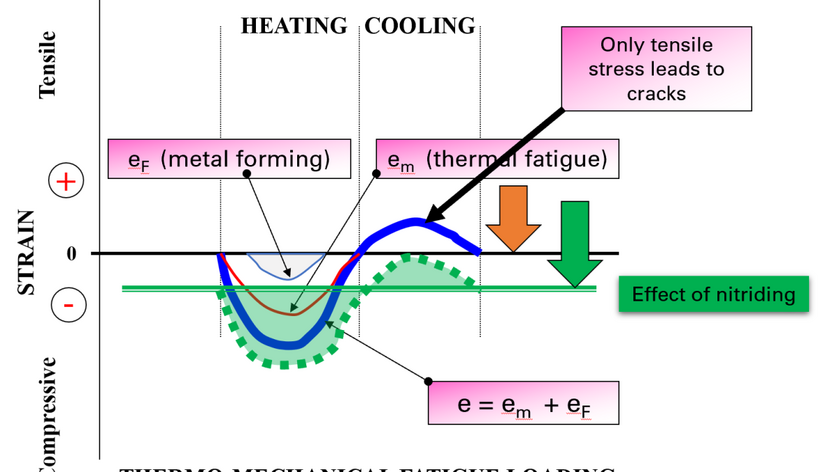
If we talk about thermal fatigue, cracks from thermal fatigue are caused by tensile stresses gradually induced in the steel surface from cyclic loading of the die, and one way to delay this process is to either release previously induced tensile stresses from the extrusion or die casting process, or try to convert the tensile stress into a compressive one. This can be done, for example, by applying shot-peening technologies or, and this is a more common variant, by nitriding.
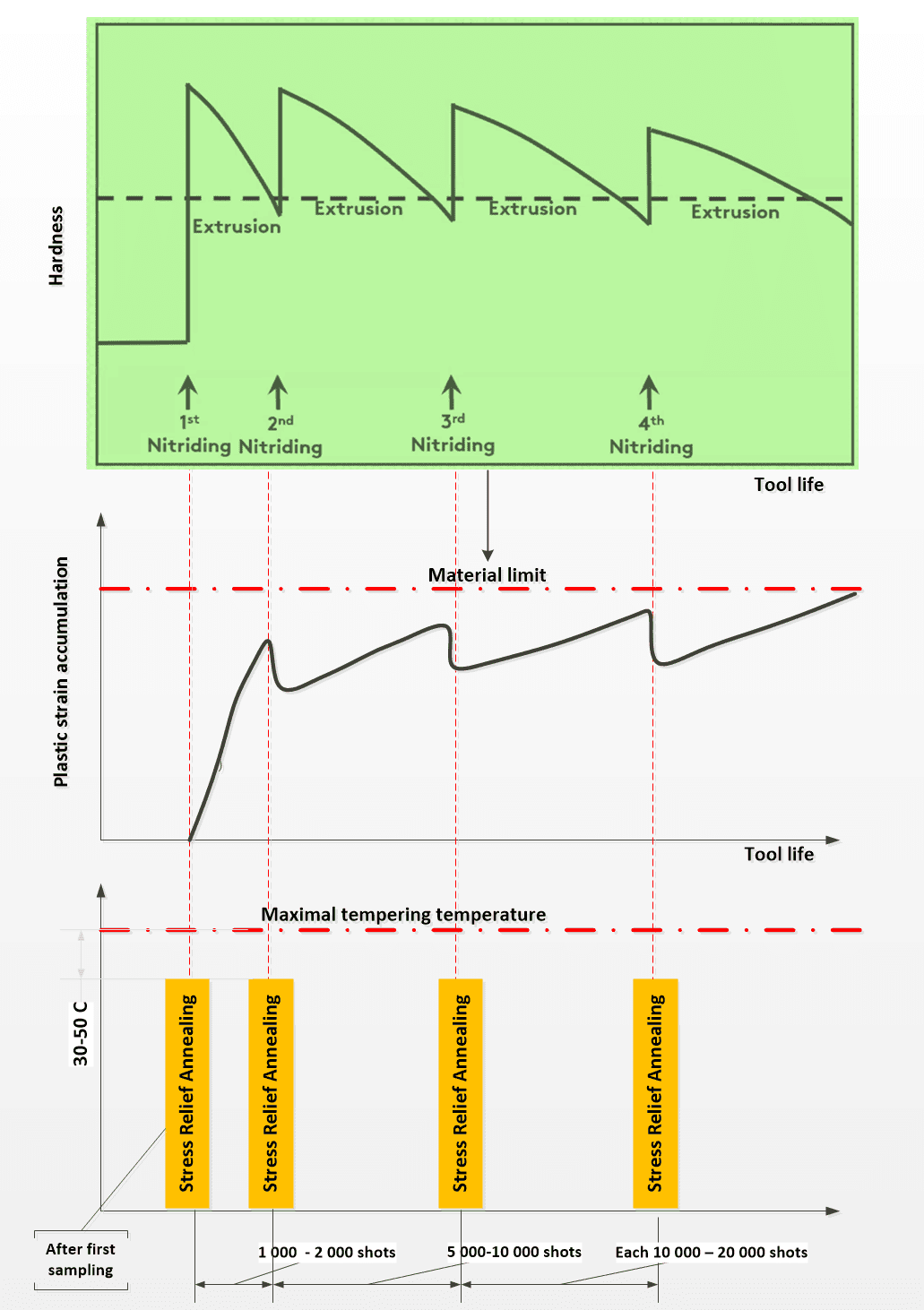
Fig. 1 – Scheduling of nitriding cycles or stress annealing cycles aimed at increasing the tool life for extrusion or die casting dies
Nitriding is a process in which nitrogen is added to a material by a diffusion process, usually to the interstitial positions of the lattice. As the amount of nitrogen increases, the hardness of the steel increases, as does the compressive stress. However, the maximum nitrogen concentration must be limited so that we do not have unwanted and brittle nitride phases of iron, from ϒ´-Fe4N to ε-Fe(2-3)N, and so that the layer is sufficiently tough.
However, if there is zero or tensile stress in the steel surface before nitriding, by means of nitriding this stress is transformed into compressive (Fig. 2), or at least the portion of tensile stress is reduced.
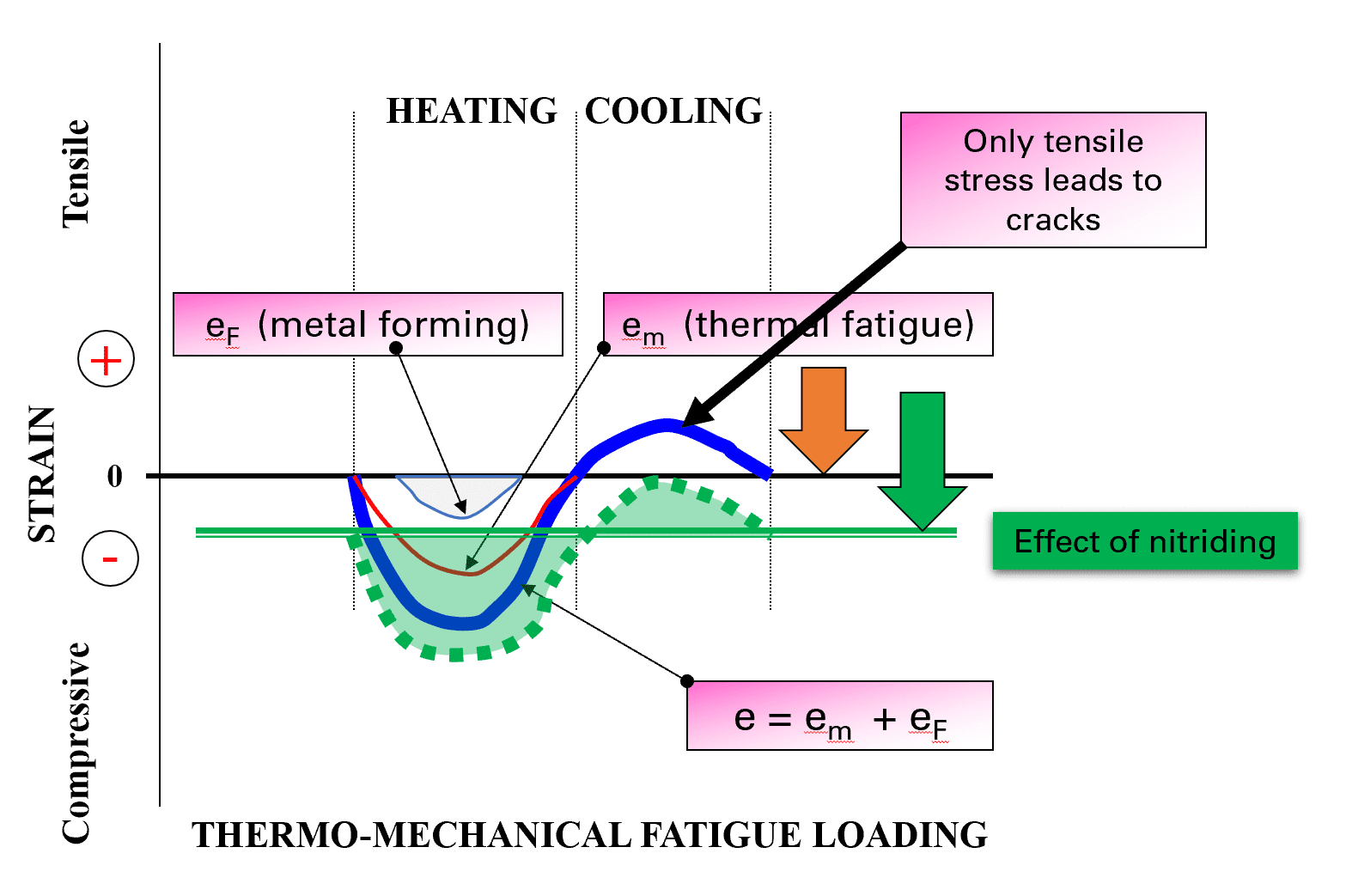
Fig. 2 – The stress development in the surface during die casting and the effect of nitriding
The initial stress relieving reducing thermal fatigue stress must be performed after the first sampling. If we have a prescribed nitriding, then its processing is usually also after sampling or testing of the tool. The reason is that in case of necessary shape correction the nitriding layer can be completely removed by grinding or polishing, or vice versa, if it is necessary to add material e.g. by welding, the presence of nitrogen in the material can cause problems with N2 bubbles in the weld.
In the further course of the die life, repeated stress annealing or nitriding processes follow, depending on the number of pieces produced or kg.
In the case of inserts without nitriding, the processes of relaxation annealing have an irreplaceable role in reducing the accumulated tensile stress from thermal fatigue in the surface.
In the case of nitrided inserts, the reason for re-nitriding is that after a certain number of cycles it is necessary to clean the tool from melt residues, polish, remove the surface layer with cracks, or repair its dimensions so that it is restored. At the same time, however, it is necessary to repair it in terms of structure, i.e. to restore the nitriding layer. This can be significantly disturbed by repairing the tool or by using the tool, where due to high operating temperatures, approximately corresponding to the nitriding temperature, the nitriding layer continuously reduces the hardness as nitrogen diffuses into the matrix, and this reduction in hardness also reduces abrasion resistance.
Because both extrusion and die casting tools are made from conventional hot working steels such as H11, H13, 1.2367, QRO90, etc., nitriding or re-nitriding processes will be compatible with each other.
However, in die casting dies, the re-nitriding process will have another, secondary impact. This is because repeated nitriding will not only fulfill the role of restoring the hardness on the surface, but will also play an equally important role in releasing stress from thermal fatigue in the tool. It is therefore a process that not only restores the hardness on the surface, but also has a positive effect on extending the life of the tool.
If we project these activities into a real heat treatment flow, we get to the following Table 1.
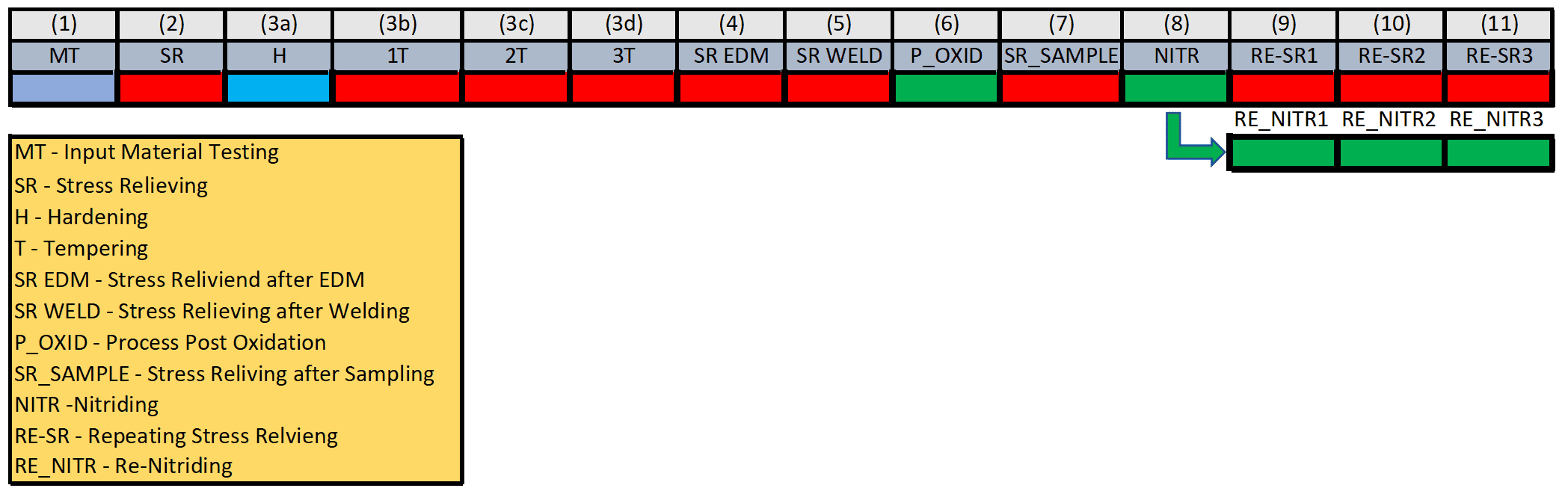
Tab. 1 – List of all heat treatment processes on die casting tools
The tool material for die casting dies should undergo a heat treatment process 11 times during its lifetime. Of these, only steps (1) and (3a) require high-temperature hardening furnace, in case od (1) with oil hardening, in case of (3a) with gas flow hardening. In other cases, these are low-temperature annealing or tempering processes up to 700 °C, or nitriding with temperatures from 450 to 550 °C. If we convert this into numbers, in the case of parts without nitriding 71% of thermal operations are performed in an annealing or tempering furnace, either vacuum or with a protective atmosphere. In the case of nitrided parts, this is only 59%, but the reduction is at the expense of nitriding, the share of which increases to 24% of the processing time.
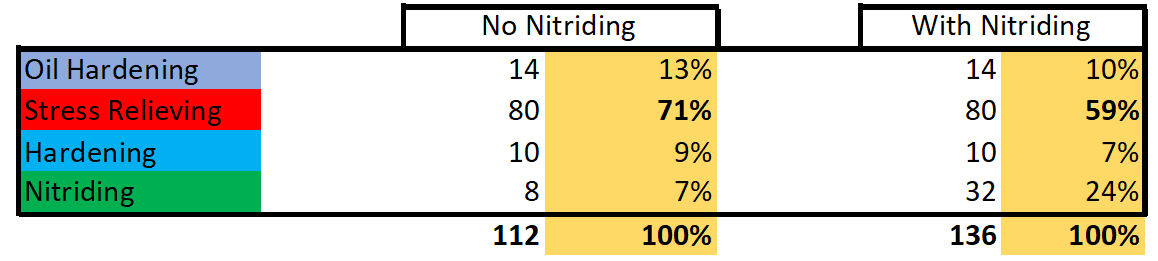
Tab. 2 – Time share of individual thermal processes in tool production
Therefore, in order for a heat treatment plant to be well-suited for the production of die-casting tools, it must above all have sufficient capacity for tempering and various annealing operations, either in a vacuum or under a protective atmosphere. The use of air annealing equipment, if I can recommend it, must be completely ruled out. All processes of both annealing and tempering take place at such high temperatures that the diffusion of oxygen from the air must be taken as a negative factor, deteriorating the mechanical properties of the material. If in some cases we need surface oxidation to improve the mold run-in, then it is necessary to use controlled oxidation, which affects the diffusion of oxygen only in the part of the surface that is needed for the function of the tool.
In today’s energy crisis, tool life will have to play a decisive role, and therefore these operations, which will ensure this life, will continue to grow. This needs to be taken into account when considering further investments. Experience has taught me that a good heat treatment plant is recognizable at first glance by the number and type of tempering furnaces, not by the number of hardening furnaces. Just open the door and go inside….
[1]: User´s guide for Relieving stresses in Die Casting Dies, Jerald V. Skoff, Badger Metal Tech, Inc. & William A. Butler, Bloomington, Indiana, April 2007 and
[2] Nitrex webinar -The Impact of Nitriding on Die Life, Performance and Cost Control, Jack Kalucki, 2020
29th of October, 2021
Jirka Stanislav