Aerospace

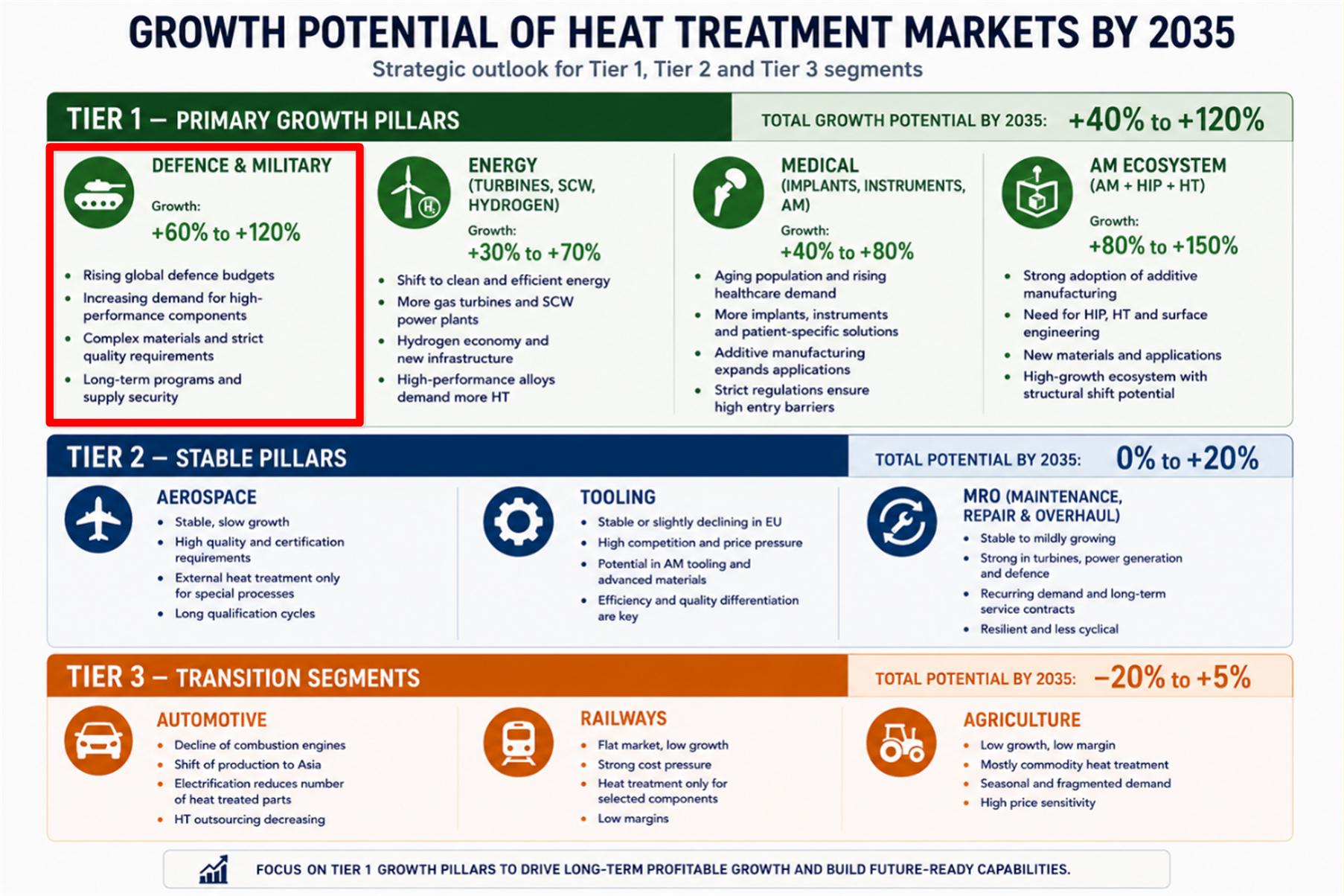
Fig. 1 –Pillars of strategic development for custom hardening plants
At the second level, rated as a stable pillar of heat treatment, is aerospace. This is a special segment. Everything critical is usually in-house. Most manufacturers of critical parts for the aerospace industry prefer to keep key special processes in-house whenever it is economically and strategically justified. External suppliers are used where skilled capacity or specialized technologies are required.
MTU, Pratt & Whitney, Rolls-Royce, GE Aerospace, Safran, Honeywell Aerospace — all:
- have their own vacuum furnaces
- have their own brazing
- have their own surface treatments
- have their own NDT
- have their own qualifications
It makes sense: critical parts = critical responsibility = in-house.
External services are used only in emergencies
- HIP – they usually do not have
- oversized
- exotic processes (plasma spray, EB welding, diffusion aluminizing)
- capacity peaks
- equipment breakdown
- new programs in the ramp-up phase
Unfortunately, CZ is not an aerospace manufacturing hub. It is more of an MRO + machining + sub-tier. So if we are to have any chance at all, then perhaps in AM and HIP, but it means having a relationship with some sub-tier. However, since a classic commercial heat treatment shop has neither 3D printers nor HIP, despite the great growth potential in aerospace, this segment, despite its great future potential, will not play a significant role in CZ and SK. There are no OEM manufacturers. Growth opportunities for commercial heat treatment subcontractors remain limited.
Classic commercial heat treatment for OEMs in aerospace will be used quite exceptionally. Within MRO, however, there is an opportunity in the production of spare parts, e.g. engine blades, manufactured by the investment casting method. Their manufacturers, casting foundries, are currently using the services of ITS Bilbao or Bodycote Sint-Niklaas for HIP, and only after HIP will mandatory heat processes be applied. These are mainly materials INC 713, INC 718, INC 738, INC 792, GTD 111, MAR-M247, 17-4PH, 15-5PH, Ti6Al4V.
There is of course also the segment of small aircraft or the production of L-410 in Aircraft Industries. Catalyst or GE H80 / H85 engines, formerly Walter M601, are still in the game, but their current manufacturer GE Aviation is self-sufficient. The remaining segments are then covered by Jihostroj Velešín, Jihlavan, Charvát AXL or CZ-AUTO SYSTEMS a.s., partly again with their own capacities.
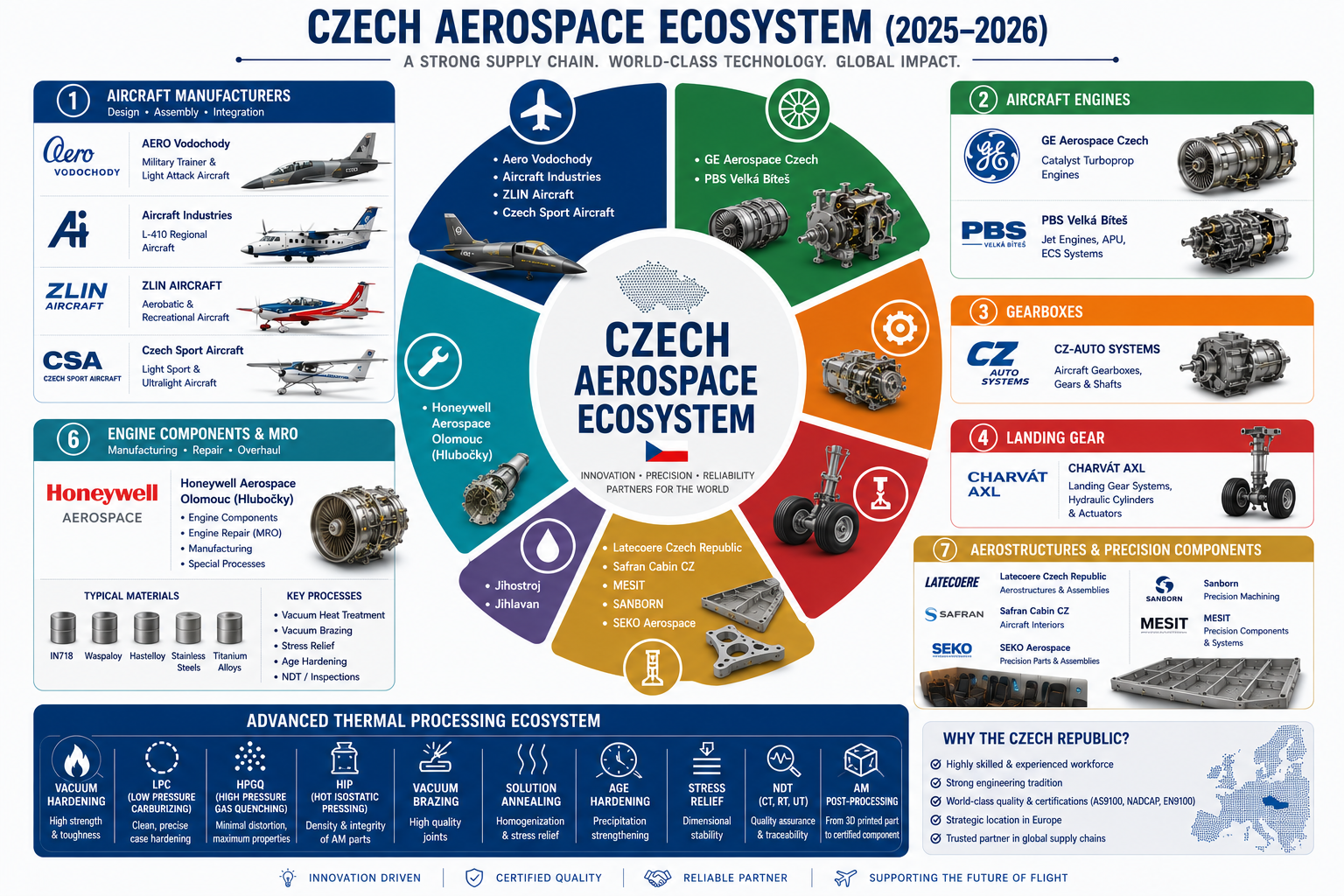
Fig. 2 – Aerospace ecosystem in CZ
However, if you are going to successfully enter this type of production, the following certification requirements are necessary:
- Company: AS9100, AQAP 2110 / 2310 (Defence)
- Process: NADCAP (AM, HIP, HT, NDT), AMS 2769(1)
- Materials: dle AMS (pro Ti6Al4V, 17-4PH, Inconel 718)
- OEM Approval: Airbus, Safran, MTU, GE Aerospace, Rolls-Royce, Honeywell Aerospace
- Cybersecurity: ISO 27001(2), NIST 800-171(3), CMMC(4), ITAR(5), EAR(6), NIS2(7).
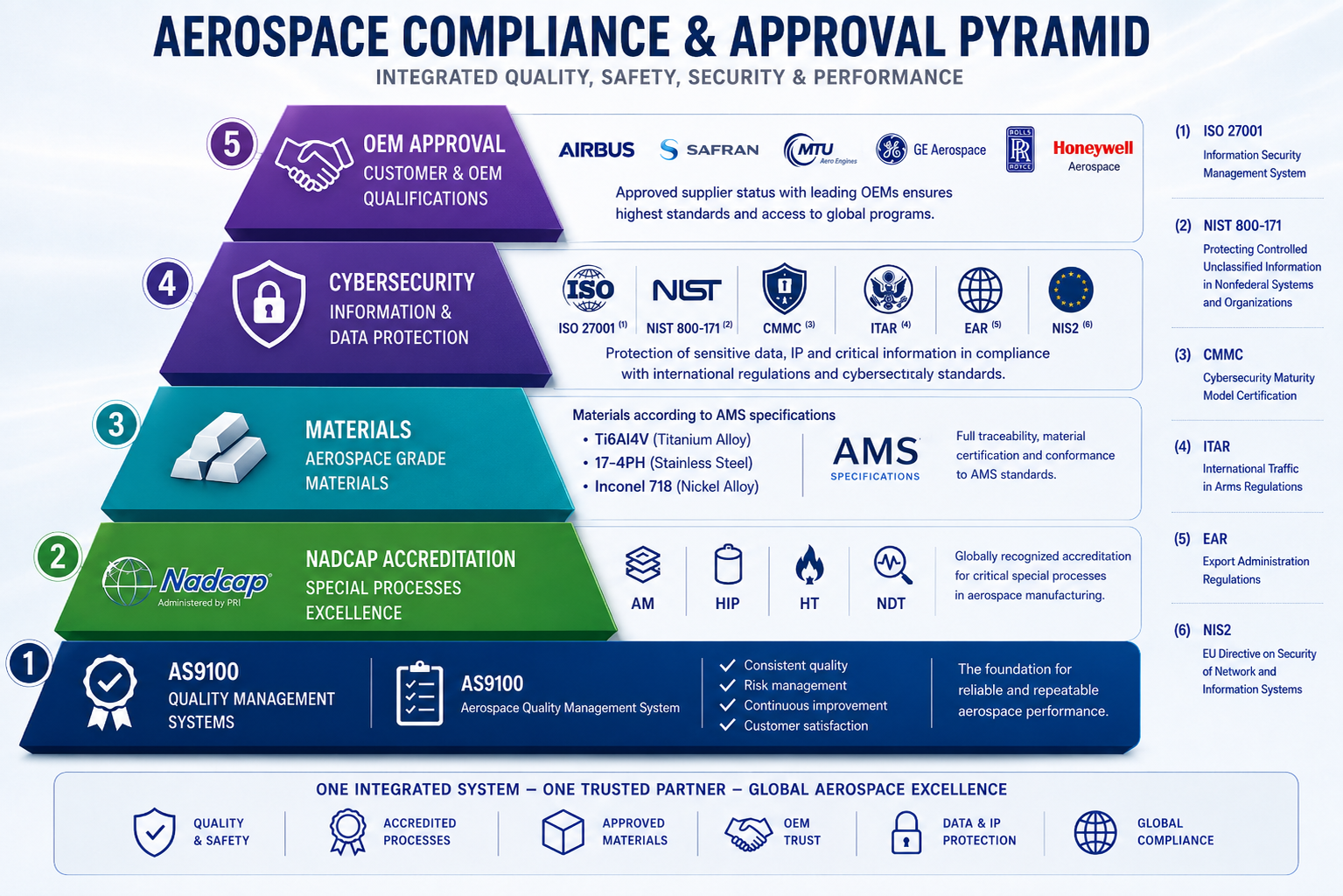
Fig. 3 – Qualification pyramid for heat treatment operations in aerospace
Nadcap HT in the Czech Republic has only 4 entities:
- Aero Vodochody
- Galvamet
- Honeywell Aerospace
- Alucast – for aluminum
In Slovakia, Kinex Bearings, Bytča.
In the heat treatment plant of the future, having furnaces will not be enough, but without data protection, the OEM may not trust you with a digital model of the part, even if you have the best LPC, HIP and vacuum furnaces in the world. For critical programs such as the F-35, hypersonic systems, rocket engines, some nuclear programs, you will need to know the answers to the following questions:
- Who made the control system?
- Who has remote access?
- Where is the data stored?
For many aerospace applications, the digital infrastructure surrounding the furnace, such as the furnace SCADA (8) system, can be as important as the furnace itself.
Previously, we focused on collecting data on time, pyrometry, vacuum, procedures/recipes. Today, it’s about
- audit trail,
- electronic records,
- user rights,
- cybersecurity.
From an audit trail perspective, it must be traceable:
- who changed the recipe,
- when they changed it,
- why they changed it.
From the perspective of electronic records, where are the
- original data,
- data changes,
- approvals.
Access Control must be managed for the roles:
- operator
- technologist
- quality
- maintenance
- administrator
and these roles must be strictly separated.
Automatic backups, password management, network access, remote service must be ensured. The furnace supplier can no longer automatically access the system remotely, VPN access must be strictly recorded and controlled.
Data Ownership will also be a problem. Will the data be stored locally, in the heat treatment plant, in an external Cloud or even in a Chinese cloud. Some defense programs are starting to have a requirement: no Chinese hardware, no Chinese software. In AM, with military STL models, it will be even stricter. The auditor will ask: Where is the SCADA? Where is the MES(9) ? Where is the database? Who has access?
The current AMS 2750 standard is intended to give confidence in temperature, the future AMS 2750 will also be about temperature, but auditable digital data will give confidence in the process. In ten years, it will not be enough to prove that the furnace was ±3 °C. It will also be necessary to prove that no one could change the recipe, manipulate the data, or remotely intervene in the process without a record.
And in this world, SCADA systems will be evaluated almost as strictly as pyrometry is today. I think that is the direction that aerospace, defense, nuclear and critical applications will take.
And what will be the future direction of this industry?
As it has been, the aerospace industry will be a leader and an example for all other industries. So if we can keep up with this industry, we can work for anyone else with critical parts. In the future, aerospace OEMs will not just buy heat treatment services. They will buy a complete and trustworthy digital record proving that each critical process was performed correctly, by qualified equipment, according to approved procedures, and with fully traceable and protected data.
Today’s auditor checks:
- SAT
- TUS
- AMS 2750
- calibration
- records
I think the auditor of 2035 will add questions:
- Where is the data physically stored?
- Who has administrative rights?
- How is it backed up?
- How is data integrity protected?
- How is remote access controlled?
- Can it be proven that the recipe has not been changed?
- Is the immutability of electronic records ensured?
- How is the authenticity of electronic signatures verified?
This is no longer just an audit of the thermal process, but an audit of the digital credibility of the process. And we must be prepared for this and we must adapt our investment policy to it. The opinion that a vacuum furnace can be maintained indefinitely is still valid. Physically yes, morally no. It is already clear today that the old furnace will not adapt to this digital trend. And above this furnace there must be an equally high-quality digital superstructure in the form of an MES system, which will allow us to connect data from the furnace with the ERP and subsequently with the OEM customer. I was part of the Bodycote team for 5 years, which tried to create just this digital footprint. I subsequently tried something similar at Galvamet. And the result? Only partial. Such projects cannot be solved without 100% management support, and unfortunately, this continues from the initial enthusiasm phase to total burnout.
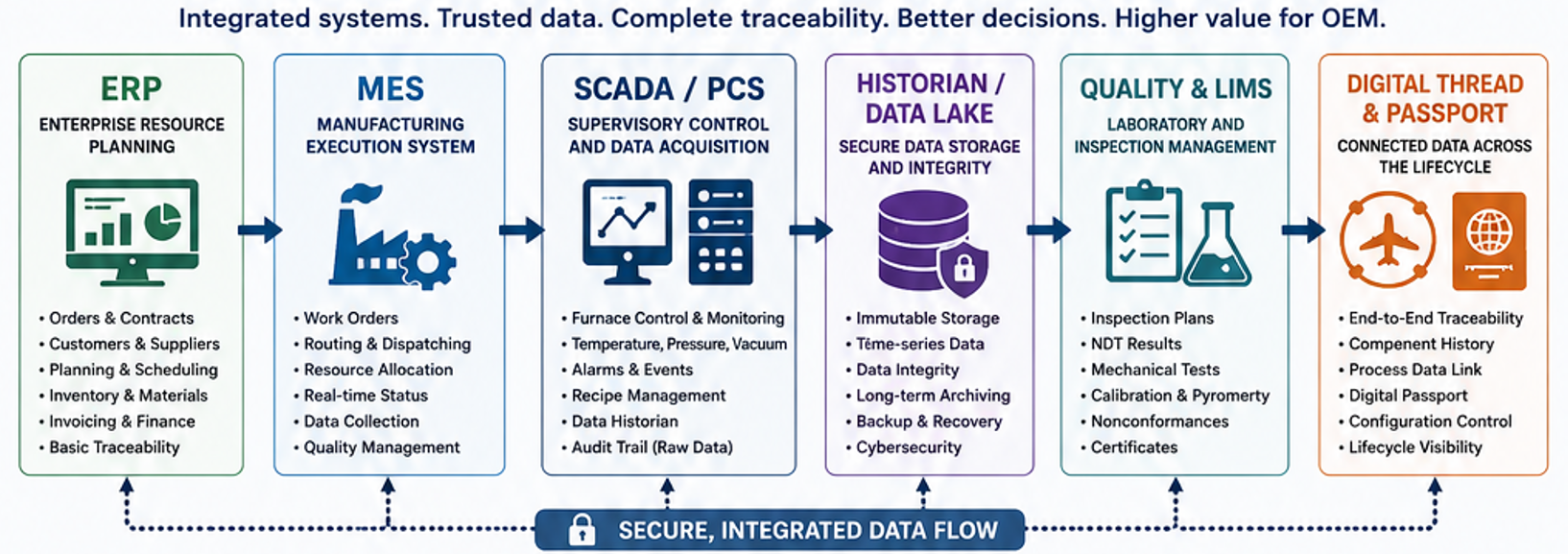
Fig. 4 – Individual segments of the digital passport
So if we want to enter this world, we have to realize that it will take not months, but years. And that we cannot solve everything at once. We need to divide the problem into sub-steps and gradually implement them, not in the initial enthusiasm of wanting everything at once.
Here I see a great benefit of using AI. It can significantly help us in evaluating data, but it will never be able to control the furnace. The role of AI will be
- AI as operator support
- AI as audit support
- AI as predictive maintenance support
- AI as technological decision support
But AI will never be allowed to change processes and recipes. But the trend will be to create digital twins:
- For the furnace
- For the batch
- For maintenance
- For energy consumption and carbon footprint
- For predictive quality
To conclude, perhaps just this infographic
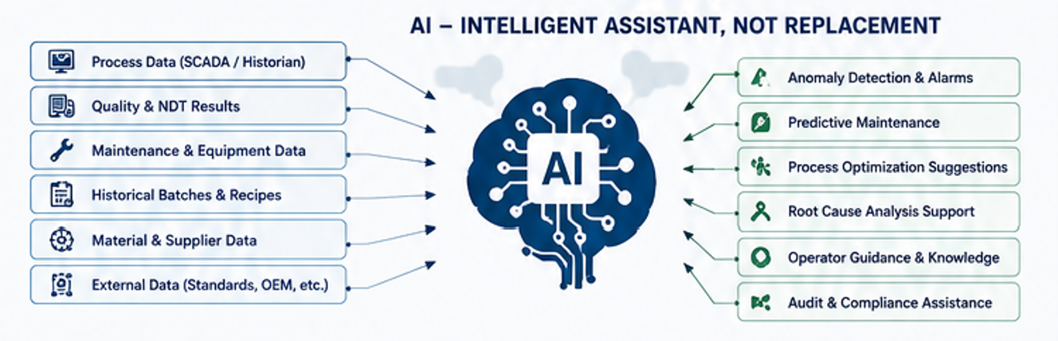
Fig. 5 – Necessary digital inputs and space for AI
The open question remains who will develop this for custom and in-house quenching plants. Heat treatment data cannot be isolated from the digital ecosystem, but will increasingly become part of the PLM (Product Lifecycle Management) environment of original equipment manufacturers (OEMs), where every step of production and inspection contributes to a continuous digital data flow covering the entire life cycle of the component.
Those who provide ERP systems are not very interested in this. After all, even SAP, Microsoft AX2012 or, in the Czech environment, QI do not have it, they cannot work with cycles. And those who supply furnaces? For them, it ends with connecting our SCADA to any external environment. They can do that. But they do not have any further continuation. So the connection of ERP – MES – SCADA will be critical. And this is where I see the greatest scope for developers. The heat treater can quench, furnace developers can do SCADA, ERP system developers can do billing, but so far I don’t see anyone seriously considering connecting these three different worlds.
Abbreviations used
(1) AMS 2769 – Heat Treatment of Parts in a Vacuum
(2) ISO 27001 – Information security, cybersecurity and privacy protection — Information security management systems — Requirements
(3) NIST 800-171 – Protecting Controlled Unclassified Information in Nonfederal Systems and Organizations
(4) CMMC – Cybersecurity Maturity Model Certification
(5) ITAR – International Traffic in Arms Regulations
(6) EAR – Export Administration Regulations
(7) NIS2 – Directive: securing network and information systems
(8) SCADA – Supervisory Control and Data Acquisition
(9) MES – Manufacturing Execution System
=======================================================================================================
Are you solving a similar problem? I will help you with the analysis…
 40+ years of experience in the field
30+ years of experience… HT-PROGRES, Bodycote, Galvamet
cooperation… VŠB, Czechimplant, ECM Technologies, TAV Vacuum Furnaces, GHC Invest
12+ years of expert activity
Want to ask for a solution or want a non-binding consultation? Click on this link, I will usually respond within 24 hours. Contact email
========================================================================================================
Jiří Stanislav, Ing. CSc.
Consultant and forensic expert
========================================================================================================
1/7/2026